 It takes insight, knowledge and innovative flair to direct an Agatha Christie classic that has been variously staged for a century, such as The Murder of Roger Ackroyd, and veteran Alan Swerdlow (pictured left) has what it takes to bring this hoary whodunnit to life, says BEVERLEY BROMMERT:
After years of misguided relegation to the realm of amateur as opposed to professional productions, the Christie repertoire is currently undergoing a renaissance, in the light of which Swerdlow firmly believes that a fresh approach is justified.
“The main challenge is to strike the right balance between entertaining and mentally stimulating an audience,” observes Alan Swerdlow. In other words, use comedy and thrills to counter each other. “In 2026, the time has come for stripping away all the accrued grime from a hundred years of staging to treat the script as new, and take it seriously.”
He considers that successful seduction of an audience is achieved by allowing its members to choose their level of involvement with the plot: some merely want to sit back and relish a good narrative, while others would rather savour the challenge of solving a crime as they focus on every detail to build a timeline of events.

Meticulous attention to detail
“This means meticulous attention to detail and sustained plausibility, particularly the latter. Each character needs to be fleshed out to become credible, and for this I invited suggestions from the cast, which the actors appreciated. A good actor will always be willing to accept guidance from a director, so my approach is to set boundaries, advise, and if necessary nudge the performer gently into the area where he or she has to be.”
For Swerdlow, it’s a matter of collaborating to achieve the desired result: as he puts it, “elaborate the character, and the rest follows naturally.”
Apart from characters, the context also has to be plausible, and this version of The Murder of Roger Ackroyd is set in the 1950s instead of the original (1920s). Thus we do not have a period piece as such, which would be exorbitantly expensive with bespoke costumes and props, but a later age which has much in common with Christie’s mind-set.
Swerdlow explains:”Like the ‘roaring twenties’, the ’50s were an optimistic post-war age newly emerged from gloom; this was the dawn of another Elizabethan era, ripe with opportunities and one wherein things previously thought to be indiscreet or inappropriate became acceptable. Attitudes evolve over two generations, hence the later period is closer in spirit to our own, making it a valid choice.”
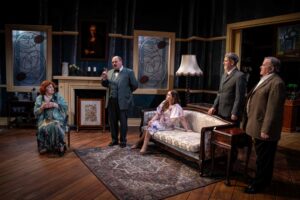
Captivating masterpiece
There are 12 personae in this work, of whom two are leads (entrusted to accomplished actors Alan Committie and Graham Hopkins). The rest require impeccable ensemble.
Naturally Detective Poirot takes centre stage, and Swerdlow mentions the interesting fact that the very first play which Alan Committie (Poirot) saw as a 10-year old lad happened to be a Christie thriller at the Baxter Theatre…
Swerdlow is warm in his praise of Committie: “Alan is such a gifted actor, equipped with a tool essential to make Poirot believable – namely endless curiosity about everything. Like Poirot, he will always ask, ‘Why?…Why?…Why?’, then observe, question, and judge”.
Which is what alert members of the audience are implicitly invited to do as they witness the action of this captivating masterpiece.
Read Karen Rutter’s review of The Murder of Roger Ackroyd here.
What: The Murder of Roger Ackroyd
Where and when: Theatre on the Bay from 16 July to 16 August 2026
Tickets: Webtickets
Where and when: Montecasino Theatre from 21 August to 27 September 2026
Tickets: Webtickets
WS