Sheila Chisholm
Messiah, George Frideric Handel’s superlative Easter oratorio, has its origins in England during the mid-1730’s. That’s the period when Charles Jennens (1700-1773) authored Messiah’s libretto for Handel who, in time, set it in music. However, the Messiah’s story runs deeper than those superficial sentences.
Jennens, as a wealthy English landowner, music patron and patron of the arts, garnered in his knowledge as a devout Christian, Bible and literary scholar to write various libretti for Handel’s oratorios. These included Saul (1735-39), Belshazzar (1744-1745), (possibly) Israel of Egypt (1738-39) and Messiah (1741-1742).
Although Messiah was Handel’s sixth work in this genre, he didn’t immediately start using Jennens’ libretto. He “picked it up” at a time English musical tastes were changing from his Italian-styled opera compositions, and he simultaneously received an invitation from the Lord Lieutenant of Dublin to compose a new work. Composed in just 24 days, that invitation is why Messiah premiered in Dublin on 13 April, 1742, and not London. The London premier took place, in the presence of King George 11, on March 23 in 1743 at the Royal Opera House, Covent Garden.
Set in three parts with four solo voices
According to legend, the king, overwhelmed by the magnificence of the Hallelujah chorus rose to his feet. Court etiquette demanded the audience should also rise. That one kingly move set a centuries old tradition for audiences to stand whenever the Hallelujah chorus is sung.
For Messiah’s text, Jennens drew upon the King James Bible and from the version of the Psalms included with the Book of Common Prayer. Some authorities attribute “Messiah’s emphasis on the Old Testament, and the choice of the Old Testament title Messiah to Jennens’ theological beliefs.” Jennens’ text is an extended reflection on Jesus as the Messiah called Christ”.
Set in three parts with four solo voices, Messiah’s structure may resemble that of opera. However, it is not in dramatic form. Neither are there character impersonations or speech. Part 1 begins with Isaiah (and others) prophesying the birth of Jesus, before moving on to the only “scene” taken from the Gospels – the annunciation to the shepherds. Part 11, centres on the Passion, ends with the Hallelujah chorus. Part 111 focuses on the resurrection of the dead and Christ’s glorification in heaven…. “Blessing and Honour, Glory and Power be Unto Him that Sitteth Upon the Throne and Unto the Lamb for Ever and Ever Amen…”
Over the centuries, many composers (Mozart among them) have tried their hand at revising and enlarging the choir and orchestration beyond Handel’s original “modest vocal and instrumental forces.”However, in recent years, presentations have leaned more towards Handel’s original simpler intentions.

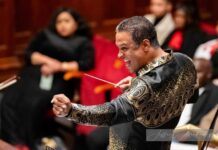
Guest conductor Maestro Raymond Hughes
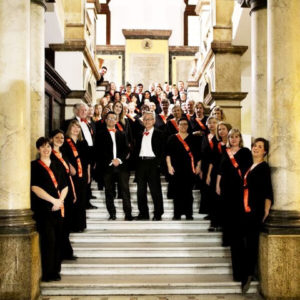
To celebrate the Philharmonia Choir’s 50th anniversary, their Messiah presentation on Good Friday, April 14, and Easter Sunday, April 16 at 7.30pm in the Cape Town City Hall, fuses the “modest with the more amplified.”
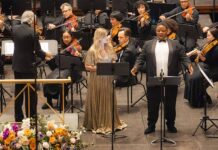
Under guest conductor Maestro Raymond Hughes, soloists Louise Howlett (soprano), Monika Voysey (alto), Given Nkosi (tenor), Barend van der Westhuizen (bass) and supported by the Cape Town Philharmonic Orchestra, approximately 120 Philharmonia Choir voices will, once again, ring Handel’s Messiah through Cape Town’s City Hall.
Drawing upon a nucleus of singers from the former Melodic Choir, John Badminton founded the Philharmonia Choir in 1967. From that relatively small beginning, the choir has grown strong enough to have travelled internationally. In 1998, at daybreak, on the beach at Cape Point they, in a satellite-linked simultaneous broadcast of five choirs from around the world, sang the chorus from Beethoven’s Ninth Symphony for the Winter Olympic Games in Japan.
On one of their more adventurous ventures, in 2001, the choir travelled to England to sing in several famous churches and cathedrals. On June 2 they joined forces with the Elgar Chorale to sing, on Sir Edward’s birthday, Elgar’s Dream of Gerontius. This concert took place in Worcester Cathedral under Dr Donald Hunt. In 2014, in collaboration with Richard Cock and Johannesburg’s Symphony Choir, they repeated Elgar’s Dream of Gerontius. And, everyone, who heard these choirs stirring 2016 account of Karl Jenkins’ The Armed Man – A Mass for Peace – with Richard Cock conducting – will remember it for many years to come.
Over and above renowned local singers who’ve sung with the choir, so too have Luciano Pavarotti and Renee Fleming. Yehudi Menuhin, John Rutter, Nicholas Cleobury, Sarah Tenant-Flowers and Norwegian Kare Hanken are but five of the illustrious guest conductors.
Guided by Richard Haigh
During the choir’s 50 years of singing, Directors of Music whose passion and knowledge has lifted the choir to its present excellent standard include Christine Reynolds, Vetta Wise, Margaret Barlow, Antionette Blyth and Raymond Hughes. Guided by Richard Haigh, current Director of Music, the choir has significantly matured and developed during the past few years of his tenure.
Maestro Hughes, presently occupying the position as Chorus Master for the magnificent Deutsche Oper in Berlin, took over Cape Town’s Philharmonia Choir’s Music Directorship’s in April 1986. That was shortly after he started as Chorus Master/Conductor at Cape Town Opera.
Said Hughes “Professor Murray Dickie, then Cape Town Opera’s GM, lured me away from Staatsteater in Pretoria, where I had worked, since 1984 as Resident Associate Conductor. I stayed with the Philharmonia until 1991 during which time we performed a huge amount of repertoire in addition to the annual Messiah performances in The City Hall. Those works included The Creation, Elijah, Belshazzar’s Feast, Mozart’s Requiem, Salieri’s Hofkapellmeister Mass, and for my farewell concert on June 17, 1991 we performed Beethoven’s Mass in C.”
Hughes, grew up surrounded by music. “My mother played piano superbly, so (naturally) taught me my scales. My father, a great jazz clarinettist/saxophonist, played in his own band for 60 years! From 12 years of age I sang in church choirs as well as played organ. This background taught me to not only to love, but also respect, a broad musical spectrum.”
Hughes’s indefatigable energy has taken him to four continents as Chorus Master and Music Director for many of the world greatest choirs and opera companies. His conducting debut with Maurice Durufle’s Requiem took place at Carnegie Hall. Hughes has worked as Principal Guest Conductor of the Festival of the Agean on Syros; conducted Norwegian National Opera Oslo, and when his reputation as an expert in concert and opera repertoire, reached the great Met conductor James Levine, Levine invited him to become Chorus Master of the Metropolitan Opera in 1991. He remained with the Met for 17 years. Hughes considers the pinnacle of the Levine/Hughes association took place in 1996 in the Carnegie Hall with a performance of Berlioz’s Damnation of Faust.
For Hughes, Messiah is one of the greatest works ever written in any genre. “I have performed Messiah in many versions with many different sized choruses. It’s testimony to the work’s greatness – which epitomises Christ’s great gift to mankind – that it is infinitely adaptable, and I never fail to find more hidden riches with every reading. Sharing the 30th anniversary of my first Easter performance of Messiah with the Philharmonia Choir, and the Philharmonia Choir’s 50th anniversary, will make these performances historically relevant to us all.”
Who: The Philharmonia Choir under Maestro Raymond Hughes
What: Handel’s Messiah
When: Fri, 14 April and Sun, 16 April, 2017 at 7.30pm
Book: www.quicket.co.za
WS