CPO REVIEW: Cape Town Philharmonic Orchestra Concert: Into the Light. At Cape Town City Hall on 25 June 2026. Conductor: Bernhard Gueller. Soloist: Daniel Rowland (Violin). Ravel: Ma mère l’Oye, Vasks: Violin Concerto “Distant Light”, Schubert: Symphony No. 9 “The Great”. ALBERT COMBRINK reviews.
The CPO concluded its winter season with a superbly played, varied programme, displaying the enormous range of styles the orchestra takes on board. The adventurous programming bodes well for the future. The City Hall also reflected the optimism and sense of occasion one experiences at these events: minimal but highly effective lighting touches, small but highly decorative plants around the conductor’s podium, an elegant table and microphone next to the organ from where a bow-tied Rodney Trudgeon delivered the Fine Music Radio Live Broadcast, not to mention the classy, catchy new look of the printed programmes.
The concert opened with a little French Impressionist gem, Maurice Ravel’s ballet Ma mère l’Oye. Well, not so little, not so Impressionist and not an entire ballet. The five-movement suite taken from the full “Grandmother Goose” ballet is not as obviously popular or known as Bolero or the enormous Daphnis et Chloé played earlier this year, but it is well-loved and regarded as a masterpiece.
The work depicts five French children’s fables, but more importantly, it reflects the love and tenderness the composer felt for the two children for whom he originally wrote the work as a piano duet. That gentle affection is the key to any performance of this work: one can not shy away from its simple, direct emotions by focussing on the flashy, colouristic elements – a temptation in a work so brilliantly orchestrated, and played by an orchestra which would rise to the challenge. One also cannot shy away from that very simplicity.

Gueller kept these two elements in confident balance. Transparent textures were handled almost like chamber music, especially in the very opening Pavane de la Belle au bois dormant: (Sleeping Beauty’s Pavane). The strings created clouds of sounds on which we drifted into the work. In Petit Poucet, Tom Thumb’s lost wandering in the woods treated the changing beat quite naturally and avoided the meandering feeling which can easily happen in this piece, by shaping the entire movement in “colour phrases” rather than metric phrases.
In Laideronnette, impératrice des pagodes, the story of ‘an ugly girl and a pagoda empire’ underplayed the “Chinoiserie” and sidestepped the entire cultural appropriation argument with a light touch: the pentatonic scales and orientalist percussion were somehow swept into a very French aesthetic, reflecting what sounds and sights were encountered through the World Fairs of the late 1800s which brought artists and musicians from all over the world to Paris.
The transparency and delicacy in Les entretiens de la Belle et de la Bête told a beguiling story of Beauty and her Beast, again with woodwinds shining above a warm bed of strings. The contrabassoon was not played for humour, and the final duet where Belle and Beast sing their love-song together, will stay in the memory. The enchanting, shimmering fairy garden which ends the work, shows both Gueller’s restraint and Ravel’s theatrical genius. Le jardin féerique is the joyful, elated apotheosis of the work, but this is not the bacchanals of Rome or Lesbos: it simply is a mantra on love and tenderness in an imagined space of great peace and beauty, and balance was strictly controlled to let us hear those all-important harp- and celeste glissandos which could so easily have been obliterated.
Not just another violin concerto
The theme of universal love continued in a performance of “Distant Light”, the firstt violin concerto of Latvian composer Pēteris Vasks, who is celebrating his 80th birthday this year. Composed in 1997, the work has emerged as one of the most important violin concertos of the last three decades, with themes of love, the battle between good and evil (which Vasks explicitly characterises and calls “The Monster”) and expresses an attempt at achieving spiritual transcendence of some kind, while leaving the specifics of that transcendence for the observer to define for themselves. It is not written in the mould of the big romantic concertos and therefore has a very specific appeal. It is not just another violin concerto. It takes on the sense of an event, a ritual, if you will. This aspect makes a live performance of this work transcend anything a recording can give.
This was my second time hearing Daniel Rowland play this work: the first time was a decade ago at the Stellenbosch International Chamber Music Festival – where incidentally, Rowland will be on the faculty again next week. At the time, this work and that particular performance had a huge impact on me: the perfect acoustics of the Endler made me slightly apprehensive about what the experience would be like in the City Hall. I need not have worried. Rowland and Gueller both know the hall well, and adjusted for its eccentricities.
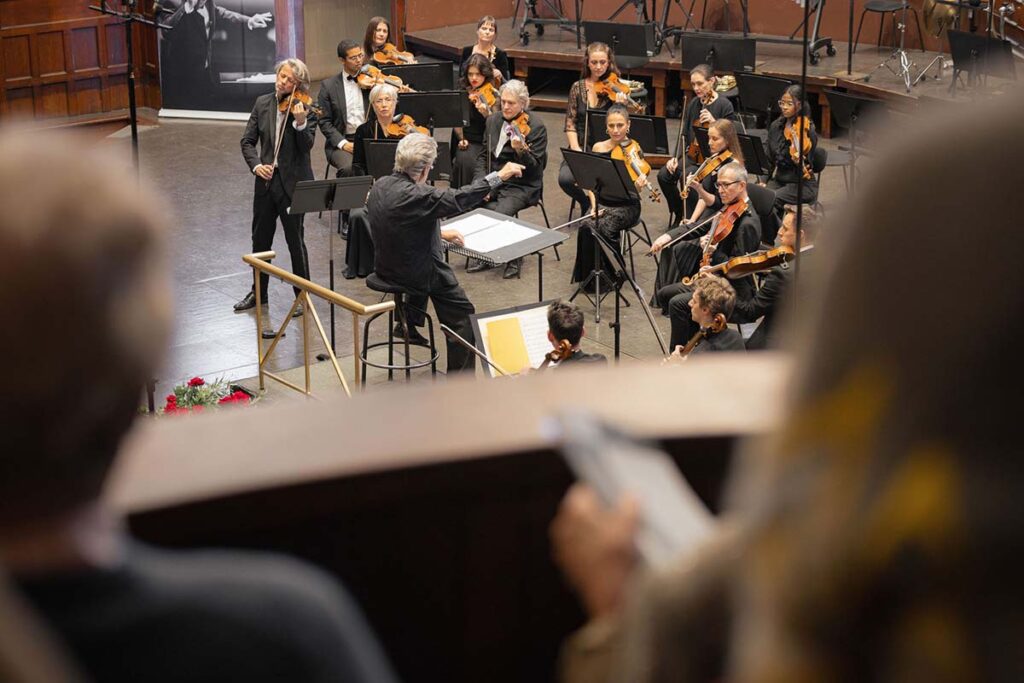
For a start, the string orchestra was moved from its usual position on stage – in a symmetrical fan in front of the conductor – to sitting much closer together, with conductor at the centre, and the cellos spiralling from the right, though a kind of C curve towards the left back corner of the stage, with Rowland at the bottom tip of the curve on the left – a kind of Fibonacci arc.
Rowland fully occupied his space, visually and aurally, and would occasionally move toward the conductor, or toward the concertmaster, opening and closing the shell-shape. When his material gelled with the string orchestra and his lines were subsumed into the larger texture, he would step right into the inner circle as far as the viola section just slightly off to the right of the conductor. These were not theatrics – but accepts that the performance is also a visual experience and that Rowland embodies every sound and emotion that he is conveying to the audience. This allowed for tremendous cohesion of the string sound, which seemed to materialise out of thin air into flavoured clouds of sound around which the solo violin could dance, weave and sing with complete freedom.
Rowland has a close relationship with Vasks, both personally and professionally: Vasks served as Composer-in-Residence at the Rowland-founded Stiftfestival in the Netherlands. And Rowland has recently recorded the work for Challenge Records – an album which has been roundly praised and is currently regarded as one of – if not the – benchmark recordings of this work.
Flying high notes suspended in mid-air
Rowland plays with a technical ease that is never flaunted. He is physically very expressive, and more so than many. But in the end, it is all about the sound. And the sound was exquisite, beguiling, seductive and even in the most aleatoric section and the hugely demanding three solo cadenzas, his sound never hardens. There is a sweetness to those floating, flying high notes that felt suspended in mid-air.
Gueller gave a masterclass of keeping the ship afloat with a firm hand on the rudder but loose enough to let it flow with the tide, to give the players absolute expressive capability. This is a very demanding work to perform, prepare and yes, even to listen to. And the performance exceeded all expectations, from soloist, conductor and orchestra. It absolutely should be experienced live. Audience members interested in this soundworld can also explore composers such as Arvo Pärt, Henryk Gorecki, Giya Kancheli and John Tavener.
We were then treated to an unprogrammed encore, with Gueller conducting the strings, of Melodie by Ukrainian composer Myroslav Skoryc (13 July 1938 – 1 June 2020). Skoryc’s personal life is filled with political strife and includes deportation to Siberia. He leaves a massive musical and cultural legacy, much of which is being explored currently. Melodie in A was originally written in 1982 for the Soviet-era war film Vysokyy Pereval (The High Pass), but has since transcended its cinematic origins to become one of Ukraine’s most beloved and frequently performed pieces of classical music. The performance was exquisite and moved me very deeply. Nothing more to say except “Thank You”.
I have often felt disappointed that great soloists are flown in and they play a concerto which is not excessive in length, and it seems a waste not to hear them play something more. On two occasions now, the orchestra has stepped in to offer accompaniment in an un-advertised encore of something new, fresh and beautiful. (Solo-line instruments are perhaps more limited in audience-pleasing encores than say, a pianist.) I have found these treats and surprises to be absolutely delightful and hope we see many more of them. There is a vast universe of these little treats to choose from and the audience was clearly thrilled.
Bernhard Gueller then led the orchestra in one of the pieces with which his has special affinity: Schubert Symphony No. 9 in C Major, D. 9444, “The Great”. It was nicknamed “The Great” mainly to distinguish it from the “The Little” 6th Symphony, and yet again, it is an example for history proving the critics wrong. The work languished unperformed. Considered too long, too difficult, too complex… Schubert never heard it performed. And one has to hazard a guess that, if he had, he might have trimmed a bit here and there, or clarified exactly which repeats were actually to be observed.
As it turns out, Gueller’s choices were quite astute, not cutting the running time to a minimum but also not playing every available (and marked) repeats, which could have led to audience fatigue. It must lead to orchestra-fatigue: It is only about 10 minutes shy of the Bruckner symphony we heard last week, and the entire orchestra is playing virtually all the time, with the strings pulling off the 12 Tasks of Heracles. The unique colour of this orchestration comes from the inclusion of three chromatic trombones, a relatively new invention at the time: an instrument with enough variable slide capability to be able to incorporate all notes of the chromatic scale. Schubert was not necessarily a master orchestrator and he was not a formal innovator. Yet the work stands out in his oeuvre. The ridiculous abundance of melodic ideas and the endless invention with which he varies his themes makes for an engaging and substantial musical engagement.
The orchestra stayed the rather tiring course, with especially strings showing spike and energy right up to the end. The french horns have a rather thankless task in this work: they introduce many of the key moments and transitions and have long repeated passages of rhythmic heartbeats that are exhausting on the lip, and the embouchure is a tiny set of muscles. But the brass held it together to the end, and the three trombones were never a balance problem. Gueller gave as convincing a reading of this work as one could hope to hear. Written somewhere in his 28th year, we can only wonder what would have been created had Schubert not died at 31. Imagine if there had been one more decade, some contact with Weber or Wagner. Sadly, we have nothing but our imagination.
In the meantime, we have “The Great”, and that should surely be good enough. Especially when played like this.
More CPO Concerts Here
WS