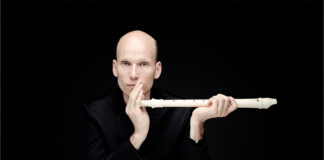
SALSA BAROQUE – 17TH AND 18TH CENTURY MUSIC FROM LATIN AMERICA AND SPAIN. Presented by the Cape Town Concert Series, The Cape Town Baroque Orchestra, and the Lutesong Consort. Guest artist: Matthias Maute (recorders, baroque flutes). Cape Town Baroque Orchestra: Annien Shaw, Ralitza Macheva (baroque violins), Emile de Roubaix (baroque viola), Rosamund Roth (viol), Henrike Kovats (baroque double bass), Uwe Grosser (baroque guitar), Lilavan Gangen (percussion), Dale de Windt (organ) and Erik Dippenaar (harpsichord/organ).
Lutesong Consort: Vasti Zeeman-Knoesen (soprano), Lusibalwethu Sesanti (alto), Jason Atherton (tenor) and Keaton Manwaring (bass). Baxter Concert Hall.
ALBERT COMBRINK reviews
The Cape Town Concert Series continued its 70th anniversary year with another innovative venture that falls right within their goal of presenting the finest chamber music available in the country. Started by music lover and Record Shop owner Hans Kramer seven decades ago, as a music club, the concert series has grown into a South African institution of musical excellence, while still maintaining that sense of being a club: music lovers meeting once a month for a dose of excellent music, and more importantly, a sense of connection with the vibrant music world which is such a large feature of not only the city, but South Africa as a whole.
The 70th year celebrations – from African piano-works to Beethoven String Quartets, to concerts outside of the normal Baxter home, have marked a musically and artistically significant year for the Cape Town Concert Series.
A particular hallmark of the series is its willingness to collaborate with artists and institutions, from the CPO musicians in concert to the more rarely heard early music groups, of which this concert was a prime example: Lente Louw and Erik Dippenaar – respective directors of the Lutesong Consort and the Baroque Orchestra – have fostered a lively and growing interest in early music. Through many years of educational involvement, concerts with visiting artists who also stay on longer to teach lessons and masterclasses, and building a loyal and enthusiastic following, a community of skilled and interested people have developed around this specialist music, both as performers and as audience members.
It is specialist: special instruments are required, such as harpsichords, theorbos and lutes, and traditional instruments such as modern violins and cellos just will not do. Baroque instruments with gut strings and the like, are bought, donated, borrowed or built specially. But none of the excitement around a Cape Town Baroque event can be attributed to the avoidance of a metal string or the performance of a work that is older than three- or four hundred years. No; the excitement and joy that audiences experience time and again, is the love and exhilaration that the musicians bring to the event. One never walks out of a Cape Town Baroque concert without that feeling of having witnessed something tender and special, but also brimming with energy.
Fully-fledged chamber music
Thursday’s concert was no exception. Held in the Baxter Concert Hall, rather than one of the venues usually used for Baroque music in Cape Town – a church or historical museum perhaps – it placed this style of music in its concert context as fully-fledged chamber music. The age of the music comfortably slots it into a concert-milieu, but the performance lifted it beyond: shorter pieces were presented in little “suites” strung together to create longer structures with various moods in each. This approach provides both respite for the ear as we move from piece to piece, but also avoids the potential monotony of a long playlist of short pieces. Alternating vocal solos with instrumental works provided the final grooming on a fun-filled and satisfying programme of works most of us had never heard before.
One audience member asked me “Who do they [the musicians] follow?” A legitimate question, as one is used to seeing a conductor in front of what looks like a little orchestra. But this was an ensemble of 10 musicians, and this is the essence of chamber music. They follow each other, and it is in the intimacy and connection of that close observation, that “chamber music” as a genre, takes on a unique characteristic. There was, however, a soloist, who played while leading, if the piece required that, and that was, unexpectedly perhaps, a recorder player.
Guest artist Matthias Maute, virtuoso recorder-player and composer – first prize winner in the soloist category of the competition Musica Antiqua Bruges, Belgium and the Dutch Impressariat Chamber Music Competition – brought a friendly, genial and “un-professorial” attitude to the stage. In his quick introductions and performance, the ideas, music and context, sounded fresh. We were literally told to imagine ourselves arriving in “the new world” on a boat, leaving behind all we remember of Africa or Europe, and to join the party that was already in swing.
Steely virtuosity
The music carried the audience through various spaces: a tavern, a cemetery, a forlorn lover reciting heartbroken poems to themselves in a lovely forest, or entertaining royalty with a flashy “La Folia” by the Italian Andrea Falconieri, the Renaissance composer who somehow had tumbled into the boat that took us to South America. Not that anyone cared that not all the works were strictly-speaking South American or even from their colonisers, the Spanish. Maute presented by what the programme referred to as a recorder concerto by Antonio Soler, but more accurately, was the African premiere of Maute’s newly created recorder concerto, using material by Padre Antonio Soler (1729-1783), with Maute as soloist. It was successful stylistic pastiche, and could well pass for a newly-discovered recorder concerto by Padre Soler. The steely virtuosity of Maute’s playing – which you can taste for yourself in over 30 CDs for sale on iTunes alone – is softened by a relaxed stage-persona and a keen interest in the music-making of the ensemble as a unit, rather than just the accompaniment to a famous soloist.
The musicians looked like a painting by a Spanish Renaissance painter, Fernando Gallego, or perhaps even Flemish Jan van Eyck, who had travelled to Spain many times and absorbed its colours: maroons, wine-reds, ochre, and Maute’s own lapis lazuli, framed by the lovely wood and mood-lighting from the Baxter Concert Hall itself, helped transport the audience.
The performance itself was not without the odd moments where our trans-Atlantic travellers were slightly off-kilter as they were finding their “land-legs”, and a wise choice to repeat one of the earlier numbers as an encore, gave everyone a chance to settle more squarely in a piece that had hardly any predictable rhythm pattern at all. A programme with 16 brand-new items will present challenges in concert, but the vibrancy of the performers drew audiences along.
The solo singers were particularly delightful, with Vasti Zeeman-Knoesen and Lusibalwethu Sesanti both bringing tremendous character and tenderness to their solos. While the four vocalists achieved an excellent blend, one could look for a bit more theatrical engagement from the gentlemen, but that is a tiny caveat.
This Salsa Baroque”- from the lively chaconas and jácaras of Spain to the spirited villancicos of Mexico and Bolivia – was a programme splashed with generous helpings of energy, colour, and rhythmic vitality.
If you were looking for delicious new music to explore, these are just some of the names that were on the programme:
Santiago de Murcia (1673-1739)
Antonio Martin y Col (c.1660-c.1740)
Henry de Bailly (c.1585-1637)
Gaspar Fernandes (c.1570-1629)
Juan de Araujo (1648-1712)
WS