CONCERT REVIEW: SPEM IN ALIUM – From the Miniature to the Monumental. Presented by the 2025 Cape Town Baroque Festival on 24 September, at St Andrew’s Presbyterian Church, De Waterkant, Cape Town. Lutesong Consort, True Voices, Erik Dippenaar & Dale de Windt (organ), conducted by Patrick Cordery. ALBERT COMBRINK reviews.
One of the highlights of the Baroque Festival 2023, was a rare performance of Spem in Alium, a gigantic work one tends to hear and read a lot more about than actually experience first-hand. Firstly, choral music has its niche audience, and a slice of that niche might be “Early Music” – that is generally any music written before Handel’s Hallelujah Chorus – and a slice of that slice, might be those with an interest in very old English choir-music. These few hurdles create a scenario where Spem n Aliumw ould become an even more rare specimen, with those in the know being excited to hear it, and those not in the know, pretty much to not even notice.
For me, when I go to Hermanus for the Whale Festival, or accidentally spot a whale in False Bay, I am instantly filled with a sense of awe, excitement and humility. Gratitude is also an emotion that comes to mind, that somehow, no matter how bad the news is and how terrible we human beings have been to each other and our only home planet, that somehow these enormous, magnificent creatures continue to swim the seas and bring their awe and beauty to our existence.
 Big undertakings
It is not too much of a stretch to say, I feel the same with something like Spem in Alium, the way I would feel about the performance of any of a number of large, difficult, hard-to-access, music works. Putting them on are big undertakings and complicated experiences. The fact that people still care and love this music almost half a century later, moves me deeply. The fact that people would take on the enormous task of putting a work of such complexity together with really very little financial reward for the individual performers, but doing so with joy and commitment simply because we all believe it is worth doing, worth remembering and worth lifting it off a music history textbook and bring it into the light one quarter into the 21st century, is for me, cause for celebration.
A textbook example of Renaissance Polyphony – polyphony meaning the playing or singing together of individual lines, rather than a simple melody-and accompaniment, we are still not sure exactly why Thomas Tallis (1505-1585) wrote this particular work. The occasion of the 40th birthday of queen Elizabeth The First has for long been one of the accepted reason for the composition. There was of course, political intrigue afoot: there was a plot to assassinate the protestant Elizabeth and replace her with her Catholic cousin, Mary, Queen of Scots. An Italian banker, Roberto Rodolfi conspired with English noblemen.
The text for Spem in Alium refers to betrayal by Judas, and many have read overlaps between Elizabethan history and the texts. The work was first performed in the home of one of the co-conspirators, in a large octagonal banquet hall. The work is written for 40 individual voices, each with their own unique part – an enormous musical, mathematical and musico-geographical exercise to start off with – but the composition is shaped such that the 40 voices function also as 8 groups of 5 singers each: perfect for performance in the octagonal banquet hall with various balconies.
40 voices
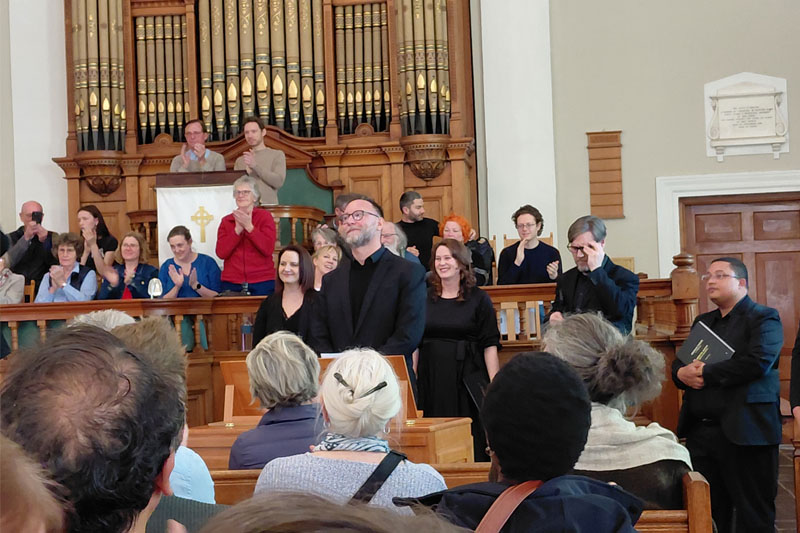
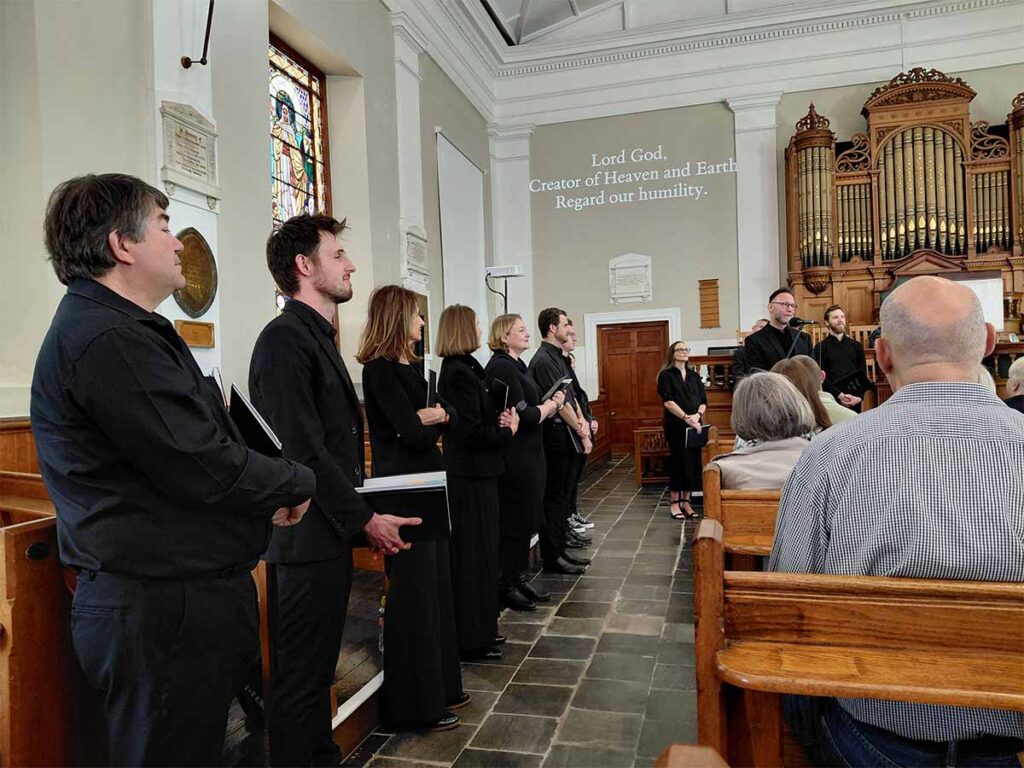
The work might also have been commissioned as a peace offering to Elizabeth. Exactly how this work came to be, we might never know. But fact remains, that no recording can do justice to the experience of this work, live. The audience were invited to sit anywhere in the middle of the church – while the 40 singers stood in a large circle along the outside walls of the church, singing in towards the audience. Because of the acoustics, one tends to hear more of the voices closest to you, but the work is also designed with pauses and dramatic entrances of new vocal groups, so that the experience gives you from 1 to 40 voices in your sensory perception at any given moment. It starts with a simple voice, and then builds up to its full splendour.
A deeply moving experience
Then, the audience is invited to move to a different seat, to experience the work a second time. On paper, this might seem odd. But as a musical and artistic experience, it is very interesting to note how one’s perception changes on second hearing: we have been washed in the sound, and experienced the floating sound-bath of 40 voices, each remarkable for being distinctive and individual, and yet, thanks to the training in the field by what is by now a team of early-music scholars in the city, one starts to pick out different timbres, new phrases, new combinations of voice-parts.
It was a very deeply moving experience – regardless of one’s thoughts about the religious basis of the texts, which by now has evolved out of its liturgical context into a Shakespearian comment on our shared humanity.
It is hard to find words to describe the sheer beauty of the sound, but even harder to pinpoint why that sound would burrow deep into my ribcage and make my eyes wet.
Two smaller motets opened the programme: Elsabé Richter and Lente Louw sang Beatus homo qui invenit sapientam by late-Renaissance Franco-Flemish composer Orlando di Lasso (c.1530-1594). The words from Proverbs 3:13, “Blessed is the man who finds wisdom”, has inspired many composers, even Brazilian Heitor Villa-Lobos. The two sopranos blend exceptionally well without losing any individuality, and the best part of hearing this was knowing there are at least an hour’s worth of these 2voiced gems for these two artists to pluck for our delectation in future programmes.
John Taverner (c.1490-1545) followed with a slightly longer 5-voiced Dum transisset sabbatum , a setting of the Easter-Sunday text from the Gospel of Mark, this version of which describes the women bringing spices to the tomb of Jesus, only to find it empty. The tenor sings a pre-existing plainchant melody – known as the “cantus firmus” which audiences from the time would have known from having heard it sung in church – from which the other lines then literally “branch off” in tree-like growth, inviting the ear on a journey following each voice wherever it choses to grow off to. Perfect” ear-expanding” for an audience about to tackle a 40-voiced composition.
A musical gem right in the heart of the city
The “miniature” opening of the concert, starting with two voices, building to a 5 voice motet before diving into the massive Tallis, was inspired programming, giving the ear and heart time to adjust to the soundworld from a completely different time in history, half a century away. It is this kind of care and attention to detail that make us love Cape Town Baroque. Artistic director Erik Dippenaar, despite living abroad now, has created a musical gem right in the heart of the city. And just like the Whales let us know that there is still beauty in the world worth protecting, the ongoing curatorship of the growing early-music study and expertise in the mother city, is a joy to experience.
The concert was preceded by a talk by Anna Stoddard, a well-known Early-Music expert who also runs a podcast on Fine Music Radio, where you can hear more about this and other programmes. The large work was conducted by Patrick Cordery with great simplicity but absolute authority. The fact that his presence was both essential and yet not attracting any attention to himself, sums up some of what was so special about this performance.
What: Spem in Alium review
Reviewer: Albert Combrink
Anna’s Baroque BonBons: Here
WS