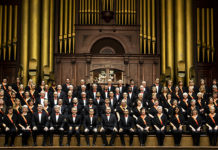
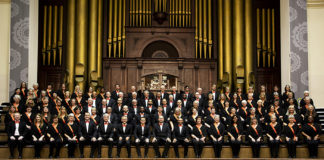
A PASSION FOR OPERA. A 75th Birthday Tribute to Angelo Gobbato. CPO conducted by Bernhard Gueller and Kamal Khan. On Wednesday, 27 June 2018. At Artscape Opera House.
DEON IRISH reviews
The number of the soloists appearing in this concert, and the disparity of their current professional bases, might have given this tribute concert something of the atmosphere of an international singing competition. Indeed, one can be certain that the last time this stage enjoyed this number of excerpts from so diverse a choice of operas, performed by this number of distinguished singers, must have been the final round of the 2016 Hans Gabor Belvedere Singing Competition.
Not that there was anything competitive about the participants in this concert. On the contrary, the single most abiding impression left of the evening was the unity of purpose with all of the many collaborators – on stage, backstage and in the pit – united in a single-minded act of musical tribute to one who has played an irreplaceable musical in the life of not only this city, but the country.
Who’s Who of Cape Town opera
The programme read a little like a Who’s Who of Opera in and from Cape Town. Whether it was Christine Crouse, returning after half a life-time to her earlier role as stage manager; or Mariso Marchio, turning decades of experience to the relative novelty of surtitles; or several members of the ad hoc chorus for the occasion, who probably haven’t trod these boards in a decade or more!
Gobbato, who although born in Genoa has lived in Cape Town since his sixth year, probably became widely known as Director of the Opera School at the South African College of Music at UCT.
But long before that, he had started his singing career in the role of Kecal, in the newly-formed Capab’s premier production, Smetana’s Bartered Bride, at the old Alhambra Theatre in Riebeeck Street. Coincidentally, this was the first opera I attended, as part of a Sea Point Boys’ High contingent, early in 1965. Perhaps that is why one of the most moving moments of the evening was listening to a recording of Gobbato singing his Act II aria from that very production, with David Tidboald (who died at the age of 92 this week) conducting the Capab Orchestra.
After some years in mostly buffo roles, Gobbato moved more assuredly towards stage direction, becoming a resident opera producer for Capab at the then Nico Malan before taking over the direction of the Opera School in 1982. He remained there until 1989, when he returned to Capab as artistic director – remaining in that post for the transformation of the opera department into Cape Town Opera in 1999 and thereafter until his formal retirement in 2008.
Between his artistic and teaching careers at Artscape and the SACM, he has amassed a veritable battalion of artists whom he can call colleagues, protégées, students and friends. And a good many of them managed to tweak diaries and find gaps to be able to travel to Cape Town and participate in this memorable occasion.
It was a beautifully produced tribute and one which passed almost without a lapse from excellence. In the spirit of the occasion, I shall forbear further comment on the finale: a grotesque bowdlerization of the Hallelujah Chorus.
Things started off with a fine reading of the Fidelio overture – conducted by Gueller as his personal tribute – before Khan assumed the baton for the remainder of the evening. This consisted of a series of extracts from various works in which Gobbato had himself appeared, or directed. (Given his level of activity in both capacities, there was no shortage of material to choose from!) Married to these was an interspersed biographical narrative that gave considerable insight into the world of opera in Cape Town over some four decades.
Solo roles
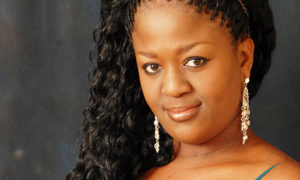
Is there a way to avoid a catalogue of names and works in a report of this nature? I suppose, as a matter of historical record, one should record that the following artists sang in one or more of the solo roles: Violina Anguelov, Marcus Desando, Bongani Kubheka, Goitsemang Lehobye, Luvuyo Mbundu, Lukhanyo Moyake, Fikile Mvinjelwa, Musa Ngqungwana, Given Nkosi, Siyabulela Ntlale, George Stevens, Nombulelo Yende and Pretty Yende.
What a collection. They would collectively grace the stage of any opera house – and the big names among them do just that. Artists are surprisingly generous creatures and they will not mind if I do single out some of the outstanding contributions of the evening for particular mention.
We heard Pretty Yende and younger sister Nombulelo sing the “Lakmé” duet, the work that first drew Yende to opera, in neatly assured fashion. It proved to be a delightful amuse-bouche to Pretty Yende’s more substantial offerings that followed. In the first half, these were the witty duet from Il Barbiere di Siviglia, sung with fellow Belvedere prize-winner, Ntlale; and then the celebrated Sempre Libera sequence from La Traviata. But the real treat was reserved for the second half: the Mad Scene from Lucia di Lammermoor, sung and acted in an authoritative manner that was beautifully conceived and wholly absorbing. It was certainly a highpoint of the evening but, sensibly, was not chosen to end a programme of this nature: that honour was given to Moyake, now with the Vienna State Opera, who sang a triumphant Nessun Dorma in fitting tribute to the evening’s dedicatee.
Philadelphia-based Ngqungwana, another singer who has a dozen or more major international prizes to his credit, was heard to advantage in various set pieces (notably the Council Chamber scene from Simon Boccanegra), but principally in a quite delicious Non piú andrai from Le Nozze di Figaro.
It’s hopeless. One simply can’t do justice to a programme of this nature without going through it item by item and voice by voice. And seeing that some of the set pieces – the Grand Triumphal Chorus from Aïda; the Toreadors’scene from Carmen; the aforesaid Council Chamber scene all involve six singers and chorus, that would make for a long and probably tedious reading exercise.
The real winner was Angelo Gobbato
I shall content myself with noting that I loved Mvinjelwa’s Prologo from I Pagliacci; the Cosí fan Tutte trio by Lehobye, Angulov and Ntlale; and the Il Trovatore duet, Mira d’acerbe lagrime sung by Stevens and Lehobye. And, as a piece of superb operatic theatre, the very grand Grand, hugely triumphal Triumphal Chorus from Aïda, which reminded us – in the midst of all this musical wealth – exactly what Verdi’s stature is. How he would have loved this recreation at the tip of Africa, with voices of the quality of Anguelov, Khubeka, Lehobye, Moyake, Ngqungwana, Ntlale and a surprisingly cohesive chorus for an ad hoc group, all soaring over his rich orchestration.
Which brings me to Khan’s wonderful contribution from the pit. It is no easy task conducting a programme of this disparate nature: continual changes of orchestral instrumentation, style, colour and mood, without even taking into account the endless adjustments required to marry orchestral levels to a whole welter of differing voices. Bravo, maestro. If this was a competition, you’d have my vote.
But the real winner was undoubtedly Angelo Gobbato: affable as ever, clearly (and rightly) proud of his achievements and of the many talents he has helped nurture: those present on the stage and those who, on that very night, were engaged on other stages, to the furthest reaches of the world. A far better choice of Handel chorus to end the evening would have been “Their sound is gone out into all lands”.
See more about CTO’s upcoming Mandela Trilogy: https://weekendspecial.co.za/
mandela-trilogy-cape-town-opera/
Angelo Gobbato Tribute: A Passion for Opera. A 75th Birthday Tribute to Angelo Gobbato review 2018
Cape Town Philharmonics Orchestra CPO: https://www.cpo.org.za/
WS