

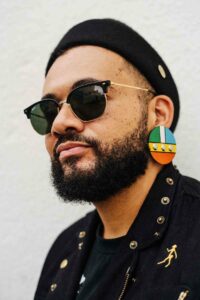
Bokani Dyer fans can soon experience a live take of the pianist’s Radio Sechaba project at The Cape Town International Jazz Festival (CTIJF), which takes place on 3 and 4 May, 2024. Released through the independent Brownswood Recordings label, the album captures a more introspective side to the jazzman. JANE MAYNE found out more.
Dyer’s upcoming festival gig comes on the back of a regional tour which started at the UKZN Centre for Jazz and Popular Music in Durban, and ends at Bushfire Festival in Swaziland. CTIJF 2024 will once again be staged at The Cape Town Internation Conference Centre (CTICC), where the composer will feature a 7-piece ensemble.
His Radio Sechaba release was recorded over a four-year period, and includes input from a variety of players. He says, “I used a lot of different people on the album as I thought different musicians were better suited to different tracks. For the upcoming festival I’ve got Leagan Starchild Breda on drums and Benjamin Jephta on bass – both played on the album. Bonge will be singing with me. Then I’ve got Keenan Ahrends on the guitar, as well as two trumpet players.”
World class festival
For most musicians, a showing on the CTIJF bill is a career highlight, and the pianist shares that he’s always had great experiences on this jazz platform.
“It’s definitely a world class festival, after playing at the Noth Sea Jazz Festival and seeing what happens out there. The Cape Town International Jazz Festival is definitely up there in terms of the standards and in terms of the lineups. It’s a really great festival. So yes, fond, fond, memories!”
An established artist whose accolades include Standard Bank Young Artist of the Year and a South African Music Award for Best Jazz Album, he’s fast expanding his discography. This includes Mirrors (2010), Emancipate the Story (2011), Oscillations (2013), World Music (2015) and Kelenosi in 2020.
Radio Sechaba marks a slight departure from his previous work. “Here I was kind of thinking of this big sound – a large ensemble with two trumpets. Just thinking about a high energy experience, and just a really fun, more groove-based show. So that’s kind of the direction I’m looking to go in – maybe less geared to a concert hall or jazz club setting club, and more easily translatable into a bigger stage festival, or outdoor experience. We’ll see how it goes. I’ve just started recording the follow-up to the album that was released last year, because by the time it came out it was kind of old music to me.”
Vocal and literary additions
Novel aspects of the Radio Sechaba sound are more vocalization and a literary component. The jazzman comments that, “it’s a way to be quite direct, as you can kind of tell a specific story. So, for me a song is like a literary work somewhere between a short story and a poem. To speak to people in words and to put those to music I think that’s a very powerful medium to communicate in a very direct way, which does feel quite empowering.”
With his Motswana-South African heritage, Dyer has a vast Southern African songbook to draw from. Amongst the pianists whose work resonates with him is Bheki Mseleku. “He’s just phenomenal, just amazing in so many different ways, even away from any instruments. Just his ideas on spirituality and being a vessel, and trying to completely empty yourself out so that the music can flow freely. These are very powerful ideas which I think about a lot. So, I’d say he’s my ultimate. Then obviously Abdullah Ibrahim as well, and Moses Molelekwa.”
In terms of his own creative process he says, “I guess it’s one of those beautiful mysteries. I’m trying to be all encompassing of all the elements that make up my musical world. For me, composition and creating music is not an assignment that I give to myself. It will maybe stem from some kind of an idea that finds its way into my head and I explore that further, or I’ll be sitting at the piano practicing, or just playing some music and through improvising I get to something I think that could be the start of something, and try and develop it. It’s just going on a journey and seeing what comes your way and what catches your eye.”
Growing up in a community of exiled musicians, he was raised with a keen sense of activism. Within that milieu, nation-building became a pivotal focus, and was also the overarching theme of the Radio Sechaba album.
But subsequently, Dyer says that he’s “back-tracking on the whole idea of nationhood. Now I’m thinking more about communities, as opposed to nations. I think the idea of nations can be a good one, but it can also be destructive, because what we see now is that people rally together behind a flag, and sometimes that flag cannot represent the full story. Look at what’s happening in Gaza. I just think about the people in Israel who may not be in support of what I believe to be a genocide in Gaza, and how it must feel, because they probably do have some kind of affinity to their homeland and their flag which represents the nation, but then what’s happing with the killing is also being pinned on Israel. So, it got me to refine my ideas, and now I am thinking more about community building.”
Bokani’s Master of Music thesis at the University of Pretoria examined whether the current wave of young South African jazz musicians use composition to address social issues in the same way that the pre-democracy generation did. “I would say that artists are always socially engaged, but sometimes in indirect ways because an artist is a human being who is experiencing things, and with the art they create you can’t remove the person from their context.”
Arts as a weapon
“The great Kenyan philosopher Ngũgĩ wa Thiong’o said that the artist is like somebody holding a mirror, but sometimes that mirror is broken, or the glass could be stained – so if you compare artists pre-democracy to artists of now, I guess there was a kind of characteristic style of engagement that was so direct which kind of gave us the image of what that looks like.”
“Albie Sachs wrote a paper in 1989 where he was trying to call for an end to the type of sloganeering of arts as a weapon of the struggle, as it was in some way to the detriment to the arts, which was losing its nuance in favour of being overtly political. So, I guess there’s lots of conversations to be had about what constitutes a real engagement with social issues, but my deduction is that I believe that the arts are always engaged, but sometimes it’s not as clearly visible – so it is indirect and direct.”
Get your Cape Town International Jazz Festival tickets here.
Who: Radio Sechaba Bokani Dyer interview
What: Cape Town International Jazz Festival (CTIJF 2024)
Where: Cape Town International Convention Centre
When: 3 and 4 May 2024
WS


