 CONCERT REVIEW: CPO Spring Symphony Season “Burnished Brahms.”
Cape Town Philharmonic Orchestra, Bernhard Gueller (Conductor) and Filippo Gorini (Piano), members of the Cape Town Philharmonic Youth Orchestra and the CPO.
ALBERT COMBRINK reviews
We are six years away from celebrating the 200th birthday of Johannes Brahms. Still regarded as one of the 3 Big B’s (along with Bach and Beethoven) – essentially the three giants who dominated the very birth of what we today classify as “classical” music – his music has held its place in the hearts and playlists of the general public. An all-Brahms fiesta was therefore reason for celebration, giving us two of his most important, popular, large-scale works – the 2nd Piano Concerto and the 3rd Symphony – prefaced by a popular treat – two Hungarian Dances, recognised around the world.
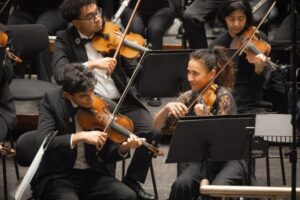
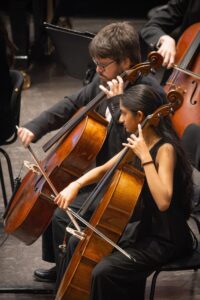
Members of the Cape Town Philharmonic Youth Orchestra joined professional CPO members on stage in a side-by-side performance. The purpose of the exercise was to give young Youth Orchestra musicians a taste of a professional working environment, testing their mettle in some serious repertoire, under the supervision of the CPO. The CPYO is the flagship of the CPO’s Youth Education and Development Programme, which brings together about 70 of the Western Cape’s most talented musicians. They are given professional orchestral training and it provides an important pathway to professional music-making. Many alumni have gone on to join the CPO and other professional ensembles, so it is a visible example of the long game: a success story playing out in front of our very eyes.
Opening the concert with two delightful, popular and lively Hungarian Dances (Nos. 1 and 6) was an inspired choice. The extra players made for quite a plush sound, in music already plushly orchestrated, and, lovely as they were to watch, perhaps even seven French Horns can occasionally be too much of a good thing, as balance was not always ideal. Ensemble was managed well, given that the sections – used to working together – had to absorb a large number of inexperienced young players. The pieces are full of tricky tempo changes, showing off the Hungarian Gypsy style Brahms had encountered as a young pianist on tour with the famous violinist Ede Reményi. After concerts, the two would go to the pubs and after a few drinks, would improvise and entertain, deep into the night. By the end of the tour Brahms had absorbed an enormous amount of this material, and it would often provide improvisatory and rumbunctious seasoning to his more serious work. No.6, characterised by the verbunkos Hungarian dance – with cadenzas and dramatic changes of tempo – was caught with playful, but elegant style.
Free But Happy
By then, we were ready for the meaty Symphony No.3 in F Major Op.90. The composer’s friend Joseph Joachim (master violinist and conductor of the first performance of this work) had a thematic motto in his works, using the notes F, A, E, taken from his life-mantra “Frei Aber Einsam” (Free But Lonely). Brahms used his own version of his personal motto for this work: F.A.F. “Frei Aber Froh” (Free But Happy). Well perhaps, “content” rather than happy, as the work is darker and more concentrated than the composer’s other three symphonies, yet still glows with life, energy and an unbreakable spirit.
When the brass unleashed that first fanfare, I was concerned that perhaps the sails on the boat were not quite as big as I had expected them to be, but appreciated that that tumultuous eruption of the strings that follow immediately after, did not sound underwhelming by comparison. However, when the opening material returns later in the piece, conductor Bernhard Gueller followed the composer’s dynamic markings to the finest detail, giving the recap of that brass fanfare an overwhelming gleam, pushing the large machine all the way to the coda.
Beautifully gauged woodwind timbres opened the second movement with an Andante that really was at a relaxed walking pace, never dragging its heels. Gueller understands this music so well, knowing when to slow down when the textures thin out in the middle section so that the horn choir and double bassoons reminisce about the party of the “Academic Festival” premiered shortly before, to such tumultuous political drama and eventual success, when Brahms received his honorary doctorate.
The heart-breaking melody of the third movement Poco allegretto was quite lively, avoiding sentimentality, but somehow keeping the emotion on a tight leash. Exquisite horn- and flute duet playing made for lovely textures and transparency. The most formally academic movement unfurled at an unhurried tempo with some delicate textures taking one by surprise, almost as if the enormous ship that had set sail with that opening fanfare, was coming in to shore, in a quiet, contented hush: “Frei Aber Froh”.
Symphony with piano
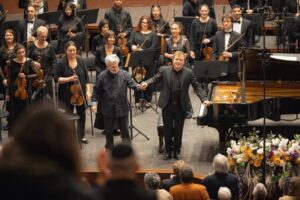
Italian pianist Filipo Gorini had stepped in as last-minute replacement in the titanic Piano Concerto No.2, at literally four days’ notice. This is a huge task to take on, and even if the work is one’s active playing repertoire, it might take more than four days to reheat to pristine condition. Gorini is a sensitive player with a wide range of musical tastes, from the baroque to the contemporary. He brought an interpretation both conservative and apt. The work is already “modern” for its time, and requires firstly that one plays it as is, without requiring excessive interpretation. Conceived almost as a symphony with piano, the three-quarter-hour work is of extreme technical difficulty, and the first movement saw some merchandise fall off the wagon on the way to the market. Soloist and conductor were comfortably on the same page musically, and by the second movement things had settled into some very beautiful playing, with the pianist balancing the powerful outbursts with tender, lyrical playing. The second movement, in particular, gave Gorini chance to show off both filigree fingerwork and thundering chords. Principal horn Shannon Thebus nailed the opening horn solo and all its iterations. Principal cellist Peter Martens provided intense, passionate and deeply touching cello solo contribution in the third movement. Was this a sweet, resigned conversation between Johannes Brahms and his beloved Clara Schumann? There was certainly a sense of deep contentment in the performance of this, one of the composer’s most personal statements. The final movement brought the massive work to a true Grazioso conclusion.
Gorini’s encore was ta piano transcription of the soprano aria Sheep May Safely Graze from J.S. Bach’s Juint Cantata BWV 208. Exquisite, delicate textures with ideal phrasing separating the vocal chorale lines from the oboe and string parts. Very memorable and beautiful playing, perfectly balancing the large and dramatic romantic landscapes we had just travelled.
WS