Peta Stewart
Dodging rockets. That was the answer to the first question asked of Theodore Kuchar about what he has been doing before coming to Cape Town to conduct two concerts in the Cape Town Philharmonic Orchestra’s Summer Symphonies at the City Hall. Of course, he was in jest, but it needn’t have been so for Kuchar is principal conductor of the Lviv National Philharmonic Orchestra of Ukraine and was there when the war broke out. At the time Lviv was a safe place, but no longer.
“Until quite recently, Lviv was a place Putin didn’t want because it was perceived to be more European than Russian, and embassies, businesses and people were in those early days relocating there from dangerous places like Kiev and Kharkiv,” he says.
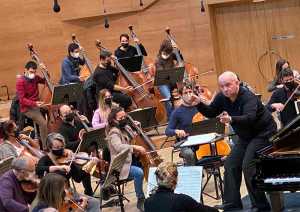
Lviv orchestra
Even so he was advised to leave Lviv, torn for two reasons – leaving his brave musicians who carried on regardless, and his Ukrainian opera singer wife Lyubov Dika who refused to go. Kuchar was born in the US of Ukrainian parents but holds American and Australian nationality so he was allowed to leave when all Ukrainian men under 60 couldn’t, though his border crossing is the stuff of spy stories! He also speaks Ukrainian like a native, so his talents are invaluable when it comes to sorting out the kind of 40-concert tour he has planned of the US in January with his Lviv orchestra which will begin in Miami and end after performances in Carnegie Hall.
That’s if Putin is stopped in his tracks, of course.
He reflects on the start of the war in late February. “It was probably the first time the entire staff of the American embassy, which had relocated from Kiev, came to a symphony concert, the Dvorak Requiem.” That was appropriate of course, because life changed then for many, and the requiem stands for all lives lost in the war. “There were 150 000 Russian troops along the Ukrainian border and it was looking like Belorussia would join in.
“The American embassy very quickly was evacuated to Poland and the ambassador suggested I do the same.”
Although Lviv was quiet, he says, “the sirens that warned of attacks sounded all over the country and we had no idea what was most at risk so everyone ran to the shelters. There was a mass exodus, the trains were full, there was panic. It was unimaginable.”
He made it to Poland then Finland, and from there to America, but about a month later was back in Lviv where he still had concerts and recordings, some of which were eventually made with an orchestra in Poland because he had to honour his commitments. Kuchar is the most recorded conductor today, with more than 140 CDs released, one of the most recent with the South African born bass player Leon Bosch.

Concerts for streaming
While life changed for Kuchar because of the war, it had already changed during Covid when the arts world just about came to a halt with concerts cancelled around the world. Like the Cape Town Philharmonic Orchestra, the Lviv orchestra remained relevant, and both made concerts for streaming so musicians were employed and good music was available to supporters.
He has been involved with orchestras in the Ukraine for more than 30 years, and his grandfather attended concerts in the same hall in which he now conducts in Lviv.
Kuchar’s schedule is now back to normal and he barely has a day off until June next year. He was about to accept a teaching position in the US when post-Covid engagements began to pour in. He has also just been appointed principal conductor of the Lublin Philharmonic in Poland and is planning joint concerts in June next year in Poland.
He comes to Cape Town after Lviv and Slovakia and returns to Lviv and engagements in Turkey. He teaches part time in Cleveland, but he is glad to be back here.
“I have incredible nostalgia for this City which gave me first job – I had just graduated when I was appointed principal viola of the Cape Town Symphony Orchestra in 1982. When I left two years later to join an orchestra in Helsinki, I had already performed Harold in Italy, considered to be THE concerto for viola, and Mozart’s Sinfonia Concertante with Gina McCormack. I have never abandoned the viola even though most of my life is now spent conducting and it was Cape Town that made me a musician!” (Post Helsinki, he was appointed to the first of many positions as music director and principal conductor, in Brisbane in Australia.)
He is bringing his Ukrainian roots to Cape Town with Taras Bulba, written by the Czech composer Leos Janacek about Ukrainian Cossacks, a sort of calling card for the Janacek Philharmonic where Kuchar was music director.
The concerts feature two brilliant musicians – Alissa Margulis who will perform the Prokofiev Violin Concerto and Ravel Tzigane on Thursday, 3 November, and Alexey Stadler who will perform the Dvorak Cello Concerto the following week. Both Ms Margulis and Stadler are also performing for the Cape Town Concert Series. Ms Margulis being joined by pianist Luis Magalhaes in a fundraiser at the Norval Gallery on 5 November, and Stadler on November 12 when he performs at the Baxter Concert Hall, solo, in a chamber group and with several rising cellists in a specially workshopped piece.
What: Cape Town Philharmonic Orchestra’s Summer Symphonies at the City Hall
Who: Theodore Kuchar, conductor
When: 3, 10 November 2022
Tickets: Dial-a-Seat 021 421 7695, Computicket; Quicket dress rehearsals, 11am each Thursday
WS