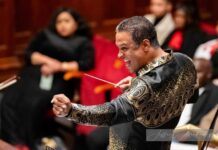
CPO CONCERT REVIEW: MOSTLY FRENCH. At The Cape Town City Hall, 24 October 2024. Cape Town Philharmonic Orchestra conducted by Jonathan McPhee. Soloist: Ben Schoeman (piano). John Simon: Fugal Fantasia on a theme by Purcell (World Premiere). Ravel: Le Tombeau de Couperin Saint-Saëns: Piano Concerto No. 4 in C minor, Op. 44 Bizet: Symphony No. 1 in C. ALBERT COMBRINK reviews.
The Cape Town Philharmonic Orchestra opened its summer season with a programme of three quintessentially French works, and a world premiere of a work by South African composer John Simon, in honour of the composer’s 80th birthday. On the podium was Jonathan McPhee, conductor emeritus of Boston Ballet, having served as their Music Director for 28 years.
McPhee gave a most informative and engaging pre-concert talk, explaining links between the composers, similarities in sound or artistic endeavour, and this certainly whetted the appetite for the actual performance.

An exquisite prelude
McPhee pointed out the transparency – indeed the “Frenchness” – of John Simon’s orchestration, and it was clear that this was an accurate assessment, from the first notes of the “Fugal Fantasia for strings, harp and tam-tam – Mysterious Mountain Peaks” (I think this is the final full title, as press releases and interviews have given different versions.) An exquisite prelude with dark colours of the double basses and harp, immediately caught the attention.
The idea behind the piece is a search for the Baroque, symbolised as a magnificent, elusive mountain. The opening Nocturne was memorable, but the Fugue lost my attention. Chords were colourful and spicy, but some out of tune playing in the violins interfered with the mists of magic. Once the tam-tam entered, the piece seemed to have clearer definition and built up to a fulfilling neo-romantic climax before sinking back into the Nocturne of the opening. Perhaps some more directional phrasing from the podium would make the middle section as charming as the outer movements.
“Le Tombeau de Couperin”
Directional phrasing was sorely absent in Ravel’s “Le Tombeau de Couperin”. An orchestration of 4 pieces from a piano suite of 6, by the same title, the work is a product of World War 1. Ravel enlisted in the army but was considered too small to be in combat duty. Instead, he became an ambulance driver, naming his ambulance “Adelaide”, and signing his letters “Chauffeur Ravel.” Despite his humour, the war left him physically delicate and emotionally scarred. Each work in the suite is dedicated to a friend who died in the war, and the title refers to a memorial to a France that was no more: the era of Couperin representing an innocence that was lost in the horrors of war.
To be successful in concert, the suite has to invite you into a painting by Manet, with sun-dappled picnics on the Seine, and it must make space for Monet, with colourful, quasi-impressionistic depictions of mood and emotion, and ideally, it should point toward Picasso, because all perspective of French life, had been indelibly altered by the War.
The graceful perpetual motion Prélude is a challenge for the woodwinds – admirably met at the brisk tempo by the orchestral players. Once the strings imitate the opening runs, one realises exactly how virtuosic this music is. Perhaps the tempo was too fast, perhaps the volume too uniform, perhaps the shaping of phrases too flattened out. Forlane suffered a similar fate – either too fast for the dotted rhythm to spike, or too blandly phrased to conjure picture of the commedia del-arte and a Venetian gondola. The stateliness of a Baroque Menuet was undermined by a fast tempo, and the plaintive sound of the oboe, deliberately chosen by Ravel, was robbed from an opportunity to colour with melancholy, especially at delicate hand-overs of material to the flute. The Rigaudon, dedicated to two brothers Pierre and Pascal Gaudin who both died together on their first day of military service, was another 4-in-a-bar affair. The dance, in 4 duple meter, originated in Provence in the seventeenth century and was characterized by hopping steps and slowing down for turning-movements. This performance did not dance quite to my taste.
The conductor’s pre-concert talk pointed out similarities between the Ravel and Puccini’s Tosca (the opening of Act 2). Perhaps the conductor wanted to bring a Puccinian simplicity to the work, but the straight-forwardness of the approach – to my ears – undermined the very texture for which we love Ravel’s orchestrations, and missed many spots along the way to stop and admire the view.

Fragments of an unfinished symphony
South African pianist Ben Schoeman had his work cut out for him in the torrents of notes in the 4th of the 5 Piano Concertos by Camile Saint-Saëns, and very few went astray. The Concerto No. 4 is based on fragments of an unfinished symphony which the composer wrote and then abandoned in his late teens.
Experimenting with forms of the classical era, the work is laid out in two large movements, based on two cyclic themes. Schoemann and McPhee presented it as a serious concerto in the grand mode, with taught rhythmical control in both movements, and by curtailing the flamboyance in the jaunty second movement. Schoemann made the most of the virtuosic finger work, but was often drowned by the orchestra. While the work lacks the immediate charm of the Second Piano Concerto, it nonetheless offers much to enjoy. It is important to remember that Saint-Saëns and Liszt admired each other as composers and performers, and that the model for the concerto was Liszt rather than Mendelssohn.
Dazzling depiction
Schoeman offered an encore: Feux d’artifice (Fireworks), the 12th of Debussy’s Second Book of Preludes from 1913. This dazzling depiction of cascading Bastille Day fireworks ends with a brief quotation from La Marseillaise, France’s national anthem, fading into the distance. A fitting tribute to the theme of the programme and played with flash and vibrant colours.
The Symphony No.1 in C by Georges Bizet is an astonishingly precocious work: written at 17 it is bursting with energy, creative ideas, innovation and phenomenal technical mastery. Written for standard orchestra – without trombones – it follows the classical symphonic form quite closely. It seems to be a link between Haydn and Prokofiev – the similarities with the latter’s “Classical Symphony” are undeniable. Full of colourful detail, the work has been disparaged as a student work – which it was. But it lay languishing in a library for 80 years after the composer’s death, and it would have been our huge loss had the work not been rediscovered.
Again, much 4-in-a-bar material tempted the performance into the occasional lull, but the orchestra sparkled in the tricky runs, and the Oboe Solo in the second movement by Lisa White was absolutely exquisite. Like a most enjoyable visit by an old friend, it was a lovely surprise to hear the work again – live – and be blown over by the sheer inventiveness and bubbling energy of a French teenager who would go on to write the most famous French opera in history: Carmen. One can play this work as a neo-classical symphony, or as a fully-fledged romantic work. Or one can aim for a mixture of the two – I suspect that is what McPhee was aiming for, and it made this a most enjoyable performance.
Read more about maestro Jonathan McPhee here.
Read Peta Stewart’s piece on John Simon’s Fugal Fantasia premiere here.
Book tickets for the Cape Town Philharmonic Orchestra’s Summer Symphonies Season here.
What: CPO Concert review Mostly French
Where: Cape Town City Hall
Reviewer: Albert Combrink – pianist, educator, presenter
WS