

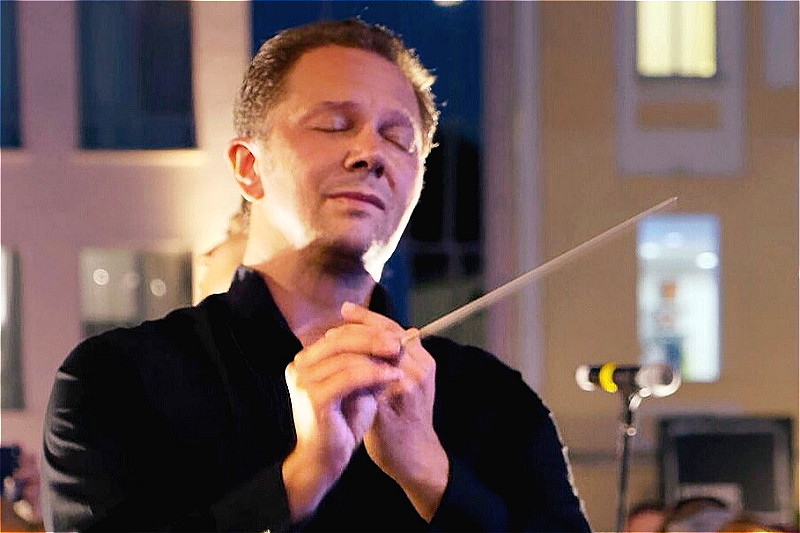
SYMPHONY CONCERT REVIEW. 18 April, 2024. At Cape Town City Hall. The CPO conducted by Martin Panteleev, soloist Christoph Croisé; Tchaikovsky: Fantasia, “Francesca da Rimini”, Op. 32; Saint-Saëns: Cello Concerto No 1 in A minor, Op. 33; Prokofiev: Symphony No 5 in B flat major, Op 100. DEON IRISH reviews.
Bulgarian born Martin Panteleev is certainly no stranger to the CPO, of which he was Principal Guest Conductor from 2011 – 2017 and with whom he made his debut on 15 April 2010, almost 14 years to the day before this appearance.
Something of a revelation
He has not conducted a great deal of Tchaikovsky in his CPO appearances: I may of course have missed some of his concerts, but I only have records of him conducting the E minor symphony and the Romeo and Juliet Fantasy. So, this account of the wickedly taxing Francesco da Rimini fantasy was still something of a revelation.
It needs to be stated at the outset that, any orchestral player who sees a concert programme in which Francesco da Rimini is slotted in, as it were, as the “overture” piece would be justified in reaching for the steroids. It is some time since we heard this work in concert – February 2008, by my reckoning) and I’m sure it would have been a first reading for quite a few of the younger and newer orchestra members.
Which requires an observation: the three works on this programme would constitute a taxing programme for any professional orchestra; with an orchestra having so many relatively inexperienced players and permitted only three rehearsals, it might have proved a little too ambitious. It is a credit to both players and conductor that the limited rehearsal time appears to have been so efficiently employed that the resultant programme sounded fully prepared even if there was a moment where things came unstuck, the glue being not quite sufficiently dried.
Romantic tale
The tale of Francesca, who succumbs to an amorous relationship with her handsome brother-in-law, Paolo, in consequence whereof both are stabbed to death by her incensed husband, fascinated Tchaikovsky. He had attended the first Bayreuth Festival in 1876 (as the special correspondent of the Russky Viedomosti), and had come away enraptured by Wagner’s music, even if distrustful of the man.
The experience did inspire him to use this overtly Romantic tale as the libretto for a somewhat Wagnerian opera and he even commissioned the libretto. Wiser counsels prevailed, however, and he eventually settled for this symphonic fantasy, in which both the tragic domestic tale and its eternal consequence as narrated by Dante in the fifth canto of his Inferno (their spirits with other carnal sinners being tossed about in the howling winds of endless night) are depicted in the composer’s always vivid orchestration.
The opening, with its wind clusters and ominously descending string scales, conjured up plenty foreboding and then burst out the depiction of the turbulence and anguish of the fifth circle. Strings (particularly violins) were splendid in the whirring passage work; brass equally good in their solemn chorales and the fanfares that fly between horns and trumpets. The trumpets did get themselves into a bit of a dither at the end of that section in an episode of false and missed entries which indicated some lack of familiarity with the work, before Panteleev got the cellos to pull things back on track.
The clarinet solo then commenced Dante’s imagined conversation with Francesca and her recounting to the poet her tragic history. There followed some fine orchestral playing in the lyrical, even elegiac writing, especially the haunting flute solo with its rippling clarinet accompaniment. The story built to its intense end, the violence graphically portrayed in the wonderful cadential brass writing, before we were hurtled back into the midst of the vortex, with the shrieking winds superbly captured in the chains of doubled string thirds and percussive brass chords. A thoroughly rewarding reading that reproduced the superb orchestration in vivid fashion.

Lovely rich tone
Next we heard Swiss-based cellist, Christoph Croisé, playing a modern 2009 instrument by Gunther Lobe, in Saint-Saëns’ lovely A minor concerto. The quality of this instrument was immediately apparent in the opening fantasia – a series of downward flourishes for the cellist, over punctuating orchestral acclamations.
It projects extremely well and has a lovely rich tone, very integrated throughout its range with lovely clarity in the upper reaches and surprisingly assertive harmonics. The first movement passed with considerable interest in the soloist’s assured technique – particularly those chains of sixths which were not merely played but allowed to sing with a remarkably full tone.
The succeeding Menuet in the surprising (but neatly prepared) key of B flat was simply delicious: a glorious confection of string band delicacy with a soulful solo contribution in apposition, delivered with a beautifully cantilena tone, the whole impeccably balanced.
The bridge passage was carefully nurtured by Panteleev into a truly architectural connection between the delicacy of the Menuet and the sterner writing of the Finale, passages of warm lyricism being contrasted with moto perpetuo writing, an entire canzona in octaves and a soaring scale that passes inexorably into harmonics before concluding on a crystalline top F. It was a fine account, beautifully accompanied and deserving of the ovation it received.
The concert concluded with a marvellous reading of Prokofiev’s acclaimed Fifth Symphony of 1944 – with the delightful first “Classical Symphony” of 1917, the most frequently performed of the composer’s works in the genre.
This was a very assured reading of a many-textured work, containing disparate elements ranging from majestic grandeur through seemingly nervous agitation to what has convincingly been described as a “threnody of compelling emotional intensity” (Ewen).
Panteleev conducted with the purposeful efficiency for which he has become known, his abundant musicality never descending in overtly expressionist gestures or showmanship. The result is a crafted performance, the clarity of musical thought well conveyed to the players and expressed in superior ensemble, balance and musical cohesion.
There were some outstanding moments: the very deliberate brass insistence in the Allegro marcato; the clarinets at the conclusion of the Adagio; the playful wind solos and string fragments in the Allegro giocoso and – especially – the tremendous, relentless energy of the final build-up. Bravo!
What: CPO review Conductor Martin Panteleev, soloist Christoph Croisé
Reviewer: Deon Irish
WS


