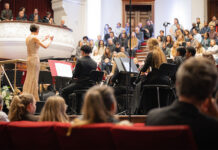
CPO AUTUMN SYMPHONIES CONCERT REVIEW. 4 May, 2024. At the Cape Town City Hall. Cape Town Philharmonic Orchestra conducted by Adam Szmidt, soloist Paul Merkelo; Mozart: Divertimento in D, K.136; Gershwin: Rhapsody in Blue (arr. Timofei Dokshitzer for Trumpet and Orchestra); Mozart: Symphony No 35 in D, K.385 (“Haffner”); Prokofiev: Symphony No 1 in D, Op. 25 (“Classical”). DEON IRISH reviews.
This programme yielded a highly enjoyable concert, which was hardly surprising since each of the works on offer was written with the unashamed intention of entertainment rather than the engendering of any depth of thought, belief, experience or emotion.
It opened with a very stylish account of a Mozart “Divertimento”, one of three string quartets conceived for performance by larger ensembles, rather in the manner of the then current “Italian symphony” form.
Leopold Mozart and his son were in Milan in late 1771, on their second Italian journey, when Leopold petitioned the Archduke Ferdinand to take his sone into his employment. Ferdinand evidently consulted his mother, the Empress Maria Theresa (who had heard Mozart play as a child prodigy) for she wrote to him, advising against employing such “useless people” and opining that their “going about the world like beggars” would bring the status of his household into disrepute. The Mozarts were accordingly back in Salzburg by 15 December (after an unforgiving winter journey over the Brenner Pass via Innsbruck),
Shortly after their return the Archbishop died and his successor, Count Colloredo, was enthroned in Salzburg Cathedral on 14 March 1772, which event was accompanied by the customary secular celebrations, for which Mozart specifically wrote Il sogno di Scipione. It was during this period, too, that he wrote four divertimenti and a string of symphonies, at least some of which were presumably also intended for celebratory events or concerts.

Clear direction
Szmidt has an evident feel for the Mozartean style, and this account was characterized by clear direction yielding splendidly cohesive ensemble, good tempi and finely judged balances. His conducting style, whilst efficiently precise, is attractively expressive without descending into the overly demonstrative or balletic.
The opening allegro had a lively immediacy, its largely two-part melodic writing with frequently antiphonal passages neatly captured in this performance. The occasional outburst of viola melodic participation provided a delightful textural alteration – alas, not afforded in the rather mundane continuo line assigned to the poor lower strings. The somewhat winsome Andante was given a beguiling reading and the final Presto had all the driving energy required, duly refined with neat choices of dynamic alteration and attack.
There followed an arrangement of Gershwin’s celebrated “Rhapsody in Blue” done by Timofey Dokshitzer, who was Russia’s most celebrated trumpeter of the post-WWII era. This treatment of the work is not wholly inappropriate, for much of what we perceive as Gershwin’s original composition was in fact contributed by others.
Instantly recognizable
The work was instigated – commissioned is too formal a term – by the famous band leader, Paul Whiteman, who persuaded Gershwin to write a jazz concerto for a concert that had already been announced for 12 February, 1924. To Gershwin’s protestations that he had no idea how to orchestrate, Whiteman replied that Ferde Grofé would handle that side of things, which he did. Whiteman’s Palais Royal Orchestra was augmented to 22 players for the premiere and, amongst the players was clarinetist Ross Gorman, who was famous for his tone-bending three and a half octave glissando party trick. So he was assigned to provide the opening of the work, a musician’s joke that has become one of the most instantly recognizable openings of any major work in the concert repertoire.
I can’t resist recording some of those who attended that premiere (in jazz-band, rather than the Grofé orchestrated version) just a century ago: apart from Whiteman and Grofé and the composer himself (who was the piano soloist), there were in attendance Kreisler, Heifetz, Rachmaninov, Damrosch, Stokowski, Mengelberg, Sousa and Stravinsky. Not even Paris of the Belle Epoque could produce a more celebrated line-up for a notable premiere than that!
This history demonstrates that this is a work that might well be tinkered with without necessarily doing any injustice to its creator’s artistic conception. And so, I was more than delighted with the many felicities that this trumpet version displayed – although they were to some extent offset a few passages that one felt came across less successfully.
Stellar trumpeter
Merkelo is a stellar trumpeter, which made much of what in lesser hands might have sounded less successful come across very convincingly. I didn’t think the opening Gorman trick was particularly successful. The trumpet – even blown by Merkelo – didn’t quite manage to ‘bend the tone’ in the way that most clarinettists seem able to do (although, having listened to a recording of Dokshitzer performing this arrangement himself, one has to concede that he came very close). That apart, the true first subject works ideally on trumpet, as does the Andantino “big tune” that was to become Whiteman’s signature theme.
There were moments, however, where the sheer percussive brilliance of the piano was missed: particularly, perhaps, the sprawl into the Grandioso E flat episode near the conclusion, with its almost obstreperous double octave account of the original saxophone theme. A single note trumpet line really can’t quite create that effect.
Merkelo’s flawless intonation, seemingly limitless breath control and superior tonal production were given further opportunity to shine in a solo trumpet account of the same composer’s aria “Summertime”, from Porgy and Bess, played by way of encore in response to the ovation he had received. The audience (and orchestra members) responded to this display with a further outbreak of unrestrained enthusiasm.
Orchestral accompaniment of the work was generally exemplary, although there was a mistimed (orchestral) piano entry. I especially enjoyed the fine obligato from principal hornist, Thebus and bassoonist Ball’s finely delivered solo.
A grandiose confection
After interval we were into the world of Classical symphonies: two complementary concoctions by composers who frequently could not restrain infusing even serious writing with their own irrepressible wit.
First off was Mozart’s “Haffner” Symphony, a grandiose confection requested by his father Leopold to mark the ennoblement of Sigmund Haffner, the Mayor of Salzburg. The request couldn’t have come at a more inconvenient time: the composer’s “Die Entführung” had just opened to enormous acclaim; he was not merely conducting performances of the work but (in those pre-copyright days) anxiously producing arrangements of the opera’s “hits” in various combinations of wind instruments and the like for popular distribution, before others could beat him to it; and he was getting married in just two weeks’ time. But Leopold could not be gainsaid.
The resultant work gives no indication of the stressful circumstances under which it was written. The opening allegro (which Mozart wanted played “with great fire”) manages to combine pomp with sheer exhilaration. The opening measures, with their considerable (if ever so slightly tongue-in-cheek – does that high-leaping subject suggest its dedicatee’s elevation?) portent need to be just restrained enough so as to ensure that the succeeding vicious string passage work attains Mozart’s desired fiery brilliance, but without suggesting a hint of hysteria that would be quite unsuitable for so ennobling a composition.
On this occasion I did find the tempo a touch too fast: the opening attained much brilliance in consequence; but the string scale work whizzed past in a blur of cascading notes, the superb imitative architectural detail – despite Szmidt’s observed indications – largely ineffective in the hall’s rich acoustic.
Pleasing elegance
The Andante fared better, although – in a rare lapse from excellent ensemble – the opening orchestral chord was messy. For the rest, its beguiling melodic elements sang with a pleasing elegance that would have graced any Mayor’s ennoblement. It was followed with a very Haydnesque Menuetto – not so much bucolic, perhaps, as a party of Salzburg gentry enjoying a rustic weekend in someone’s schloss. Then came the final Presto movement. Mozart wanted it “just as fast as possible”. And it pretty much was.
How lovely – these minor caveats aside – to hear such stylish Mozart playing in this hall again. It took one right back to the days of Hubert Soudant and Lamar Crowson.
This lovely programme ended with a fine account of Prokofiev’s first and wittiest symphony. Witty because – despite the sobriquet – the harmonies and more pertinently the harmonic progressions are very far removed from the “Classical” sobriquet. If the sudden E major progression in the third bar of Beethoven’s C major mass was enough to have Prince Esterhazy reaching for the ratafia, the first three bars of this symphony would have required nothing less than the salts.
Of course, these harmonies are mild compared to the delicious vagaries of the Gavotta. It was originally an independent confection but was press-ganged into service in this symphony – seemingly taking to the Service quite happily.
Szmidt engendered a delightful reading of this delicious early work and orchestral playing was delicately assured, although the very opening measures of the work did have a slightly unsettled rhythmic feel, until all concerned began to feel the appointed tempo. The bassoonist deserved the accolade he received at the curtain call; as did the principal violin. The whole string section can take a bow for the gossamer light conclusion of the Gavotta,
What: CPO with soloist Paul Merkelo
Who: Cape Town Philharmonic Orchestra Autumn Symphonies
Conductor: Adam Szmidt
Reviewer: Deon Irish
WS