CPO CONCERT REVIEW: PRICE’S RENAISSANCE. The Cape Town Philharmonic Orchestra, on 29 August 2024. At The Cape Town City Hall. Conductor Rossen Milanov. Violin Melissa White. Aaron Copland – Four Dance Episodes from “Rodeo”. Florence Price – Violin Concerto No. 2. William Levi Dawson – Negro Folk Symphony. ALBERT COMBRINK reviews.
The Cape Town Philharmonic Orchestra Spring Season kicked off with a significant concert of three American works, never before performed in the city. Selling three classical works of the twentieth century – and two of them by composers most of the audience would never have heard of before – is traditionally a hard-sell. But the orchestra has developed a reputation for pulling off a huge variety of repertoire, from operetta to contemporary music. Tonight was no exception, and while the hall was not packed, it was respectably full and audience approval was generous.
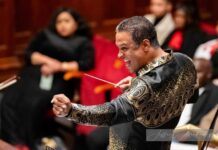
Bulgarian-born conductor Rossen Milanov, in his various tenures at American orchestras such as the Philadelphia Orchestra (over 200 performances), 15 years with the New Jersey “Symphony in C”, etc, has already programmed these particular works to great public acclaim. His familiarity and ease with the musical language made for a well-prepared and executed performance of challenging works.
Copland is hard to play. His rhythms are as spikey as his harmonies are spicy, creating a unique voice in the American symphonic pantheon. Copland was very interested in modern dance. From his first ballet “Grohg” about vampires, there was an interest in finding a musical expression for physical space and movement. So, when the Ballets Russe commissioned him to write a quintessentially American ballet, the result was a work, not taking inspiration and influences from jazz and Afro-American material as he did elsewhere, but rather the very specific world of the cowboy rodeo.
“Four Dance Episodes” from “Rodeo” gave the orchestra plenty of opportunity to show virtuosity, which it did in spades. There was a sense of “careful” playing, and perhaps when the orchestra plays the work again, there might be a tad more abandon to the sheer joy of the wild physical movement suggested by the music. “Buckaroo Holiday” was taken at a sturdy tempo and everything was in place.
A clear narrative
“Corral Nocturne” was played with great tenderness, and the pianissimo strings reminded one of the style of writing that Samuel Barber employed for the great “Adagio for Strings”. Slower speed paid off, as this performance took its time, and crept deep into the spiritual contemplation which one can overlook in Copland’s music. “Saturday Night Waltz” had a light-hearted sweetness, complete with cuckoo-flutes and chirpy woodwinds. The rambunctious “Hoe Down” was given at a careful tempo allowing every offbeat and syncopation to fall in place. The element of risk and heady virtuosity was slightly under-fuelled. Yet, the conductor set out a clear narrative that the audience could follow with ease. Applause between the movements was spontaneous and heart-felt from an audience who were clearly thrilled.
The Violin Concerto No.2 by Florence Price, at first, appears to be a slight work – roughly 15 minutes in length (one third the length of say a Brahms or Elgar concerto). Price has also largely been ignored by the mainstream, and the renaissance of interest in her work is fairly recent. She was clearly a fine musician – teacher, pianist, organist, composer – and no doubt, her early death contributed to the oblivion to which her music was consigned for half a century. Passing herself off as Mexican, rather than “black” and fabricating a Mexican town of birth, Price gained entrance to university where she later became part of the important “Chicago Black Renaissance” in the 30s and 40s.
The work is deliciously melodious – hinting at African American Spiritual material, but without naïveté. Romantically colourful with ample use of whole-tone and pentatonic patterns, making it extremely hard to play, the work is attractive in the style of Bruch or Korngold, and occasionally the ghost of Dvořák makes and appearance. Price is not a master-orchestrator like her models, but the work does not suffer greatly as a result. Colourful flourishes from piano and other unusual orchestral sounds, add to the enjoyment.
There is something rhapsodic about the work that is undermined by some foursquare phrases, but there might be a performance solution to this which will only become apparent once this work has been played and recorded by larger numbers of musicians. Balance is well-planned and the work does not overstay the promise of its material, which is essentially three melodic blocks which interlock and interplay with each other.
An exquisite singing-tone
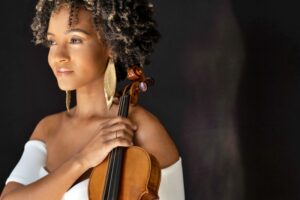
Violinist Melissa White was a dazzling soloist. She played with ease, with an exquisite singing-tone that never was pushed, even when she had to work harder to be heard over the orchestra. She presented the material with a conversational freedom that could flower into achingly sweet melodic cascades high above the rest of the musicians. Her performance was a delight. We were in for a special treat: the encore was the 3rd movement “Andante” from Bach’s Solo Unaccompanied Violin Suite No. 2 in A minor BWV1003.
Perfectly controlled hushed pianissimo playing from what sounded like violin duet – two players having an exquisite, poetic, private conversation. Not a note out of place, and the perfect counterpart for the lush, colourful romantic concerto we had just heard.
One shudders to think that the Price Violin Concerto, along with many other works, were almost destroyed. After her death, her music was boxed up and it was only decades later when someone wanted to buy and renovate the property, that the music was discovered and literally saved at the last minute from being put out with the trash.
Another work that almost suffered a similar fate, is the “Negro Folk Symphony” by William Dawson. The work was the culmination of his compositional ambitions, and received immediate acclaim on its premiere in 1934. Leopold Stokowski considered it a masterpiece and performed it 5 times. When Stokowski died, the Dawson Symphony fell from the public eye. Handwritten parts were boxed and placed in storage until a Philadelphia librarian approached the Fleischer Foundation to sponsor the preparation of a printed edition. Were it not for that librarian, this important and vibrant work, might have vanished forever. Deliberately quoting African American Spirituals, the work makes its artistic intentions clear from the very opening: Revival church-like call-and-responses open the first movement “The Bond of Africa.”
Huge orchestral climaxes
The soloists of the CPO had ample opportunity here to show the wealth of musicianship and excellence of the individual players. Praise to both composer and conductor must go to the handling of the huge orchestral climaxes: they were well-controlled, in particular the brass, which could come flying through at full-force and not drown the strings. The emotional heart of the work, the second movement “Hope in the Night”, speaks to the suffering of a people living in the shadow of their grim past. Without milking the drama or trauma, but at the same time giving fair measure to both, is the challenge for the conductor. Again soloists from the orchestra shone. Those heartbreaking chimes and the rumbling gasps of emotion at the end were intense, emotional and gripping. The wildness of the percussion was always perfectly controlled. This is absolutely a work that should be performed again.
The third movement “O, Le’ Me Shine, Shine Like a Morning Star!” tips its hat at the music of Antonin Dvořák more than once, but in an affectionate way – there is no doubt that Dvořák had an influence on the writing: Dvořák established a music school in New York that insisted on teaching students of all colours, and he repeatedly said that the future of American music was to be found in it’s Afro-American roots. Dawson had run away from home at 13 to study music at the Tuskegee Institute in Alabama. He never lost faith in his symphony, even when it was being neglected after Stokowski died, and even travelled to West Africa, coming back with new musical ideas of percussion writing with which he wanted to infuse new life into the work, by giving it a revision. Sadly, Dawson wrote no other large-scale works: he spent the rest of his career focusing mostly on music education, choral performance and arranging.
Highly imaginative programming resulted in a thrilled audience – I do not mind people clapping in between movements when they are genuinely taken by surprise by how delightful the movement was, that they had just heard. I have often lamented the reluctance of managements to programme shorter concertos – but in this case, coupling it with the longer Copland opener, the result was an extremely enjoyable concert with variety, vitality and new discoveries for both performers and audience.
What: CPO review conductor Rossen Milanov, violinist Melissa White
Reviewer: Albert Combrink
Book for upcoming CPO concerts: Spring Symphonies
WS