SYMPHONY CONCERT, Thursday, 11 September 2025. At Cape Town City Hall. CPO conducted by Martin Panteleev, soloist Alvaro Toscano; De Falla : Suite No 2 from “The Three-Cornered Hat”; Rodrigo: Concierto de Aranjuez; Tchaikovsky: Symphony No 4 in F minor, Op 36. DEON IRISH reviews.
This concert continued what has proved to be a season of well-chosen repertoire resulting in most enjoyable concerts. This concert featured works from the geographical extremities of the European continent; but, in so doing, drew attention to the quite disparate, yet equally exotic, musical impulses that characterise the Iberian Peninsula on one hand, and the Russian Steppes on the other.
The point has been made by more than one commentator that no major composer of the 20th century produced as little as did Manuel de Falla, despite an extraordinarily busy career as a composer. However, his hypercritical nature led him to destroy all but a handful of his compositions.
 La Vida Breve
Falla had already experienced his first success with La Vida Breve, the opera with which in 1905 he won a competition sponsored by the Madrid Academy of Arts, when he embarked on a visit to Paris – and stayed for seven years! There he moved as a welcome member of a circle of composers that included Debussy, Dukas, Ravel and Satie. He also burnished his folk-music derived compositional style, most evident in the Pièces Espagnoles of 1908.
It was on a subsequent visit to Spain that Diaghilev encountered Falla’s score for a pantomime and commissioned the composer to expand it into a full ballet for his company. The result was “The Three-Corned Hat”, premiered in London in July, 1919, with choreography by Diaghilev and sets and costumes (based in part on paintings by Goya) designed by Pablo Picasso. It was a triumph.
Wonderfully balletic account of the finale
On this occasion we had a largely vibrant account of the three-dance suite from the ballet. Although the rather elusive rhythms of the opening bars of the Seguidillas were lacking in cohesion, the subsequent scale passages established a more rhythmically precise “Spanish” atmosphere. The succeeding Farucca, with its well-executed French and English horn solos, was exuberant – the more so, given the tautly executed molto mosso of the closing measures. The suite concluded with a wonderfully balletic account of the finale, its riotous rhythms delivered in crisply taut fashion and whisking us to a vivid evocation of at least Aragon, if not all Spain.
We stayed in Spain for one of the compositions most evocative of its sounds and settings: the hauntingly beautiful guitar concerto by Joaquin Rodrigo, whose lifespan made him almost as wholly 20th century as it is possible to be: born in 1901 and dying in 1999, the penultimate year of the century.
Another product of Parisian study (with Dukas), this concerto was written in Paris where Rodrigo had moved to escape the Spanish Civil War. It was subsequently premiered in Madrid in 1940, after the composer’s return to his homeland following the outbreak of the Second World War.
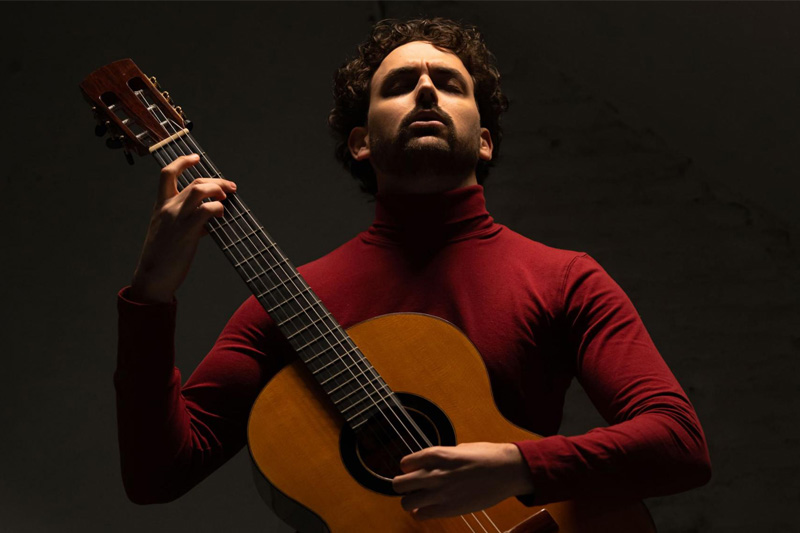
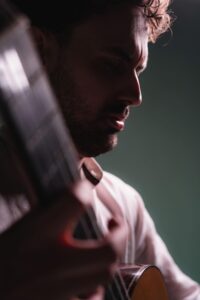
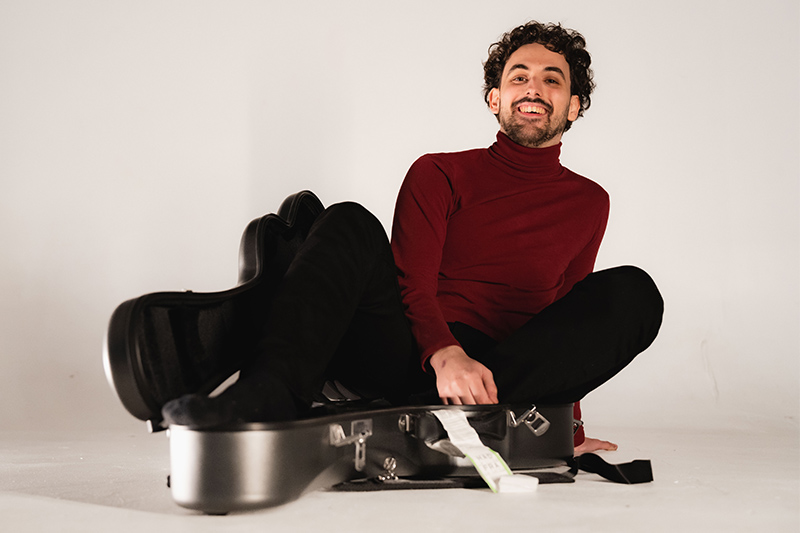
Toscano is the winner of a slew of international guitar competitions and is possessed not only of an assured technique, but of a sensitive and communicative musical personality. It was a delight to hear this concerto live in this venue for the first time in a great many years: as I have it, the last Rodrigo concerto we heard here was the Concerto Pastoral, performed by the SACM’s Liesl Stoltz in 2008.
The opening statements were beautifully crafted – the increasingly urgent strumming of the guitar being echoed in a pianissimo entry from the full string section of the orchestra. We heard the same effects in reverse at the conclusion of the movement, with a brilliantly decisive orchestral statement being echoed by a flamenco inspired guitar, before the quiet strumming of full orchestra returned and allowed Toscano a last, poignant farewell to the scene.
Orchestral string disposition was – if not quite full – almost so, which required the soloist to be amplified to achieve meaningful balance. It was largely successful (he wisely insists on his own microphones being used); but the clarity of sound capture notwithstanding, tonal balance was not entirely uniformly mixed throughout the instrument’s range and the guitar’s lower notes tended to come across somewhat unnaturally heavier.
The most fulfilling movement
There followed what is arguably the most fulfilling movement of the work: a soulful lament for guitar and cor anglais duet, with suitably restrained orchestral shading. The work is said to have had its genesis in the Rodrigo couple having lost their first expected infant to a miscarriage. The strong allusion to a religious Marian devotion in the writing may indeed reflect just such a sorrow. Toscano delivered it with a smouldering intensity that captured its depth of emotion, without ever falling into overly expressive characterization. Accompaniment matched suit and the account proved memorable.
The finale is a delightful bonbon; delicate, wistful and good-humoured but, again, without any undue jollity or back-slapping bonhomie. It asks technically severe questions of the soloist and Toscano responded with an account that was as leisurely assured as if he was playing for a group of friends sitting at a table laden with tapas. The orchestra seemed equally happy in that role; they played along in imitative fashion, savouring each passing episode with neatly sympathetic accompaniment.
I’d almost forgotten how captivating this concerto can be; this lovely performance has remedied that.
After interval, we were transported to the opposite end of Europe and to the sternly beautiful landscapes and unforgiving social order of Imperial Russia. Tchaikovsky’s “Fate” symphony is a work of extraordinary inventiveness that makes considerable demands on orchestral players in instrumental solos, declamatory fanfares, breakneck passage work and – notably – an entire movement devoted to pizzicato string playing (in which no bows are used, but the strings of the instruments are all plucked with fingertips).
This was a wonderful reading, Panteleev demonstrating not merely an intimate knowledge of the score but a deep understanding of its musical and emotional impulses. For all the brass outbursts – of which there are many – of the opening movement, it was the really distinguished delivery by the assembled string players of their frequently unforgivingly taxing parts that most impressed – even though the delicious pirouettes of clarinet and flute in the second subject was quite delicious.
Introductory oboe solo
The deeply melancholic Andantino featured a beautifully delivered introductory oboe solo, a theme equally alluring on its return at the end of the movement, now sweetly conveyed by delicate string playing, with filigrees of woodwind decoration as accompaniment.
The scherzo (the pizzicato movement) was as neatly precise as I have heard it, despite the urgent tempo adopted; and the characteristic crescendi and stresses were splendidly integrated into the overall musical pattern. The imitative episode for the wind band (their staccato writing as effective, if not as unusual) as the strings’ endeavours.
Finally, a raucous finale, in which the bleak landscapes and social melancholia of the earlier movements finally give way to something approaching unrestrained celebration. But this couldn’t be further removed from our evocative tapas patio and gentle happiness of Rodrigo’s gathering: this is the outburst of momentary happiness such as might be found at a peasant festival, the communal folk songs and vodka displacing at least for a while a pervading and relentless discontent.
The performance captured these elements in the abandonment of string passages delivered with finger-whizzing alacrity, in strident wind interpolations and in the unwelcome reminiscences of a baleful Fate, thundered out in some of Tchaikovsky’s most effective passages for the full brass complement.
What: CPO concert review Alvaro Toscano
Reviewer: Deon Irish
WS