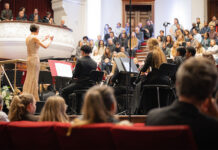
SYMPHONY CONCERT REVIEW. Thursday, 1 June, 2023. At The Cape Town City Hall. CPO conducted by Brandon Phillips, soloist Jeffrey Armstrong; Tchaikovsky: Capriccio Italien; Matthijs van Dijk: “Concerto”, for Violin and Orchestra; Mozart: Symphony No 41 in C, K.551 (Jupiter”). DEON IRISH reviews
The Capriccio Italien is a work that I – and a great many of my contemporaries – grew up with, through the medium of a set of 12 long-playing records published by Readers’ Digest and featuring a selection of “Light Classics”, which I received as a Christmas or birthday present.
The disparate variety of works contained in that collection had two common characteristics: they all featured memorable melodies and striking orchestration. I listened to them over and over and the consequence was to make familiar compositional and orchestral styles as varied as Mozart, Wagner or Ravel. I can’t help thinking that something of that nature would be of enormous benefit in contemporary South Africa.
Tchaikovsky’s memento of an Italian holiday was written in 1880, when the composer escaped the Russian winter for the relative warmth of Rome in February, with the pre-Lenten carnival season in full swing. The work is full of musical bits and bobs he heard or came across during this visit; the arresting opening trumpet fanfare being based on a bugle call he heard every morning from his lodgings in the Hotel Costanzi, adjacent to the barracks of the Royal Cuirassiers.
Final giddy outburst
The performance caught much of the vibrancy of the conception, the contributions of trumpets, horns, and lower brass in the opening measures certainly proving arresting enough. The succeeding somewhat lugubrious string melody was, however, rendered somewhat unstable because Phillips so toyed with the tempo that the distinctive brass rhythm in accompaniment became a bit of an ensemblic hit and miss.
The oboes’ catchy theme of the succeeding episode would have benefitted from greater prominence – and the whole tranche from greater forward propulsion. However, the full orchestral outbursts of the concluding tarantella fared considerably better, and Phillips conducted this section with assurance and with a pleasingly elegant style. The work concluded with a vigorously exhilarating acceleration into the final giddy outburst.
There followed the first performance of a new work for violin and orchestra, by Matthijs van Dijk, who is well-known in Cape Town as being a member of a distinguished musical family.
He terms the work – originally conceived for violinists Patrick Goodwin and Marc Uys (both now pursuing successful careers in North America) – a concerto for violin and orchestra, since sections of the orchestra are featured in much of the writing in what amounts to concertante roles.
A single movement
Van Dijk can be well pleased with the collaboration of Brandon Phillips and soloist Jeffrey Armstrong in this performance, since both self-evidently gave a great deal of time and thought in preparation of this premiere performance.
The work is conceived in a single movement, although it does fall into three segments that do approximate to the traditional concerto form, even down to a solo cadenza with a fine display of harmonics. The opening movement has plenty of interest, its very dramatic (and rather unforgiving for the soloist) opening giving way to some intriguing interplay between juxtaposed musical worlds – the soundscape of a rock band being suggested by the incorporation into the tonal scheme of an electric bass guitar, a piano and a drum kit.
Disparate, but assured writing
Whether this juxtaposition always works is perhaps questionable; certainly, the somewhat incessant and even relentless bass note does pall after a while. But, that having been said, the movement does feature some very disparate but assured writing – languorous, rather chant-like evocations being set off against tinkling percussion and glockenspiel; shimmering string chords alternating with pulsing tubular bells; and an ever more anxious violin solo being interrupted by brutal timpani strokes.
The orchestra does reach full-throated utterances, with the violin being assigned reasonably effective angular interjections – although here, and more particularly in the finale, balance between orchestra and soloist was to prove a recurrent problem.
The transition into the slow movement would be assisted by a clearer architectural delineation for, even in a work played without breaks between movements, some sense of transition is nevertheless required. Armstrong delivered the elegiac writing (I can’t really say theme) with elegant consideration and the accompaniment provided some effective colouration: but one must comment on the absence of a truly recognizable, linear melody. Whatever one can get away with in outer movements, it is hard to escape the need for a good tune in a slow movement.
After a few hesitant statements, the finale burst out in a virtual tarantella of moto perpetuo writing from the alternating elements of solo violin and orchestra. The violin’s passage work was, however, virtually inaudible against massive orchestral outbursts. Balance in this movement is a really big issue, Given the stated intention to give the piece a feeling of being performed in a cocktail bar, perhaps the solo violin should be miked? The orchestral writing is vibrant and works well and it would be a pity to diminish that side of the equation.
Enthusiastic audience response
These reservations aside, the performance received an entirely deserved and enthusiastic audience response, and one hopes that it might be programmed again in the not too distant future.
After interval, we returned to an almost wholly different musical world for the Mozart “Jupiter” symphony. I can’t count this performance an unqualified success. Not that it was badly played, for the orchestra showed every indication of careful preparation of phrasing and balances and delivered their contribution with generally pleasing cohesion. It was rather the general interpretive approach that seemed to miss the mark. In a word, it was a too Romantic, unashamedly lyrical interpretation of the piece.
I am one of those who subscribe to the view that Mozart should on no account be invested with a soft-centre quality, more befitting a Mozartkugel than a Mozart symphony. This particular symphony is not called the Jupiter for nothing: however inappropriate it might seem, the sobriquet does speak of its premiere rank amongst the composer’s essays in the genre, of its strength and conceptual stature. Indeed, even the principal theme of the Andante, with its off-beat stressed notes, eschews the winsome in favour of the decisive. Most importantly, and particularly in the final movement, the vast, contrapuntal rococo edifice is weakened by too saccharine an approach, precisely as sugar weakens concrete.
Perhaps some of this was reflected in a conducting stance which was overtly expressive, with Phillips at times resembling a Paganini without the violin. Music of this precision would perhaps better be served with a more analytical control and a greater attention to recreating the musical architecture.
So, for example, that very theme in the Andante was rendered somewhat spongy by the repeated application of a rather exaggerated decrescendo to the downward phrases, rather than just a slight release of melodic tension. It might sound like mere cavil – but it is these details that render performances good, bad or indifferent.
The Minuet and Trio had charm enough but suffered a lack of sinew in the softer passages – especially the deceptively delicate but in fact defining opening string phrases. The finale fared better in this regard, with some real energy and lively attack in evidence. However, things were not kept on a tight enough rein and – as the movement swept along – so did things manifest a degree of running away with the tempo. This inevitably gave rise to a certain lack of contrapuntal delineation, more particularly in those exhilarating scale passages.
Read Weekend Special’s interview with Jeffrey Armstrong here.
What: CPO conducted by Brandon Phillips, soloist Jeffrey Armstrong review
Reviewer: Deon Irish
WS