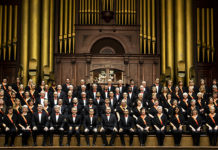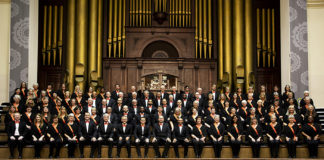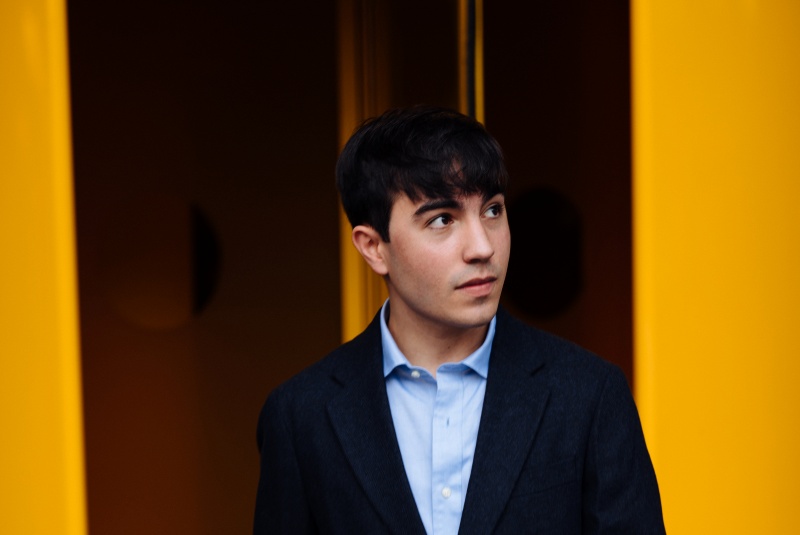
SYMPHONY CONCERT. Thursday 27 August, 2026. At the Cape Town City Hall; CPO conducted by Daniel Raiskin, soloist Leo Gevisser; Strauss: Don Juan, Op 20; Ravel: Piano Concerto in G major; Murphy: Dark Nights, Bright Stars, Vast Universe; Mussorgsky (orch Ravel): Pictures at an Exhibition. DEON IRISH reviews.
Having heard the Poulenc Concerto for Two Pianos in the last CPO season – a work we have not heard at this venue for many moons – it was the turn of the orchestra’s Ravel Piano Concerto parts to have the cobwebs blown off them for a long overdue reappearance. (I have it as having been last heard eighteen years ago to this very week, conducted by Theodore Kuchar, with Clara Würtz as soloist.)
Sophisticated elegance, witty charm
The work is undoubtedly one of the finest examples of the genre from the last century. It was written in the unstable years of the Great Depression, but its sophisticated elegance and witty charm are hardly reflective of those uncertain times. Ravel himself responded to criticisms that his music was “artificial” by responding, “How do they know that I am not by nature artificial?”
As to this remark, the composer’s biographer, Roland Manuel, perhaps understood it accurately: “Should his skill ever fail him, he can never plead sincerity as an excuse. Art …. is not, in his eyes, the supreme truth, but rather the most dazzling lie – a marvellous imposture.”
Many commentators identify in this concerto elements attributable to the composer’s 1928 American tour, and his visits to jazz clubs. There are some compositional elements characteristic of such; but the concerto feels far more at home in the sophisticated salons of Art Deco Paris, a world in which a fascination for things American was expressed more in the champagne cocktail than the Tom Collins.
The combination of conductor Raiskin and soloist Gevisser proved a worthy collaborative duo in engendering both the sophisticated witticisms and the flashy rhythmic brittleness of this attractive score; and both of the outer movements passed in a flurry of crisp finger work, scampering accompaniments and occasional bluesy excursions.
It was only the central adagio that ultimately disappointed, and largely for the reasons given in the above preface. I am not sure what mood Gevisser intended in the lengthy solo introduction to the movement, a soliloquy eventually broken by one of the composer’s most telling orchestral interpolations – a solitary high flute note that parallels the character Salieri’s emotional description of the opening bars of Mozart’s “Gran Partita” in the film, Amadeus.
This long cantilena, in its diffident gorgeousness, does not seek to achieve feelings of tragedy or even deep loss; if anything, it conveys the sort of transient emotion one might experience – appropriately fleetingly – as, cocktail in hand, one draws the evening curtains and shuts out the last of a lingering Côte d’Azur sunset. Gevisser’s account had all the restrained accuracy, but ultimately failed to capture that even more elusive atmosphere – perhaps attributable to an insufficiently legato line, particularly in the left hand.

Pictures at an Exhibition
Ravel’s other contribution to this programme was his quite splendid orchestration of Mussorgsky’s suite for solo piano, entitled “Pictures at an Exhibition”, portraying a disparate series of paintings by the composer’s friend, the architect Victor Hartmann.
It was Serge Koussevitzky who commissioned Ravel to orchestrate Mussorgsky’s suite (and who also, ten years later. persuaded Respighi to orchestrate Rachmaninov’s Cinq Etudes Tableaux for piano). This familiar orchestrated version was given for the first time on 3 May, 1923 – to enormous success.
I thought this a fine account, Raiskin self-evidently revelling in a score he knows well and enjoys conducting. The orchestra – by and large – matched his application, although there were – perhaps inevitably, given the unrelenting demands of the writing – a few concerning moments.
The opening Promenade was taken at a mercifully measured tempo. (So many of the more recent performances of this work we have heard have had the viewer hurrying through the imagined exhibition, rather like a tourist ticking off the entire Uffizi in the last couple of hours of a fleeting Florence stay.)
The succeeding portrayal of the Gnome was made particularly effective by really effective pauses in the portrayed narrative; and the Old Castle featured a beautifully delivered saxophone solo by McLure.
In the brisk depiction of the Gardens of the Tuileries, the loss of ensemble was perhaps a little too realistic a depiction of the disputatious children at play; but security was re-asserted in the ponderous depiction of the unstable wagon by Langford’s euphonium, making its insecure way through the rutted tracks of a Polish country road.
Winds came to a chirpy fore in the engaging Ballet of the Newly Hatched Chicks and the portrayal of the socially disparate Goldenberg and Schmuyle was notable for the stroke of genius employment of the muted trumpet to depict, not the self-important Goldenberg, but rather the importunistic Schmuyle, assuredly portrayed by principal trumpet Thomson.
The Marketplace at Limoges
The score of The Marketplace at Limoges (the picture in question portraying a gaggle of gossiping women) was annotated by Mussorgsky with an imaginary conversation: “Great news! M. De Puissangeot has just recovered his cow.”; and the score certainly captures something of the heady immediacy of that exhilarating news. This, again, was a movement in which execution did not achieve precise ensemble, making of the good women’s conversation an even more breathy fragmentation than the composer – or orchestrator – probably intended.
Mussorgsky then plunges the listener – with no real warning – into a catacomb (the relevant picture depicting Hartmann himself with a fellow architect in the Roman catacombs of Paris, led by a guide with a flickering lamp). The solemn chords of this depiction were certainly accurate in their delivery, but perhaps a shade too immediate in attack for the depiction of so insecure a destination, portrayed in such uncertain lighting.
The succeeding Hut on Fowls’ Legs, however, captured exactly the energy of Hartmann’s depiction of the popular character of Russian fable, Baba-Yaga: her hut, with its fowl legs, accelerating jaggedly through a bouncy take-off into wild flight through a portentous sky and leading seamlessly into a depiction of the Great Gate of Kiev.
This movement is based on Hartmann’s architectural design for a notional City Gate – one suggestive of a structure of great antiquity, with the old Slavonic (and hence Kievian) text of the Benedictus inscribed over its central arch. Music does not really get grander than this and the CPO players did it justice: all pealing brass and pounding percussion, emphatic string chords and colourful winds. It does, in large measure, really reflect the “dazzling lie” or ”marvellous imposture”, of which the composer stands accused; except that we, in our more flexible Age, understand it to be simply a glorious musical fantasy.
Aside from these two works, the concert also featured Strauss’s celebrated depiction of Don Juan, a character perhaps even more celebrated in music and musical theatre than in literature. Strauss’s father was a celebrated French horn player. (Even Wagner was said to be cautious around him: once asked whether he claimed to be the finest horn player in the world, the elder Strauss replied that he did not claim, but did admit that status.)
It is therefore not surprising that the composer’s published works include splendid passages of writing for horns – including two entire concertos of very different character. This early essay in dramatic depiction is no exception, with brilliant quasi-fanfare writing for full-throated horns, stirringly delivered by an on-form CPO horn section in this performance.
The other work on the programme left one with rather less abiding impression. Kelly-Marie Murphy is a Canadian composer and her self-described essay on the night sky and its vast implications is an exercise in orchestration that, whilst attractive enough, leaves one with neither heightened understanding, nor memorable utterance.
I do not blame Raiskin for any failure in this regard: whatever his terse rudeness in post-concert conversation might be, he displays no inability to communicate musical thoughts to great effect. The flaws must accordingly be laid at a composition which, whilst rich in sound effect, ultimately displays a lack of structural cohesion or melodic conviction.
Reviewer: Deon Irish
WS