SYMPHONY CONCERT. Thursday 9 April, 2026. At Cape Town City Hall. CPO conducted by Nicholas Chalmers, soloist Roelof Temmingh; Britten: The Young Person’s Guide to the Orchestra, Op 34; Temmingh: Piano Concerto No 1; Tchaikovsky: Symphony No 6 in B minor, Op 74 (“Pathétique”). DEON IRISH reviews.
One might assume that the inclusion of the Britten piece in this programme was thanks to Chalmers being its designated conductor. Known for his choral conducting, he made a great impression with his finely executed account of Walton’s “Belshazzar’s Feast” last year, and was duly invited back to conduct a two concert series which included Mendelssohn’s “Lobgesang” in the second concert.
For this, the first, we had as the concerto a welcome first Cape Town performance of an important South African work; and then the Tchaikovsky 6th Symphony, perhaps a curious choice, having heard the same composer’s 5th as recently as November and his 4th just two months earlier. Perhaps it was a case of wishing to close the cycle.
However, the Britten work was quite another matter. I cannot remember when we last heard it at a regular symphony concert. In 2007, in a review of a concert that included another Britten composition, I bewailed its long absence from concert programmes. I have not reviewed it since then. So it was more than welcome, and I was really looking forward to an informed reading from a conductor who surely evinced every qualification to do so.
A tour de force of orchestrational effects
The work is a tour de force of orchestrational effects and, in consequence, makes enormous demands of individual musicianship of almost every department of the orchestra. Other than perhaps violins, violas and celli, there is little place to hide for almost every other instrumentalist: being either assigned technically demanding solos or – as in the example of the double basses – a stern test of ensemble with very exposed, extremely wide-ranging melodic writing requiring precise intonation in delivering wide intervals and even harmonics.
I thought the statement of the opening Purcell theme, the Rondeau from his music for a play “Abdelazer”, was a little too brisk for the style of the writing, more particularly if one regards it desirable to replicate that tempo when its reappears in the marvellously chaotic amalgamation of disparate material in the finale, concluding the fugue.
Of the individual instrumentalists, the oboes and clarinets had particularly nice contributions, as did the imposing battery of percussion instruments. Chalmers – seemingly determined to maintain a burgeoning reputation as a pacemaker – set off the fugue at pretty breakneck pace, which was fine for most of the winds (the bassoons might have lost a few lower incisors).
However, difficulties emerged with some indifferent ensemble in the violins’ frantic scampering around to meet each other; and matters then became increasingly strident in the rather panicky whinnying of some of the brass contributions before they collectively pulled out of the chase to return to the relative grandeur their Purcell theme, leaving further delivery of the rather manic fugal writing to the rest of the orchestra. All very exciting, but one did think that a little speed control might have improved cohesion.
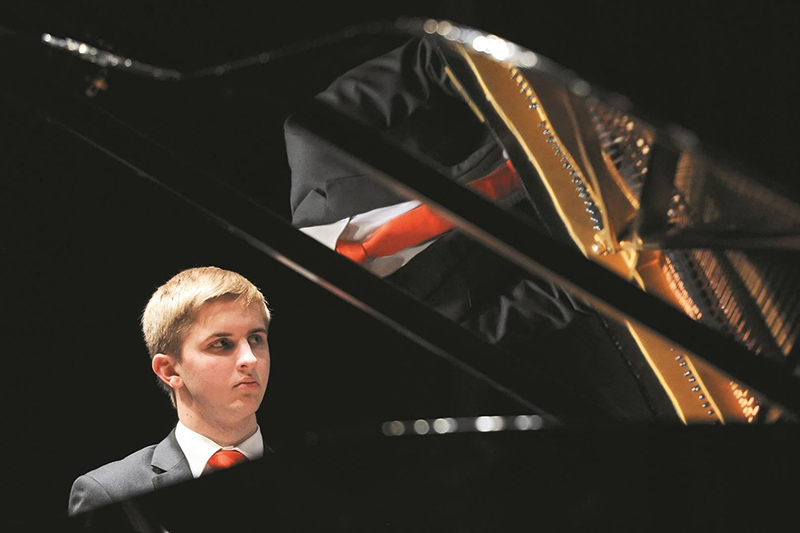
Piano concertos by Roelof Temmingh
There followed the first of the two piano concertos written by Roelof Temmingh (1946 – 2012), who for many years lectured composition at Stellenbosch University. The concerto, completed in 1995 on the composer’s 49th birthday, was premiered by Melanie Horne with the then TPO under the baton of David Tidboald. I believe that this is the first Cape Town performance, although the soloist has performed this work in Durban, .
As soloist, we were extraordinarily fortunate to have another Roelof Temmingh, the pianist son of the composer and his organist wife, Zorada. AT present resident in the UK, he has now played the work several times – including in competition performances in London.
There was something in the first subject material of the opening movement that called to mind another father/son combination: Dmitri Shostakovich, whose second piano concerto was written for his son Maxim’s 19th birthday. Perhaps is was the slightly astringent harmonies coupled with the perky pianistic writing.
However, the subsequent rather more introspective element – with its atmospheric string writing – was perhaps more Scriabinesque and the subsequent meno mosso episode even hinted at a Gershwin influence. It reinforced what has become a feature of the contemporary listening experience: given our generous exposure to a multiplicity of recordings in every genre and from every period, it is almost impossible to listen to any composition without hearing echoes of some other work.
A fluid reading
Temmingh demonstrated an assured familiarity with the score which enabled him to deliver a fluid reading which captured the architectural delineations of the piece very well; whilst some of the mood and colour episodes required subtle delivery, there was nothing subtle about the overtly Rachmaninovian passages, more particularly the very invigorating finale of the movement, its pianistic demands considerable and its effect brilliant.
The writing of the central slow movement struck one as differing significantly from the outer movements, perhaps because of a strong suggestion of serialism in the rather disjointed theme over a quasi-ground bass. The movement has a surprise – a central, presto episode, that almost startles in its sudden violent outburst before returning to the preceding languid reflection. The movement concludes with a passage of really distinguished writing: an arresting confection of descending piano musings over high violin harmonics.
Some stentorian horn calls set off the final movement, which then developed the material in a passage of almost Brittenesque colouring and irregular rhythms. Ensemble was crisply efficient: indeed, the orchestra here, as throughout, sounded very well-rehearsed by Chalmers and accompaniment was consistently grateful to the soloist in balance and ensemble. A repeat of the horn calls had the effect of a curfew, for all quietened down and a pervading sense of farewell permeated the succeeding measures – only to be dispelled by a final, brilliant piano excursion to bring the work to an emphatic conclusion.

Given its status as a programme rarity and the need to learn and perform it from scratch, Chalmers and the CPO had every good reason to share in the enthusiastic ovation given the performance by a packed City Hall. At least some of that applause may be attributed to the work itself. It is a fine concerto, and one that deserves repeated exposure as a significant South African contribution to the repertoire.
The concert concluded with the Tchaikovsky “Pathétique” symphony, which received a perfectly acceptable performance, but one which raised questions both in respect of interpretation and of execution.
Interpretive doubts lay in an overly lavenderized (is there such a word?) approach to the composer’s musical intentions. The subtitle of the work in its French translation suggests an evocation of pity; but the original Russian word employed by the composer means rather “passionate” or “emotional” and has no particular connotation of evoking pity. The death of the composer only nine days after the first performance (together with dark tales of Honour Courts, compelled suicide and the like) make the score a fertile ground for febrile emotionalism. But there is no actual evidence of any suicidal intent at the time of the actual writing of the work and, indeed, his brother noted him to have been in very good spirits in the period following completion of the work.
I thought there was a little of this overlay in Chalmers’ reading of the first movement. Everything perhaps a little too exaggerated: those hairpin crescendo and decrescendo markings rather too generously executed; rubati erring on the side of lugubrious; and so on. There is much darkness in this opening movement; but it seems to be more existential than the overt emotionalism encountered later in the finale.
I found the curious, hobbled 5/4 dance-like movement the most successful of the account, with a well-judged tempo pulsing away like a heart responding to adrenaline.
The celebrated scherzo movement sounded under-rehearsed and was taken at a questionably brisk tempo. The strings of the opening (and in their repeat) were simply never as crisply together as required; the wind chording in accompaniment equally uncertain.
Of course, things inevitably got even faster along the way and by the time those final, extraordinary brass measures were reached, the band had the bit firmly between the teeth and there was no holding them back – nor, it would appear, any real desire to do so. In the result, the whirling wind arabesques lost pulse and precision and the plummeting trombone scales surrendered the precision of barking machine-gun in favour of something akin to a musical foefie slide.
The Adagio that concludes the work was well played and true to the writing in the depth of emotion it explored. The trouble was that, having already been given such a dose of these very elements in the account of the opening movement, the impact of this finale was greatly reduced by coming across as somewhat repetitive.
What: Pianist Roelof Temmingh, CPO
Reviewer: Deon Irish
WS