CONCERT REVIEW. CPO Spring Symphony Season “Resonance and Reflections”. At Cape Town City Hall, 3 September 2026. Cape Town Philharmonic Orchestra; Daniel Raiskin (Conductor); Jordan Brooks (Violin) CPYWE; Charlene Verster (Conductor). Works on the programme: Swearingen Blue Ridge Saga for Wind Ensemble, Pärt Cantus in memoriam Benjamin Britten, Britten Violin Concerto Op.15, Schumann Symphony No. 3 Op.97 “Rhenish”. ALBERT COMBRINK reviews.
By the looks of it, an eclectic selection of works, spanning a range of musical styles, this programme had one curious about what the overall experience would be: a contemporary work for an unusual orchestra made up of only wind instruments, followed by its tonal polar opposite, a short Estonian work for strings only, leading to an intense, modern violin concerto, and culminating in a meat-and-potatoes romantic symphony. As it turns out, the programme had a delightful logic, and despite – and perhaps because of – the timeline bouncing around between modern and romantic, made for a satisfying evening at the symphony.
The City Hall looked festive in lights and flowers, with Fine Music Radio 101.3 presenter Rodney Trudgeon and Production Coordinator Mawande Lobi at their live broadcast station situated next to the organ. The ‘new look’ printed programmes clearly brand the soloist and contain interesting information about the CPO’s activities, such as their new Cadet Programme, an important bridge between tertiary study and professional orchestral life.
“Commitment to regeneration by empowering the next generation” is not just an idea thought out in a boardroom, it is simply going to be the path to a sustained music industry in South Africa. The programme even has a “Meet Our Musicians” feature which highlight individual players.
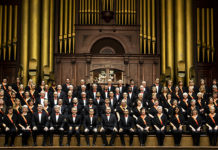
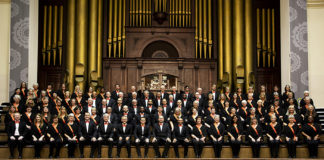
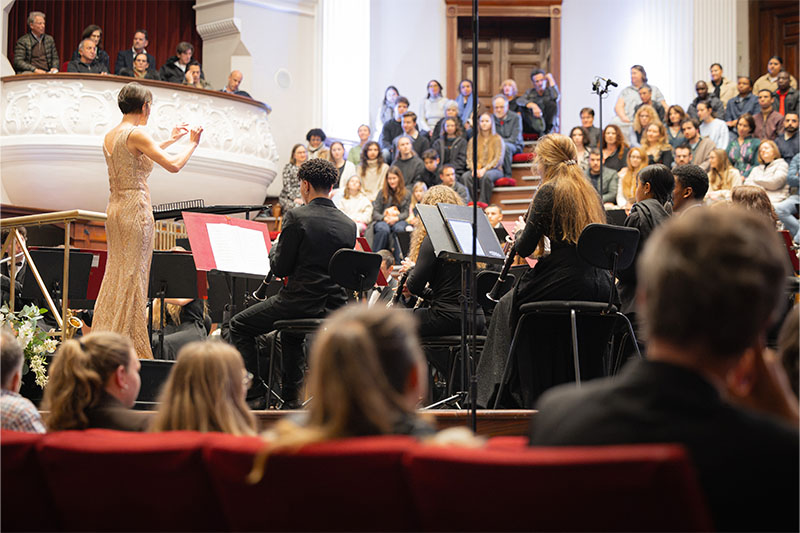
Conductor Charlene Verster, heading the Cape Town Philharmonic Youth Wind Ensemble since 2024, continues to lead these young musicians to new heights. Her choice of repertoire is always level- and age appropriate and her confident, no-fuss conducting always results in crisp ensemble and solid rhythmic work. James Swearingen (b. 1947), Professor Emeritus at Capital University in Columbus, Ohio, is a well-known composer in the wind band world. His Blue Ridge Saga (1990) draws on the spirit of Appalachian folk music. As always, with a youth orchestra, there was a wayward pitch or timbre that will be refined with time. But the 6-minute suite was engaging, light and entertaining, an ideal hors d’oeuvre for the serious works to follow.
The deeply moving Cantus in memoriam Benjamin Britten was written in 1977 by Estonian Arvo Pärt (91), shortly after the death of one of the UK’s greatest 20th century composers, as a deep personal tribute: he greatly admired Britten’s music and felt it possessed an “unusual purity”, a quality to which he aspired in his own music. It remains one of Pärt’s most famous and frequently performed compositions. It is quite startling to encounter the work “in the wild”, live on stage, as opposed to a home sound-system.
A perfect example of Pärt’s tintinnabuli compositional style, it uses bell sounds; very simple, almost traditional harmonies; and repeated, mostly stepwise melodies. On CD it is easier to separate the layers and use volume-sliders to highlight this melodic movement or that, while in the City Hall, the building acoustics become another instrument, creating swirling clouds of sound rather than distinct melodic ideas – simple as they are: repeated A Minor Aeolian scales dripping slowly, like honey from the comb. An unusual piece to hear live, and surprisingly effective, and hitting its emotional mark as the audience were genuinely caught in the spell, with a long reverent pause before applause. Family, perhaps, of Barber’s famous Adagio, it is good to encounter important repertoire such as this, in live concert.
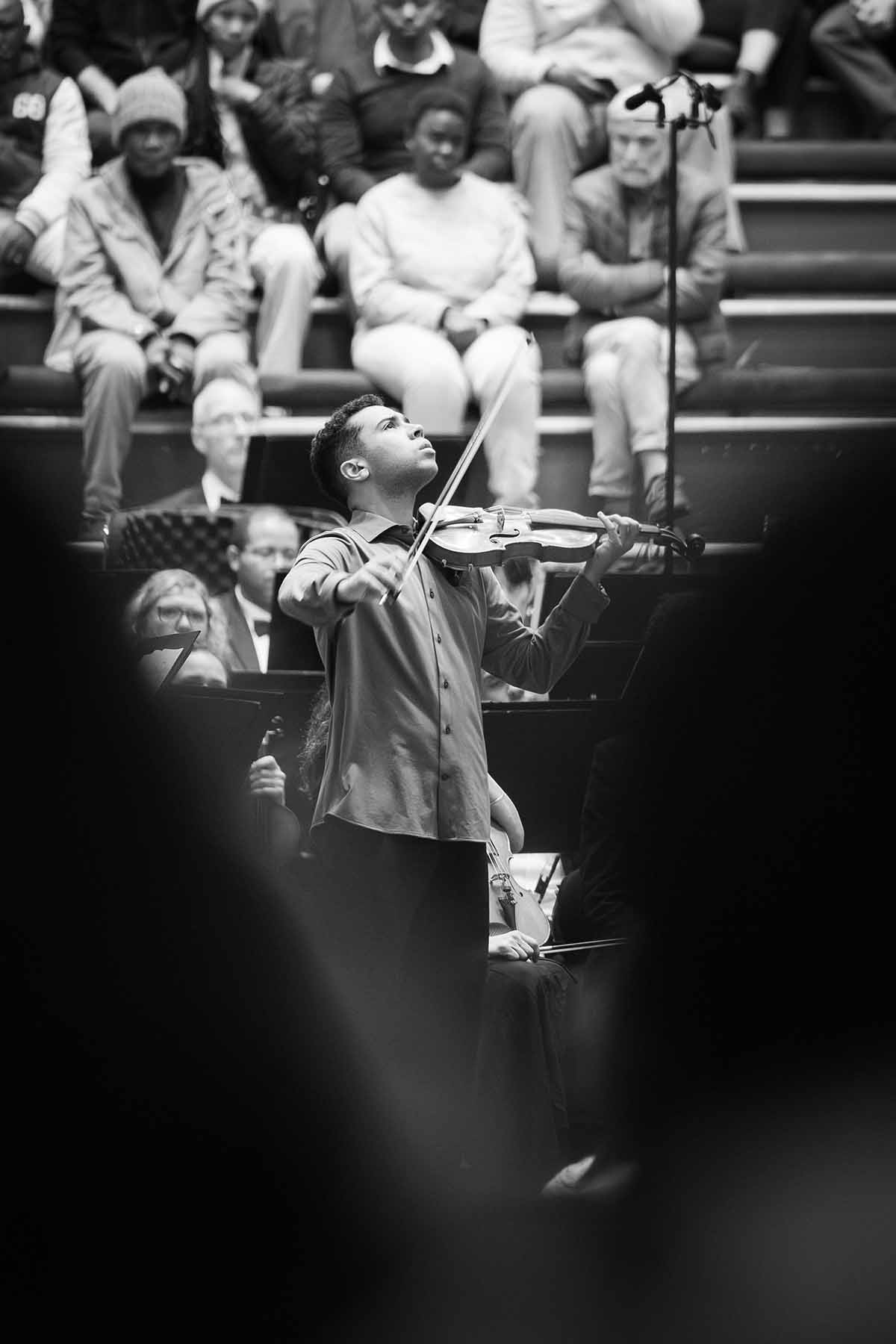
Violinist Jordan Brooks
South African violinist Jordan Brooks already has an impressive CV: former CPYO concertmaster who performed as a soloist with the CPO many times since he was 11, he won the Joseph Bologne International Violin Competition in France in 2025. Jordan left SA to study at the Royal College of Music on full scholarship and won the National Youth Music Competition in 2019 as well as being the strings category winner of the 2024 Royal Over-Seas League Annual Music Competition and performed in the Wigmore Hall. Jordan was concertmaster of the CPYO from the age of 13 until he left in 2020 to study on a full scholarship at the prestigious Chetham’s School of Music in Manchester before moving to the RCM.
The Britten Violin Concerto is rarely heard live, and is often described in terms of what it is not: it isn’t a big-boned, big-tuned concerto like the Brahms or Tchaikovsky; it is neither the dramatic landscape of Sibelius nor the quasi-cinematic narratives of Barber or Korngold. But what it also is not, is gnarly, discordant and acerbic like other concertos of the second world war. Initially neglected, because it departs from flashy romantic traditions and ends in quiet melancholy rather than a triumphant roar, it has recently earned its rightful place in the repertoire, through championing by modern soloists.
Brooks made a most beguiling case for the work: a completely relaxed but deeply lyrical violin sound sang the opening love songs into the space, with total ease and confidence, with nary a second thought to the technical challenges of the stratospheric range or double stops. Brooks always produced an attractive sound, which remained comfortably audible above the orchestra, at all times, despite percussion and colourful orchestral writing, busily at work throughout the entire piece.
Brooks has a distinctive timbre that will remain long in the memory, as will his playing, somehow never overcompensating for the work – pushing neither the melodies nor the virtuosic writing for audience display. Simple musicmaking, and some very real chamber music moments between the soloist and orchestra, made this an unexpectedly memorable first live encounter with this work. There is simply something magical about those violin notes hanging suspended in mid-air in the vast space of the City Hall. The timpani heartbeat was mesmerising from first note to last, and the orchestra and soloist managed the ending in a deeply moving manner: reaching for resolution and perhaps getting there, perhaps letting it slip away, with the sound simply dissolving into thin air in the heartfelt final tableaux. Exquisite playing.
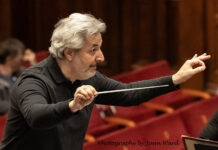
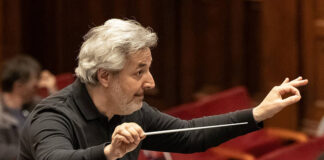
Conductor Daniel Raiskin
If I have not mentioned St. Petersburg-born conductor Daniel Raiskin, yet, it is not because his contributions were not noticed in the first half. He controls the performance in great detail, while simultaneously not appearing to inject himself into the process, thus projecting the music without attracting attention to his own role in the proceedings. The third of Robert Schumann’s four symphonies, the 1850 Symphony in E Flat Op.97, nicknamed the Rhenish, turned out to be an unexpected delight. After the rarified sound clouds of Pärt and the highly sculpted transparency of the Britten, a historical U-turn to meaty, romantic, Germanic repertoire – a five-movement symphony, no less – might seem counter-intuitive. But what a thrilling final serving it was, perfectly balancing the intellectual and emotional heavier first half. Raiskin lived 50 meters from the Rhine river in Koblenz, and claims a deep, personal connection with this symphony.
The work launched forth with confidence – and of course there is an instant double-take as Schumann start his rhythmic shenanigans almost right off the bat. Regarding Schumann’s skills – or lack thereof – as an orchestrator, too much ink has been spilt by people pretending to be clever. In Raiskin’s hands, the work presented itself as a work of pure genius. Transparent textures with writing that is not overly string-heavy, and enthusiastic and life-affirming contributions from all sections of the orchestra, all whisked together at a brisk-but-not-hysterical tempo, made for an absolutely delightful romp along the Rhine. Crucially, the orchestral balance seemed ideal, with brass providing gleam and substance, present but never in danger of overplaying the ensemble.
Where the brass was prominent, it made a significant contribution: the horn section started showing their gold in the first movement, shining a light on that warm heart of the romantic orchestra with bold confidence. Given the technical demands, many conductors tone down the horn writing in the second movement, but Raiskin did the opposite, treating them as a concertante soloist. And they rose to the occasion, with repeated leaps up into the stratosphere. Thrilling playing. One can see Schumann had been inspired the year before, to write his 1849 Concertstück, Op.86 for four horns and orchestra, for the superb players of the Leipzig Gewandhaus Orchestra. The new valve-horn had only recently been invented, allowing it to play a wider range of notes, in all keys. I do not recall the horns being this prominent in most recordings, and their joyful virtuosity was thrilling.
The fourth movement, inspired by the Cologne Cathedral, with superb trombone trio, hit the spot, creating an ancient, ecclesiastical atmosphere of a church procession without turning it into a sermon. The final Lebhaft movement was as lively as one could dare, taken at quite a speed, but never sounding frazzled. By the end of the symphony, one felt uplifted and elated. One could ask for nothing more.
The Next CPO Symphony Concert: 10 September 2026 at 19:30
Cape Town City Hall
Conductor Daniel Raiskin
Soloist Lisa de la Salle (piano)
Rachmaninoff Piano Concerto No.3 in D Minor, Op. 30
Shostakovich Symphony No. 15 in A Major, Op. 141
Book here.
Reviewer: Albert Combrink
WS