[star rating=”4″]
DETROIT. Directed by Kathryn Bigelow with John Boyega, Will Poulter, Algee Smith, Jacob Latimore, Jason Mitchell, Anthony Mackie and Hannah Murray.
KAREN RUTTER reviews
Detroit is not an easy film to sit through. It’s brutal, and shocking, and heart-breaking. Most scarily, it’s all too familiar. Based on Detroit’s 1967 12th Street riots, director Kathryn Bigelow and writer Mark Boal (who worked previously on the muscular hits The Hurt Locker and Zero Dark Thirty) have put together a production that melds facts, archival footage and fiction. Some of the narrative is the straight truth – how the riots began, how officials responded. And some of it is a dramatisation, based on happenings in the Algiers Motel where three young black men were found killed. It is the latter segment which features the most horrific scenes – and possibly the most problematic, on some levels.
A civil war zone
The riots in 1967 were sparked when police raided an illegal club where celebrations were underway to welcome home black veterans from the Vietnam war. While the raid was ostensibly legitimate, the humiliation of the club’s patrons was unduly harsh, inciting onlookers to throw rocks at the cops and later start fires. Looting followed, and when the local law forces were unable to maintain order, the National Guard and army paratroopers were called in. Detroit’s streets became a civil war zone.
Bigelow and Boal begin the film with this narrative, quickly establishing a context. Then the film follows an aspiring black R & B band who come to Detroit to make their fortune, but get caught up in the riots. They escape and split up , with two of the band members, Larry Reed (Algee Smith) and Fred Temple (Jacob Latimore) renting a room in the Algiers Motel. Here they link up with Carl Cooper (Jason Mitchell) and Aubrey Pollard (Nathan Davies Jr), and party girls Julie Ann (Hannah Murray) and Karen (Kaitlan Dever).
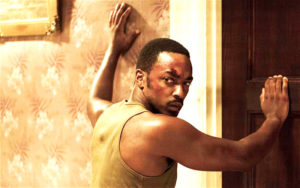
Whilst hanging out, a prank goes horribly wrong, incurring the wrath of a squad of local police led by Phillip Krauss (Will Poulter). He lines the six young people up against a wall in the motel, and the terror begins. Krauss is ostensibly in search of what he thinks is a sniper gun, but in reality is driven by race hate, fuelled by the fact that the two young girls (who are white) are hanging out with black men. The “interrogation” lasts for what feels like hours of extreme humiliation and fear and helplessness. At the end of the night, three men are dead.
There is a court case, in which Melvin Dismukes (John Boyage), a black security guard who witnessed the events, is accused of murder. Without bringing on a spoiler alert, let’s just say things do not end happily.
Detroit is a searing, roiling movie which evokes many emotions – amongst them anger, sadness, and hopelessness. One of its central themes is that we fail to learn the lessons of history, and the release of this film in the aftermath of the Charlottesville protests, and in the context of the Black Lives Matter movement, and further back to Alton Sterling, Philando Castile and Rodney King is particularly poignant. Yes, Detroit is hard to watch – but it’s important to watch, too.

Controversial
That said, there has been criticism levelled at Bigelow and Boal. Some of it has to do with them being white people telling a black story. Some of it has to do with using the riots as a backdrop to what is essentially a horror movie set in a motel. Some of it is concerned with the fact that black people are primarily portrayed as victims throughout. And that there is not one black woman’s voice that is heard.
All valid points, and I would recommend reading John Sims’ review on Al Jazeera for a really good perspective.
But don’t let it stop you from seeing this film. As South Africans with an abhorrent past, we are all too familiar with the scenario.
What: Detroit
Release date: Friday, 18 August, 2017
Run time: 143 minutes
Rating: 16 L N S
WS