 Social critique has always been currency for film and documentary makers, and movies selected for National Arts Festival 2017 highlight film’s role as a ‘disruptor’ of the mainstream narrative.
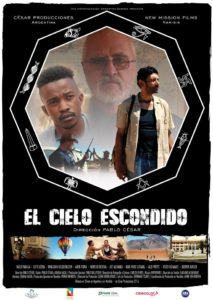
JANE MAYNE chats to longstanding film buff, Trevor Steele Taylor, who curates by pulling together a programme which underscores movies about conflict and war (John Pilger’s The Coming War On China, Wolfgang Staudte’s The Murderers Among Us); resistance (Michael Verhoeven’s The White Rose); and politics, freedom and dissension (Akong – A Remarkable Life; The Hidden Sky by Argentinian director Pablo Cesar).
“My aim is to show films that confront issues and engage thought, instead of being co-opted and compliant,” says Steele Taylor. “Life seen as investment aspiration has become the narrative, so films like these highlight the dispossessed who are not aspirational – so that’s what I had in mind”.
 A flick through of global news channels mostly shows the same content projected out for mass consumption. Who’s really shaping ‘The News’? “Some are hiding in plain view: Murdoch, old boy’s schools, the banks, financial institutions, and the whole ugly capitalist world view. Sometimes I lose hope entirely and other times I’m surprised. I loved it when Trump turned on CNN and said ‘You are fake news’. As are the BBC in pushing their own agendas.”
Powerful new South African cinema at this year’s NAF includes Kalushi: The Story of Solomon Mhlangu, Meg Rickard’s Tess, Daryne Joshua’s Noem My Skollie, and SifisoKhanyile’s Uprize!, which explores the world that shaped the students of 1976.
The programme also includes a tribute to Freddy Ogetrop, a film librarian at the Cape Provincial Film Library. This tribute screening features some of the treasures he collected over 40 years at the library, including a very rare film by Marcel Ophuls – A Sense of Loss.
“Freddy quietly worked away as a librarian, and he convinced the library in the deep apartheid years to buy films. Some have degenerated over time, and some are the only left in the world.”
 Steele Taylor currently teaches Essential Cinema at a film college in Pretoria. “People like Pasolini, Sam Peckinpah etc – it’s incredible how the icons are quickly forgotten. They’ll go as far back as Spielberg, and some they’ll download from YouTube. Although sometimes I’m surprised to find rarities like Gates to Paradise on YouTube.”
For the full NAF screening schedule see the arts fest magazine or web site. Here are some highlights relevant to the theme of Disruption, in addition to Ken Loach, Fellini, Korea and South African themes.
Discombobulating mainstream narratives – A handful of highlights
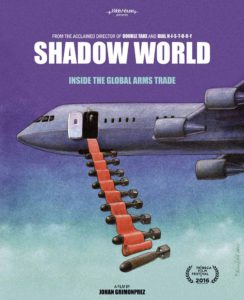
SHADOW WORLD: Belgium/USA 2016. Director: Johan Grimonprez.
Based on one-time ANC parliamentarian and whistleblower Andrew Feinstein’s mammoth expose of the international arms trade – a business that counts its profits in billions and its collateral damage in human lives. The film unravels a number of the world’s most corrupt arms deals through those involved in perpetrating and investigating them. It illustrates why this trade accounts for almost 40% of all corruption in global trade, and how it operates in a parallel universe in which the national security elite who drive it are seldom prosecuted. Moreover, the film looks at the way that the arms trade is inextricably linked to governments to the point that they are part of the establishment who dictate what goes down. Andrew Feinstein will be present for a Q & A at both screenings. Running Time: 94 minutes
THE KILLING$ OF TONY BLAIR. UK 2016. Directors: Sanne van den Bergh, Greg Ward. With: George Galloway, Stephen Fry, Tony Blair.
The story of Blair’s destruction of the Labour Party, his well-remunerated business interests, and the thousands of innocent people who have died following his decision to invade Iraq. George Galloway eviscerates Blair, pretty much every aspect of his premiership; such complete takedowns of one politician are quite rare. While there is a great deal of focus on Blair’s engagement in the Middle East, there’s also much on the astonishing amounts of money Blair has made. An odious piece of work! Running Time: 95 minutes
WE ARE MANY. UK 2015. Director: Amir Amirani. With: Ken Loach, Mark Rylance, John le Carre, Desmond Tutu
The story of the biggest demonstration in human history, which took place on 15 February 2003, against the impending war on Iraq. A powerful, intelligent documentary around the huge effort to head off the start of the Iraq war, and the lingering echoes coming down from the protest marches of tens of millions in hundreds of cities of around the world on Feb. 15, 2003, the largest world-wide protest ever. At a moment when it feels like peaceful protest and citizen empowerment movements are all but pointless and impotent, the film is a welcome balm pointing out that the reality is more complex, and giving up in despair is neither wise nor called for. Running Time: 110 minutes
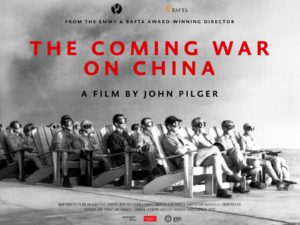 THE COMING WAR ON CHINA. UK/Australia 2016. Director: John Pilger. With: Franklin Blaisdell, James Bradley, Bruce Cumings
Pilger’s 60th film for ITV. he reveals what the news doesn’t – that the US and the world’s second economic power, China (both nuclear armed) are on a trajectory to conflict. This details the greatest American-led build up of forces since the Second World War, an insane bit of posturing in which Russia and China are encircled by a nearly unbroken necklace of warheads, fleets and military bases, all capable of strangling trade, cutting off oil networks and instigating outright Armageddon. Duration: 113 minutes
THE WHITE ROSE. Die Weisse Rose. Director: Michael Verhoeven. With: Lena Stolze, Wulf Kessler, Oliver Siebert
This underground student group which originated at Munich University in 1943, kept a brave resistance to the Nazi narrative until they were rounded up, convicted in a kangaroo court and promptly guillotined. Their example of resistance to overwhelming tyrannical political systems has been an inspiration to activists ever since, including our own Helen Joseph and the White Rose, in however particular a moment, was living proof that not all Germans during the Nazi years were compliant. Duration: 123 minutes
THE MURDERERS ARE AMONGST US. Die Morder Sind Unter Uns. DDR 1946. Director: Wolfgang Staudte. With: Hildegard Knef, Elly Burgmer, Erna Selmer
The first film to be shot in East Germany after the war, this striking evocation of the landscape of rubble in East Berlin and the fractured state of a society only recently liberated by the arrival of Soviet troops is a classic of post war cinema. A woman returns from a concentration camp to discover that her apartment, in ruins, is being lived in by an alcoholic doctor, driven deep into cynicism by what he has seen. When he discovers that his former commander, Ferdinand Bruckner who was responsible for the massacre of 100 civilians in Poland is still resident in Berlin, they set out to unmask him. Duration: 85 minutes
GERMANY IN AUTUMN. Deutschland im Herbst. Germany 1978. Directors: Rainer Werner Fassbinder, Volker Schlondorff, Alexander Kluge, Edgar Reitz, Heinrich Boll. With: Angela Winkler, Helmut Griem, Heinz Bennent
A unique to document of 1977 – the year of middle-class Germany rocked by the activities of the Baader-Meinhof Group (Red Army Faction) and their escalating war on the wealthy indolence of Capitalist Germany, re-inventing itself from its Nazi roots. Duration: 119 minutes
What: National Arts Festival Grahamstown
When: 29 June – 9 July, 2017
Book: www.nationalartsfestival.co.za
Social media: www.facebook.com/nationalartsfestival, Twitter: @artsfestival
Web: www.nationalartsfestival.co.za
WS