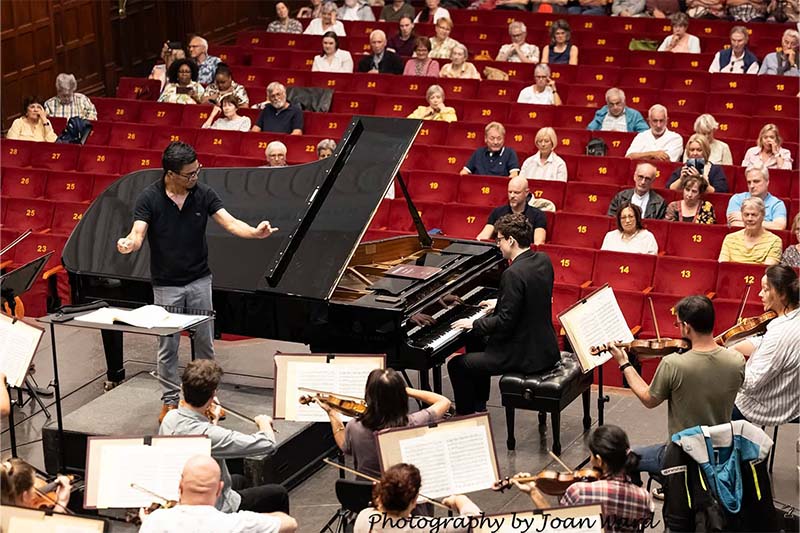
CONCERT REVIEW: FOM BENEFIT GALA. A tribute to Ruth Allen in the CPO Summer Festival. At Cape Town City Hall. On Thursday 16 January 2026. Pianist Alexander Ullman (Soloist) with the Cape Town Philharmonic Orchestra conducted by Jonathan Lo. ALBERT COMBRINK reviews.
The “Friends of Orchestral Music” benefit gala concert, opened the CPO’s 2026 season, in memory of Ruth Allen who was involved with the CPO for 40 years as board member and chairperson. In her honour, Elgar’s “Nimrod” from his “Enigma Variations”, was played.
“Nimrod” is one of those pieces that has taken on a life of its own, outside of the original work it for which it was composed: we love it – of course – and its very deep and moving “sweep”, has made it a memorial and funeral anthem, in its own right. Therefore, hearing it – much like Barber’s “Adagio” – brings up many extra-musical connotations. The danger is that these connotations can obscure the music.
An other-worldly pianissimo
I settled in for “another Nimrod”, prepared for it to be well-played, and of course, well-placed and appropriate for the occasion. What I was not prepared for, was the instant effect of the opening: an other-worldly pianissimo that gathered the audience up and condensed all attention and energy to focus on that first, pure sound, and with it, a very clear emotional content that the audience could perceive in an instant – even without the context of the tribute or the original work.
That hushed, quiet vibration, turning into a single pitch, which then flowers into an extraordinary surge of emotion, was handled perfectly by conductor Jonathan Lo and of course, the CPO responded magnificently. Pity the brass stubbed a toe on their way in the door, but other things made up for that: textures were crystal-clear, and details such as the double basses anchoring the counterpoint, were fresh to the ear.
Each new billowing of the melodic wave grew in intensity with a sense of appropriateness: un-hurried and completely natural. Every swell became brighter in colour until the last one where the ship sails triumphantly in a golden sunlight, as only Elgar could have painted it. Deeply affecting. The emotional impact is, of course, calculated and executed with a steely grip on the resources, both by composer and conductor, but the art lies in letting the audience experience the effects of the craft without noticing the craftsmen.
Not noticing the craftsmen was a little harder to do in the “Academic Festival Overture” Op.18. At 47, Brahms was the most famous he had ever been: he had made the treacherous and often career-ending transition from child prodigy (excelling at piano and violin and playing his own First Piano Sonata in public at age 12), to an established and recognised composer of a gargantuan First Piano Concerto and two Symphonies through which he was already defining what was to become the modern “Symphony Orchestra” . Breslau University chose to honour him with an “Honorary Doctorate of Philosophy”.
Brahms wrote a POSTCARD to say: “Thanks Very Much” – the equivalent of “If there isn’t a cheque attached, I think I’ll skip your party”, but his friend, the conductor Bernard Scholtz, insisted that he write something for the occasion, saying:” Compose a fine symphony for us! Just make sure it is well orchestrated, old boy! Nothing too thick and heavy!” Brahms responded with the “Academic Festival Overture”.

The title says it all
“Overture” – it is a single-movement, stand-alone work.
“Festive” – using the largest orchestral forces to date, Brahms threw in everything from bass drum to contrabassoon, and cymbals – rare for Brahms.
“Academic” – While it sounds like a loose, episodic concert piece, it is, in fact, a tightly-controlled and intricately academic, formal structure, using a myriad of musical tricks-of-the-trade such as fugal writing or using the harmony of one song to accompany the melody of another. There is also the matter of Brahms using banned political student songs that reference the Unification of German Municipalities, resulting in the Vienna premiere being halted by police.
Today, we know this piece as an irreverent, “Gaudeamus Igitur” party-pastiche. But somehow Jonathan Lo avoids the stereotype in all he does. The work was not played for comedic or even light-hearted effect. He takes it deadly serious from the opening, with unexpectedly brilliant results. This performance, with some dreamy flute-passages and well-balanced brass, seemed to recall the Flying Dutchman (already 40 years old, at this point!). There was a gravitas to its opening sections which made the triumphant C Major finale even more “Maestoso”.
 International Franz Liszt Piano Competition
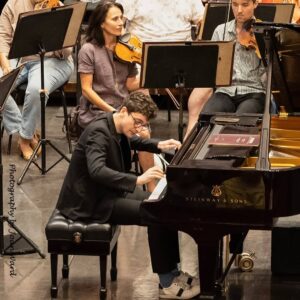
Pianist Alexander Ullman, winner of the 2017 International Franz Liszt Piano Competition, performed Beethoven’s Piano Concerto No. 5 in E flat, Op73, nicknamed the “Emperor”, because it was simply the biggest, longest, most difficult and loudest of all piano concertos ever heard. But, importantly: heard up to that time. Musically, a lot has happened in the 217 years since its premiere in 1809. Primarily, we have been fed a steady diet of Grieg, Schumann and Rachmaninoff concertos, written for, and played, on modern concert grands. And of course, we hear and consider the “Emperor” in the company of these works. A loud, big, dramatic work pitting orchestra against soloist in a heroic battle for supremacy: one where the pianist – an indefatigable hero – stumbles to their feet, bloody and sweaty, to the screaming adulation of the crowd, for having vanquished the power of the orchestra with some thundering octaves.
Beethoven, however, wrote these concertos for the forerunner of the piano. While this work obviously pushed the boundaries of that instrument to the limit – and beyond – its capabilities, it is a fact that the “PianoForte” as we know it, would not be invented for at least another decade. And of course Beethoven wanted a bigger sound than his instruments could produce. His own deafness aside, he was known from eyewitness accounts to be hard on his hardware: the instrument manufacturer Johann Andreas Stumpff described one of Beethoven’s pianos as a “ruin” with “the broken strings in a tangle, like a thorn bush whipped by a storm”. Composer Anton Reicha, a friend and page-turner for Beethoven during a concerto performance, recalled being mostly occupied with “wrenching the strings of the piano which snapped, while the hammers stuck among the broken strings”.
Ullman has power and strength in reserve. What made his performance a stand-out was his willingness to eschew the volume and romantic drama for something altogether more intimate, and disarming. The performance seemed to reference the concertos of Mozart rather than Brahms, which would not appear for another half a century. When Ullman entered – in bar 1 – I made a mental note: his unusual phrasing shaped the sweeping arpeggios rather than throwing them at us in an avalanche. At his first entrance after the orchestral exposition, I made another mental note to mention his heart-stopping diminuendo on the trill, so unexpected and so exquisite, and so unaffected as I have seldom heard it. I gave up trying to make notes to mention after that, because this performance simply yielded a treasure-chest of noticed details, uncovering gentleness and tenderness and subtlety in phrases where one has grown accustomed to not finding them.
This was simply one of the most interesting concerto performances I have ever heard live: agree with his concept or not, the pianist was impossible to ignore. I found myself so focussed on his musical ideas that I occasionally forgot to take in the orchestra. This is a compliment to them, with Jonathan Lo and the CPO supporting him without trying to interject themselves into the conversation. Yet, at some points, the work felt like chamber-music, with Ullman and certain orchestral musicians sharing a musical idea and shaping it with great care. Of course there were moments. “That” famous passage in the first movement with the crazy left hand, where something always happens? Well, something happened. And it happens twice in different keys! Noted. But not derailed. Without skipping a beat, we stayed on the trajectory. The slow movement was exquisite. Such beautiful piano sounds! From a hushed whisper to aquatic arpeggios, all wrapped up in a cozy blanket that said that we had nowhere else to be. What a treat to hear a familiar war horse rethought with love and care for the musical details. The encore, Liszt’s “En rêve” (Nocturne), S207/R87 was quiet, intimate and tender. Ullman is a musician’s musician.
When the orchestra is happy, it seems to generate extra overtones. I felt that tonight. From the first notes of Antonín Dvořák’s Symphony No.8 in G Major Op. 88, Jonathan Lo had an extraordinary ability to make the music flow “naturally”. While he obviously had a tight grip on the rails, he seemed to let the orchestra find its happy-spot, expressively speaking. The symphony abounds with solos, from the quirky bird-call of the piccolo (does it really play only once in the symphony?) and the cor anglais (ditto…). The orchestra just seemed to be very happy to be expressive in a way that felt elevated. Many details were deeply affecting: In the slow movement, duetting clarinets make a quiet echo of a little gypsy/folk theme; garlands of runs from the flute, shaped with a little stealing of time and volume at the end, and many more.
Jonathan Lo also has the ability to make everything he conducts, feel like it could be choregraphed and danced to. To quote Rafel Kubelik, as quoted in John Woodland’s excellent pre-concert talk: “In Bohemia the trumpets never call to battle; they always call to the dance!” Speaking of trumpets: Jonathan Lo seems to have the balance issues of the City Hall sorted. Once or twice in the first half, I felt that perhaps I would like the “treble” turned up on the violins, just to give them a bit more bite, but the warm luscious textures were a joy. And to hear the orchestra play a true pianissimo, one that carries out the back door and into the foyer, is a very special sound to experience live.
Jonathan Lo will conduct two more concerts in the CPO Summer Season 2026.
Upcoming CPO concerts
Thursday 22 Jan, 2026
Cape Town City Hall 19:30
JONATHAN LO CONDUCTOR
RYOKO YANO VIOLIN
Mozart Symphony No. 31 in D Major, K. 297 “Paris”
Saint-Saëns Violin Concerto No. 3 in B Minor, Op. 61
Debussy La Mer
Ravel Boléro
Thursday 29 Jan, 2026
Cape Town City Hall 19:30
JONATHAN LO CONDUCTOR
LOTHAR HENSEL BANDONEON
Gershwin Cuban Overture
Piazzolla “Aconcagua” for Bandoneon and Orchestra
Copland El Salón México
Respighi Pines of Rome
What: FOM Benefit Gala review 2026
Reviewer: Albert Combrink
WS