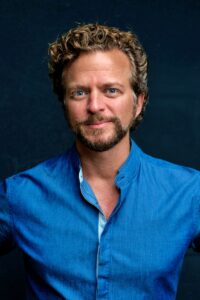
 Enviable versatility and a gift for insightful direction make Steven Stead (pictured left) a worthy theatre-maker to stage this year’s Shakespeare production at Maynardville Open Air Theatre – Twelfth Night, says BEVERLEY BROMMERT:
The latter happens to be very highly placed among Stead’s favourite comedies from the pen of the Bard, (second only to Midsummer Night’s Dream); he describes it as “a play for the thinking man” due to its happy blend of intellectual muscle and groundling humour.
He points out that the work, commissioned in 1601 by Queen Elizabeth I for the court revels of Twelfth Night, bears its 424 years with grace, and still has much to offer audiences after more than four centuries. What started out as a piece of corporate fun has, in addition to obvious entertainment value, a rich density of content inviting reflection on social mobility, the pervasive nature of illusions, and the all-too-human tendency to lose one’s emotional compass.
All that Shakespeare jazz
As if this were not challenging enough per se, Stead’s brief on undertaking the current production was to include the element of jazz, the common denominator for Maynardville offerings this year.
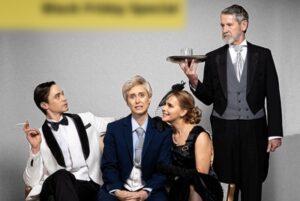
Hence he is marrying Shakespearean comedy with the 1960s’ jazz era, the Mediterranean setting of the work reflected in “la dolce vita” of mid-20th century Italy, with its Fellini-esque off-beat glamour and hedonism.
Says Stead: “Unlike tragedy, comedy does not readily lend itself to a staging of time-neutral universality; more often than not, it involves breaking social boundaries, which necessitates a social context …” Thus we have subversion of a distinct social order as an integral part of Twelfth Night, with servants like Malvolio and Maria aspiring above their station, and the wise fool Feste able to say whatever he wishes without fear or favour, being both insider and detached observer of his employer’s foibles.
As such, Feste represents lucidity and truth in a perfect jungle of misconceptions, while the other honest voice is that of Antonio, whose speech is the longest in the play, as Stead shrewdly observes. “Antonio, in his total devotion to Sebastian, is free of all illusions and pretence, the only one who knows his heart – which serves to define the state of the other characters, who are emotionally lost and unhappy.”
Comedy with an edge
Fluidity of gender and rank, loyalties wrongly invested, and mistaken identities make for comedy with an edge that lifts it above mere slapstick à la Plautus. Stead is particularly struck by the terse line that sums up life under the Lord of Misrule: “Nothing that is so, is so.”
There is moreover the darker element of Malvolio’s ill usage at the hands of antipathetic characters, his egregious humiliation justifying the threat of revenge … a discernible vein of negative energy in Twelfth Night.
Music, “the food of love”, plays a major role in the play, and to this end original, jazz-accented compositions by Wessel Odendaal are woven into the text. Stead is delighted with them, describing them as “plangent and soulful, befitting the melancholy of unrequited love and loss: Viola believes her brother is dead, and Olivia is in mourning for her sibling”.
An al fresco production such as this involves some notable editing of the original text, and fortunately Stead is comfortable working within the requisite parameters: “Some prose (as opposed to verse) has had to be cut, and to this end archaic word-play can be reasonably omitted; I’m loving the challenge of getting to grips with the language, asking the actors to wrestle with its complexities and ultimately own it.”
With a stellar cast of his choosing, Odendaal’s score, and a clear-eyed vision of the core issues of the play, it seems Stead is set to deliver a memorable reading of this year’s Shakespeare play at Maynardville.
What: Twelfth Night
Where and when: Maynardville Park from 30 January to 7 March 2026
Twelfth Night tickets: Quicket
WS