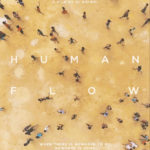
 Times Media Films is releasing the critically-acclaimed documentary HUMAN FLOW at cinemas in Johannesburg, Pretoria and Cape Town on 10, 11, 13 and 14 February, 2018.
Over 65 million people around the world have been forced from their homes to escape famine, climate change and war in the greatest human displacement since World War II.
HUMAN FLOW, an epic film journey led by renowned artist Ai Weiwei, gives a powerful visual expression to this massive human migration. The documentary elucidates both the staggering scale of the refugee crisis and its profoundly personal human impact.
Captured over the course of an eventful year in 23 countries, the film follows a chain of urgent human stories that stretches across the globe in countries including Afghanistan, Bangladesh, France, Greece, Germany, Iraq, Israel, Italy, Kenya, Mexico, and Turkey.
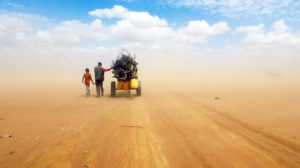
HUMAN FLOW is a witness to its subjects and their desperate search for safety, shelter and justice: from teeming refugee camps to perilous ocean crossings to barbed-wire borders; from dislocation and disillusionment to courage, endurance and adaptation; from the haunting lure of lives left behind to the unknown potential of the future.
HUMAN FLOW comes at a crucial time when tolerance, compassion and trust are needed more than ever. This visceral work of cinema is a testament to the unassailable human spirit and poses one of the questions that will define this century: Will our global society emerge from fear, isolation, and self-interest and choose a path of openness, freedom, and respect for humanity?
This crisis is our crisis
Imagine this: When danger comes, you and your family jettison your lives, leaving behind a bombed-out home and repression at your heels. You pour all your precious savings into a passage of weeks or months—over mountains, across deserts—to jump into a flimsy rubber raft, daring to defy the ocean’s perils, chasing an unwritten future. Or you wait in suspense, journey blocked, at a closed border, in an improvised camp, fighting to never allow the barbed wire to pierce your hope. Perhaps you escape catastrophe, only to deliver yourself to a city you’ve never even imagined, to new streets crackling with fears and furies that make no sense, and even still, you are driven by the most basic human optimism, to live your life no matter what it takes.
 A planet in the midst of a human emergency
These are not fictional situations. These are the real human faces—each lined and luminous with stories of love and courage and the urgent battle for survival—of a planet on the move, a planet in the midst of a human emergency. Much has been said in the past few years by politicians and pundits about the millions of refugees fleeing war, hunger and persecution.
Yet, as debates rage about who and how many, security versus responsibility, putting up walls or building bridges, the vital truth of real people with real dreams and real needs caught in a labyrinth of uncertainty can get lost. The very word “refugee” can distance, can lull us into forgetting this major story of our times is not about statistics or abstract masses but about beating hearts, about lives-in-process, a stream of individual stories full of colour, ecstasies and sorrows no different from our own.
That’s why artist Ai Weiwei foregrounds the humanity of refugees—their quest for the things we all want: safety, shelter, peace, the opportunity to be who you are—in his powerful new work of cinema: Human Flow. Ai, at once celebrated, persecuted and famed for an outlaw spirit that speaks directly to a world of inequality and injustice, here pushes back against the worldwide tide of fear with a defiant act of gentleness. His whole career has been about resisting borders of all kinds, about unifying art and activism. And now, with HUMAN FLOW, he again stretches art’s definition to include trying to change the social fabric to which his work responds.
Ai has said the crisis before us is not only the staggering number of refugees with nowhere to go right now but the temptation to turn away in a time that asks something of each of us. So he set out on a journey of his own—a simple yet epic journey to share in the daily lives of people fleeing turmoil in every corner of the planet. The result is a cinematic experience grand in scale but deeply intimate in feel. It is a fluid intermixing of poetry with hard facts, laughter with adversity, the stark with the staggeringly beautiful. Moving across 23 countries, Ai creates an immersion that invites the most personal exploration, one that allows each viewer to consider what it’s like to live life at its most vulnerable—and to ponder what we owe to one another.
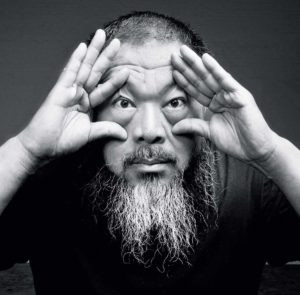 200 crew members joined the effort
Says Ai: “As an artist, I always believe in humanity and I see this crisis as my crisis. I see those people coming down to the boats as my family. They could be my children, could be my parents, could be my brothers. I don’t see myself as any different from them. We may speak totally different languages and have totally different belief systems but I understand them. Like me, they are also afraid of the cold and don’t like standing in the rain or being hungry. Like me, they need a sense of security.”
He continues: “As a human being, I believe any crisis or hardship that happens to another human being should be as if it is happening to us. If we don’t have that kind of trust in each other, we are deeply in trouble. Then we will experience walls and division and misleading by politicians that will make for a future in the shadows.”
Ultimately, over 200 crew members joined the worldwide effort to make Human Flow. Together, they turned the massive production into a variegated celebration of human dignity and a plea for protecting those whose everyday dreams, loves and freedoms have been trampled by tyranny, war and deprivation.
Editor Niels Pagh Andersen (The Act of Killing and The Look of Silence), who cut the film with Ai in his Berlin studio, notes the film offers a perspective charged with the primacy of life and family: “A film like this could easily become too sentimental, which is wrong. We wanted to avoid victimizing the refugees in the film. Weiwei and I felt we had to get beyond any kind of pity or fear and see them as our fellow human beings. Film works best through identification—when you’re able to crawl inside another’s skin to see their journeys, their battles. In this case, we enter a fight for a life without war, without hunger, without threats. But Weiwei also lifts us up, and allows us to see this human flow in larger historical and global perspective and in so doing the film asks us: what kind of world do we want? That’s extremely inspiring.”
For executive producer Diane Weyermann, exec vice president of documentary films at Participant, the film opens doors within—which she hopes will pry open more external doors for those seeking safety. “The film is so cinematic and when you see it with an audience there’s a feeling of being connected both to one another and to the people on screen. You feel like you are the one marching through the mud or waiting in a camp. It’s striking and incredibly moving. And then you have Weiwei who is a relentless force of nature. He cares so much about this story and the people he meets along the way, and you feel that strongly as you watch. He reminds us that in this crisis, we have to look, we have to feel, we have to not accept the status quo and we have to change it.”
What: HUMAN FLOW – A Film by Ai Weiwei
Screenings South Africa: 10, 11, 13, 14 February, 2017 at select cinemas
When: 4 shows daily, showtimes to be confirmed
Run time: 140 minutes
WS