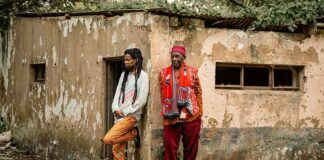
The vibrant and enigmatic Sechaba Gqeba has been chosen to host a brand new season of the longstanding women’s talk show, Motswako on SABC2. Kat Manne from WeekendSpecial spoke to Sechaba about her approach to the new season and the exciting transition from radio to television.

WeekendSpecial: How was your debut on Motswako?
Sechaba Gqeba: Look, the thing with television is that they need to cover current affairs and things that are happening, so, we had to kind of reshuffle and interfere with programming because Mam Winnie Mandela passed away. So we had to start off with a tribute. It was mainly a documentary about Mam Winnie – a two-part special. It’s weird because I’ve been in radio, so, how I look never really matters. Now all of sudden I’m having to watch myself – I already even struggle with listening to myself, now watching myself is a completely different story. It’s daunting, it’s exciting, it’s everything I’ve ever been waiting for happening literally now in the space of two to three months, so it’s really been an interesting time in my life.
WS: Has this new gig affected your home life in any way?
Sechaba: Not particularly. I do fly out to shoot but they’ve structured it in a way where they don’t disturb my family life. We try to get the trips down to once or twice a month. Two days at most. It is once a week, so, we can afford to do that. They’ve tried to tailor things to accommodate me.
WS: What is your process before shooting for TV?
Sechaba: It’s the opposite of radio. I arrive at like 6am and then I have a snack because I can’t eat. They cater, like, there’s breakfast and everyone’s eating, the crew and everyone is eating but I can’t eat because I’m still very new at it, so essentially, I’m still at the butterfly stage. So I’ll have like half a croissant, half a piece of a pineapple. I can’t really eat a big meal, so I’ll have a snack for like ten to fifteen minutes, hydrate, then I go straight into wardrobe to check the looks, discuss the looks with the two stylists and once we’re done with the looks, I go into make-up and hair and from there back to wardrobe to get dressed and from there you get mic’d up and from there it’s the final touches. “Ooh, your lash is in the wrong place”, move that strand, people are tying your shoes. People are faffing. It’s a lot. When they say “it takes a village” there’s an entire team to ensure that the episode looks the way it does, the guests look the way they do and that I look my best. It’s a team. It’s teamwork.
WS: You mentioned that you’re a shy person. How are you managing that now?
Sechaba: The thing is when you’re in this industry, you almost have to always be open with people because you essentially speak to people for a living … whether it’s on radio, whether it’s on TV. So, when people meet you, they always assume that you must be this overly bubbly person. I don’t think I’ve changed; I do what I need to do. I’m a very warm person. I can be guarded. I’m still trying to figure out whether I’m mistaking guarded for shy but I need – especially for a while day of shooting, if you’re on set for ten hours straight – I need my moments where I’m just by myself while everyone is still chatting, just to spend fifteen minutes by myself.

WS: Are you bringing anything new to the table with regards to the issues that have been dealt with on the show?
Sechaba: We will still be dealing with similar issues. It’s primarily a woman-empowerment show, a woman-focused show. I think what we’re trying to do here is to bridge different generations and people from different walks of life. We’re trying to bring a fresh, younger take whilst still engage the older generation. Just a mix of everything, you know. It is a difficult balance but it boils down to the fact that they allow me to have those perky moments where I’m laughing loud or clapping someone’s hand.
WS: Will you be touching intersectional feminism and how other forms of discrimination like racism affects gender discrimination?
Sechaba: Oh, we are not sugar-coating anything. We’re going right in. Stuff that people feel the need to tip-toe around – we have the most honest conversations around that.
WS: You mentioned that you want to keep Mam Winnie’s fire burning. What did you mean by that?
Sechaba: I had this discussion with my Mom the other day, she was like: “I feel like your generation kinda knew what she did, what she was about but I don’t think you guys really know the extent to which this woman suffered.” For me, I feel like my generation went on Instagram and social media and Twitter and were like all black with a doek and I get all that, but guys, once that frenzy’s done, what do we do? Past the social media, past the doek, past the tweet, past the hashtags, what do we do?
And the one thing I said was that it was great to see women, and primarily black women, coming together and feeling the need to own their stories, to own their narrative. And I think going forward, we need to be more unapologetic about that. I think, going into this next phase of my career, I want to be me unapologetically, authentically … I want to try to a be a voice for the voiceless but also steer away from the politically correct in the sense of “I don’t want to lose a sponsorship”. I’m not gonna go out and tear down buildings, but I think we need to start having honest conversations with each other and that’s where we’ll start doing the work. Once we’re being honest with each other, in terms of all races, genders, people from different walks of life, once we start having open conversations about where we are as a country and what we need to do to carry Mama Winnie’s legacy on, the work will start.

WS: Everyone has their eye on you and yet you are addressing difficult sensitive issues. Is it hard to navigate that balance?
Sechaba: To have a mentor like Carol Bouwer has helped. Even in the moments where I’m like “Oh my gosh, I’m so new to this, there’s so much happening”, she’s like: “Girl, stand up straight, walk tall, be bold.” It’s been great having her, giving me advice. She’s had an extensive career in broadcasting.
WS: Will you be broaching the subject of ally-ship, particularly male allies?
Sechaba: We’re always saying that Motswako is a woman-focused show, but we’re not saying that men shouldn’t watch it. Specifically with sexism and a lot of the issues that we’re faced with as women in this country, men have a massive role to play. I’m married and I have these very honest conversations with my husband about things that we encounter as women on a day-to-day basis. The catcalling and how we, as women, our lives, our bodies, our presence are just policed by absolutely everybody. I feel like with men, we’re getting to an era now where we need to have honest conversations. The guys, when they’re together in a group, be it in a professional setting, be it in a friend setting with their boys, be it with their brothers, their family, they need to start calling each other out in certain situations. We can’t do all the work. They need to have the discussions. I think men have a massive role to play with regard to sexism.
What: Motswako
Where and when: SABC2 on Wednesdays from 8.30 to 9pm
WS