[star rating=”2.5″] INXEBA (THE WOUND). Directed by John Trengove. Written by Malusi Bengu, Thando Mgqolozana and John Trengove, with Nakhane Touré (Xolani or “X”), Bongile Mantsai (Vija), Niza Jay (Kwanda).
RICHARD LOWNDES reviews
If South Africa’s population is similar in sexual orientation to counties around the world, where polls and surveys have been undertaken, then it is possible that the percentage of those with same-sex orientation is the equivalent to twice the Indian/Asian population and may approach a percentage equivalent to the white population. Given those statistics, a South African film exploring gay relationships and masculinity is to be welcomed.
Before opening in South Africa Inxeba had been shown at film festivals around the world picking up many awards along the way. It was the official South African entry for the Best Foreign Language film at the Oscars, making a shortlist of nine but eventually failing to be nominated.
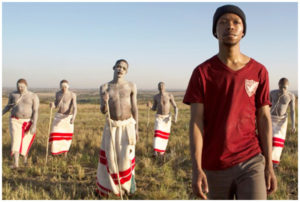
Inxeba is the story of two men, Xolani (Nakhane Touré) and Vija (Bongile Mantsai), who meet up every year in the mountains of the Eastern Cape to assist in the initiation of Xhosa teenage boys into manhood. An initiate from the city (Niza Jay) discovers their secret and Xolani’s life unravels.
It is said that less is revealed about the Xhosa initiation ceremony in Inxeba than appeared in the 2013 film The Long Walk to Freedom.
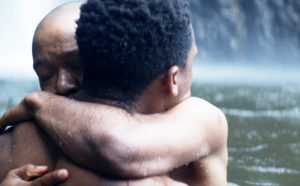
‘Many will enjoy Inxeba’s minimalism’
So, is Inxeba South Africa’s Brokeback Mountain? There is a similarity in concept but that is all. The storyline of Inxeba is best described as thin. It is essentially the relationship between the two initiation caregivers. Nakhane Touré, gives a stand-out performance as Xolani in his first acting role, but he and Bongile Mantsai have little to work with. It is not their fault that the film drags in the middle section. Ang Lee made Annie Proulx’s short story Brokeback Mountain into a well-paced full-length film. One of the reasons for this is that Inxeba is set almost entirely on the mountain and there is no exploration of the backstory of the two men. Of course, there will be many who enjoy Inxeba’s minimalism.
My biggest gripe with Inxeba is the cinematography (Paul Ozgur). The dark interiors fail to create atmosphere – they are just dark. Is the hand-held camera supposed to be faux documentary or did someone have pretentions of the French new-wave? I believe that most film audiences in 2018 expect something that is easier on the eye – unless of course you want to flaunt a low production cost badge? One thing I did like was keeping the power cables in frame; a reminder that “going to the mountain” is never far away. Sadly, the film doesn’t do justice to the landscape, even in the waterfall scene towards the end and the cinematographer has pretentions of being ‘arty’, with out-of-focus trees etc.
So, the producers are to be congratulated for the concept, the writers, director and cinematographer failed to come across with the best finished product. It’s still an important film, but could have been so much better.
Film: Inxeba (The Wound)
Info: www.inxeba.com
Rating 16: Scenes with strong Language, Sex, Nudity (16 LSN)
WS