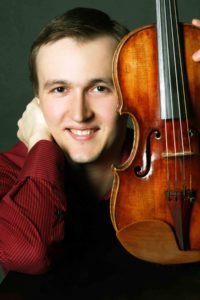
SYMPHONY CONCERT. Thursday 7 June, 2018. CPO conducted by Conrad van Alphen, soloist Nikita Boriso-Glebsky; Beethoven: Overture, Fidelio; Tchaikovsky: Violin Concerto in D, Op 35; Sibelius: Symphony No 1 in E minor, Op 39. At Artscape Opera House.
DEON IRISH reviews
The second concert of the CPO’s Autumn Season was again given in the Artscape Opera House due to the current renovation of the auditorium of the City Hall. The venue, with its unsympathetic instrumental acoustic, inevitably took its toll on the enjoyment of this programme.
In this regard, the acoustic shell which is employed for the orchestral concerts on the venue’s stage has both advantages and disadvantages. I am sure it assists the orchestra members to hear themselves better and it does provide a more cohesive sound; but it is not uniform and there be no talk of a blended result.
The sound of the brass instruments, from their position at the rear of the orchestra where the shell curves up and forward, seems to project with an unwelcome ferocity over the anterior winds and strings; and upper harmonics in general certainly speak with greater clarity and projection than do the deeper tones.
The welcome addition of an extra desk of celli and basses did help to achieve a better string disposition (one should not forget that the City Hall’s acoustic is the equivalent of an extra desk of string players all around); but nothing can overcome the lifeless splat of a snatched orchestral chord falling at the players’ collective feet.
Which is why the opening Fidelio overture was such an inappropriate choice for this venue. The opening drama depends so heavily on those abrupt chords soaring out into the space – and the timpani strokes echoing with a round fullness. Instead we had an effect which for some unexplained reason brought to mind a hotel breakfast chef whizzing through a batch of easy-over eggs. Not, I think, quite what the composer had in mind.

An astounding instrumentalist
Similar problems invested much of the succeeding concerto, the violin part in this concerto so frequently (less so in the finale) depending on some assistance from a generous acoustic. In this case, Boriso-Glebsky was playing his Matteo Goffriller Venetian instrument of the 1720’s. As to be expected from this Tyrolean-born luthier, the Steiner influence is not wholly absent – despite the Cremonese overlay – and the violin has innately a fairly muscular quality, displaying more strength than lyrical beauty. It would have been immeasurably assisted in a more rewarding acoustic, which would have added a harmonic richness to the focused tone.
Boriso-Glebsky is an astounding instrumentalist, with a prodigious technical armoury and an uncompromising artistic vision. This was nowhere more apparent than in the last 90 or so bars of the invigorating finale, from the sempre crescendo indication. The writing is fiercely challenging: chromatic modulations testing security of left hand intonation; semi-quaver broken chords with rapidly altering double-stops challenging both hand and finger mobility and accuracy; vicious passage work of seemingly unending semiquavers making a bowing work like the connecting rods of a Class 25 at high speed.
All this on the technical side must be matched to a vision of what the music should be doing. And this is where the uncompromising part of Boriso-Glebsky’s approach manifested itself. What he clearly understands in the score is the depiction of frenetic dance, a frenzied Cossack celebration in which the participants twirl in giddying abandon. In the result, he took the episode at breakneck tempo, a risk of failure of accurate execution being willingly assumed in order to achieve the intended musical purpose. Although – given this display of technical ability – perhaps there was perhaps actually not that much risk of any lapses. It certainly ensured him a standing ovation.
The opening movement’s more Romantic episodes – and also, obviously, the slow movement with its muted strings – suffered from the lack of acoustic bloom. But other episodes worked very well: the piu mosso episode with its elegant trills and ever more urgent broken chords leading to the great ceremonial march-like outburst, with its pulsating triplet accompanimental figure. And then the beautifully delicately delivered molto sostenuto variation, with its pizzicato accompaniment.
Nina Beilina at the City Hall
The live performance of this concerto which I still rate the best heard in Cape Town was that of Nina Beilina at the City Hall. I am sure that this account by Boriso-Glebsky would have been its equal, had it only enjoyed the benefit of the same venue.
After a disastrous interval, in which the Artscape bar staff demonstrated a logistic and service ineptitude rare by even South African standards, we returned to the auditorium – dry-mouthed from the queues – for Sibelius’ first symphony.
It is a work which van Alphen clearly likes and he conducted it with authority and affection. That affection is not shared by myself, for I find the work rather shy in its development and transformation of the promising but ultimately rather palling thematic material. It’s a bit like Liszt-lite.
There were some lovely moments, of course – the cello solo of the slow movement; the opening clarinet solo (which, in the determination to be really pianissimo, did flirt with “stalling”); but orchestral playing also left much to be desired with some indifferent wind chording and some truly teeth clenching horn passages.
 Fairly triumphant conclusion
Van Alphen – rather like the Springboks last week – didn’t lose heart and, perhaps equally surprisingly, the urgent chosen tempi of the final allegro molto did lead to a fairly triumphant conclusion.
Read Nikita Boriso-Glebsky’s WS interview: https://weekendspecial.co.za/nikita-boriso-glebsky-interview-cpo/
What: Violinist Nikita Boriso-Glebsky review CPO
Where: Artscape Opera House, Baxter Concert Hall
Info: www.cpo.org.za/
WS