[star rating=”3″] 7 DAYS IN ENTEBBE. Directed by José Padilha with Rosamund Pike, Daniel Brühl and Eddie Marsan.
MEGAN FURNISS reviews (spoiler alerts below)

I was probably not the right person to review 7 Days in Entebbe. I am not crazy about movies based on historical facts; I find fiction far more exciting than what really happened. I think at some point I probably saw both other early film versions of the story while I was growing up, and I have my own powerful memories of the highjacking and Israeli military mission on Entebbe. So, I was curious but suspicious about what a new retelling could bring.
I think everyone knows the bare bones of the story. German revolutionaries join forces with the Popular Front for the Liberation of Palestine to highjack a plane, fly it to Uganda, and demand the release of Palestinian prisoners and $5 million dollars in exchange for the Jewish and Israeli hostages. The Israelis, while negotiating, organise a military operation to rescue the hostages, and on day seven, they execute the daring mission.
On 27 June 1976 I was eleven. Eleven days before, my father had had to try and explain what had happened in township schools across the country. Our country’s revolution had just started when news broke about the highjacking. My father had to explain this too, and because we were Jewish, with family in Israel, it had its own connection for us. Somehow, my world was decided in that time and I have been coloured by it, and those two events happening so closely together are conflated into a bizarre sense memory of politics, identity, freedom fighters, terrorism, the military and power. I was interested to see what 46 years of distance would put on the story.
Doubly confusing …
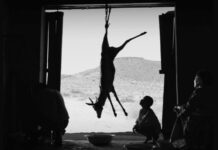
I could have been forgiven for thinking I was in the wrong movie house when the film started with an incredibly stylised dance sequence in a theatre. The heavy drum beat gave way to a familiar traditional religious song, Ehad Mi Yodea, usually sung around the Passover table at the Seder. Here, the seated, suited dancers move, and sing, aggressively, violently, to the song and this is chilling and beautiful, but makes very little sense at all. I imagine that for those who don’t know the song and its meaning this must have been doubly confusing.
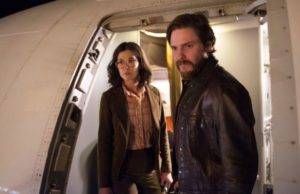
Huge red titles then take us to the various locations, starting in Athens where more passengers, including the highjackers, board the Air France flight en route to Israel. The story moves forward in linear action, following the highjack, hostage situation at Entebbe Airport in Uganda, and military rescue that took place over seven days in 1976. Flashbacks are also used to paint a picture of the two German revolutionaries (Rosamund Pike and Daniel Brühl), and their backstory, and how they got to become these people who could do this thing. An Israeli soldier (Ben Schnetzer) and his girlfriend (Zina Zichenko), who is one of the dance troupe, also feature throughout the story, and give more opportunity to see the mesmerising, powerful, but totally obscure dance complete. But mostly we move back and forth from Entebbe to Israel, where the prime minister Yitzhak Rabin (Lior Ashkenazi) and his ideologically divergent Defense Minister Shimon Peres (Eddie Marsan) decide what to do. Rabin wants to negotiate. Peres believes any negotiating with terrorists is disastrous. What is terribly sorely missing is the development of the backstory, or any personal thread for the two Palestinians, who are colored in broad brushstrokes, and neglected as part of the narrative.
What about the Palestinians?
I couldn’t help but feel that the director really wanted to bring a different sensibility to the story by portraying a complex and tense Israeli government struggling with identity, and two German revolutionaries caught up in post Nazi guilt and misplaced ideology. Interesting, but what about the Palestinians? A throwaway line about deaths in Lebanon is all we get. And Idi Amin is the usual bat shit crazy African dictator. The rest of the Ugandans are silent bodies, who are shot at and killed.
Stylistically, the movie gets a lot right. The set, costume, hair, and 70s detail is very memorable. The smoking on the plane (and everywhere else), the multi-coloured carpets, the old-fashioned passports create authenticity, and the planes and guns and vehicles are perfect. Unfortunately, silly things, like the soldiers hand painting a gold Merc black, only to have it shiny as it comes off the plane, spoilt it for me, and shattered the suspension of disbelief.
Then there is language. The Germans speak German to each other. The Palestinians speak English. The French pilots and crew move between English and French, there are a few lines of Hebrew given to one or two passengers, and all the Israelis speak English, with varied success at the Israeli accent. This was so jarring and weird. It’s obviously about casting, but it is horrible.
That dance again …
Because so much time is spent on the hostage situation and the politics, the real action of the piece, the rescue operation, is given little screen time. It’s all over very fast, and since it is the real action of the film, it’s all a little disappointing. It is also dramatically intercut with the live performance of the dance, which is very magnificent and very confusing. The dancers (except for the girlfriend who enacts a shocking death every verse) end up stripping and making a huge pile of their clothes. Apparently, this symbolises the forming of the state of Israel; a country born of Holocaust survivors (I had to look it up, and I read that somewhere else), but it feels like a bit of an excuse actually.
I have said a lot about a movie that doesn’t deserve this much attention.
What: 7 Days in Entebbe
Where and when: Ster-Kinekor Cinemas from 6 April 2018
Book: Ster-Kinekor website
WS