CHAPTER 2 SECTION 9. Directed by Phyllis Klotz with Ayanda Rose Fali, Khanyisa Nanase,Tsholofelo Ross and Ayanda Sibisi. Music composed and performed by Isaac Molelekoa. Set and costumes by Sarah Roberts. Lighting by Stan Knight. Research and interviews by Collen Mfazwe and Janneke Strijdonk-Xulu. Translations by Smal Ndaba.
REVIEW: Tracey Saunders
There are some tales so awful that the telling of them is almost unspeakable, the listening unbearable. Phyllis Klotz and her remarkable cast accompanied by music by Isaac Molelekoa have made the unspeakable heard and with authenticity and courage share the stories of women who have been “supported by the constitution, betrayed by the world.”
There are no plot spoilers in this review as the fate faced by many black lesbians – abuse, rape and often murder – is well known. It is no surprise and news stories about brutal gang rapes and abductions while often assigned to page three of a regional newspaper, are a depressingly regular occurrence. This selection of personal reflections is presented verbatim, based on dozens of interviews with women and there is no fiction here as we are introduced to women who have survived and those that they love.
Impressive cast
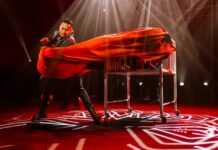
The cast are impressive. Each one with a unique character and a powerful sense of identity, there is no amorphous “them” here. A mother, a police woman, a daughter, a niece – each with a very personal tale. As Ross scans the audience you feel as if she is addressing you directly. In her proud strut across the stage she is both playful and pugnacious, but unafraid to show naked grief. Sibisi provides an anchor for the performers and seems to be the pivot on which much rests, the silent conductor of the choir on stage. The piece is not without humour and it just one of the aspects that gives it such a human and engaging quality. The one weak aspect of the play is the projection of the English speaking and Afrikaans women. The accents sound almost cliched and the actors risk stereotyping and making caricatures of them.

Gabrielle Goliath presented an incredibly moving work Elegy at the Live Art Festival at the Young Blood in February. The lament, a commemorative gesture was sung by a group of women, dressed in black who trod in formation up a simple staircase and addressed themselves in a singular voice to the audience. The result was spine chilling and the repetitive nature of the wailing left an indelible impression. Each iteration of the Elegy is dedicated to an individual and this particular performance was dedicated to a young lesbian Noluvo Swelindawo who was murdered on the 3rd of December 2016 in Driftsands near Khayelitsha. Present at the performance was her partner, Nqabisa Mkataliwho. I was struck by the simple but obvious fact that this artistic expression was more than just an art piece to her. It was a reflection of her life, a memorial to her personal tragedy and while it couldn’t alter the horrific events it validated her experience and acknowledged Vovo’s life with dignity.
Chapter 2 Section 9 achieves a similar goal. It is an artistic expression and yet transcends that, acknowledging pain and yet not allowing the pain and trauma to be the sole identifier of lesbian women. Through the inclusion of music and a capella singing, this production laments the loss of life in songs reminiscent of funeral dirges. The music also soothes and Molelekoa’s instrumental voice is as much a part of the narrative as the dialogue. Often plaintive and soulful without risking sentimentality the soundscape provides the audience with some small measure of comfort.
Become part of the solution
At the end of the piece, the audience are invited on to the stage to observe a moment of silence for those murdered – their images hung on branches on set. The very real faces of Noxolo Nogwazato, Motshidisi Pascalina, Eudy Simelane, Sizakele Sigasa, Salone Massooa to name but a few, tragic reminders of the reality one has just observed. The invitation to leave a message of support on the stage is a first step in encouraging audiences to do more than just observe, be moved and leave. Given Klotz’s wealth of experience in presenting theatre which tackles societal issues and injustice it is no surprise that is more than just a performance but an exhortation to become part of the solution.
Lin-Manuel Miranda the creator of Hamilton, said, “I think that there’s a healing effect to theatre. There’s something about everyone being in the same room and having the same experience that is powerful and increasingly rare. We curate our reality more than ever. We unfollow people we disagree with, and it’s easier than ever. Even in the news, we can get a different set of facts from a different network. So I think that the power is in everyone being in a room, putting down their phones, and theatre is one of the last bastions of that as well.” Sibikwa Arts Centre have built that bastion and fortified it with silenced voices from the battlefield.
Chapter 2 Section 9 is a harsh reminder of how far South Africa still has to go. No matter how marvellous our constitution is, it is no more than a piece of paper without a society that honours it. This is a call to speak out and stand up. In the face of such a compelling narrative it is impossible not to.
Where and when: Baxter Golden Arrow Studio Theatre until 11 March
Book: Computicket
WS