DIAL M FOR MURDER. Thriller by Frederick Knott. Directed by Aubrey Hindle. Assistant director: Michaela Richards. Lighting/Sound: John Howland. Set/Costume design: Jane Philbrick and team. Presented by Fish Hoek Dramatic Society. Masque Theatre.
Photographs: Lynda Jennings
SHEILA CHISHOLM reviews
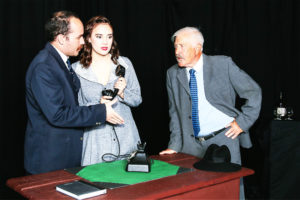
Playwright Frederick Knott places Dial M for Murder in London when £1 000 could tempt a small-time crook to commit murder. For that money, Tony Wendices (Robert Shenton) quickly persuades Lesgate (Andy Rabagliati) to murder his wife, Sheila (Michaela Richards). This, despite Lesgate’s crime career not going beyond petty pilfering, swindling landladies, pinching cash from tills and altering his surname every second week.
Lesgate’s low mark skills hardly make him an ideal murderer. However, for a year Tony has plotted every single tiny detail for this perfect murder. He explains the manoeuvres necessary for Lesgate to kill Sheila, while he, Tony, will be dining with Max (Wayne Ronne). Thus Tony provides himself with an infallible alibi, and if Lesgate follows directions nothing can possibly go wrong.
Jealousy, and Sheila’s inheritance, are Tony’s motives. He loves Sheila. However, as Tony pursued his pro-tennis career Sheila felt neglected. And, in the way neglected wives tend to do, found herself a lover … Max. When a love letter from Max to Sheila proves his suspicions, Tony starts hatching revenge – with her death his goal. Knott’s web of lies is exceptionally clever and tightly wound.
It’s on Shenton’s eyes that this production hangs. Constantly changing, his eyes suit each situation. They flash love to Sheila, friendliness, mixed with contempt, for Max and shield his cold-bloodied determination to see Sheila dead. In a fine controlled manner Shenton neither exaggerates nor down plays Tony’s evil intentions.
The eyes have it
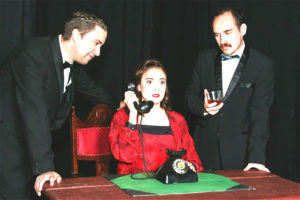
Looking stunning in a red shantung dress Richards’ eyes also tell her story. They seek Max’s at every opportunity and show disbelief at Tony’s lies. Lies which keep backing her into a corner unable to defend herself – without calling Tony a liar.
Calm and unhurried, Chris Bingham, as Inspector Hubbard, held everyone in suspense as he employed slow and steady police detecting practices to uncover the truth. Ronne and Rabagliati are clear speakers, drawing upon vocal light and shade to unfold Knott’s wily tactics. However both appeared tense. A problem likely to resolve as confidence grows with further performances.
As much as Jane Philbrick and her team’s set and costumes add dramatic impact, so did John Howland’s lighting detract. Whatever electronic difficulties experienced, when lights fail to switch on and off on cue and the murder scene is barely visible, it’s essential Howland sorts this out. As a thriller, correct atmospheric lighting is vital to bring people to the edge of their seats. That’s what Dial M for Murder is famed for.
What: Dial M for Murder
Where and when: Masque Theatre, Muizenberg until 12 May 2018
Book: Computicket
WS