 SYMPHONY CONCERT REVIEW: RISING STARS 1. Thursday 18 January 2024, at the Cape Town City Hall. CPO Conducted by Jonathan Lo (Conductor), Miclen Laipang (Violin). Mozart: Don Giovanni Overture. Barber: Violin Concerto. Rimsky-Korsakov – Scheherazade.
ALBERT COMBRINK reviews
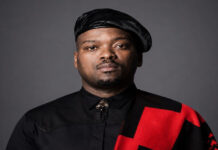
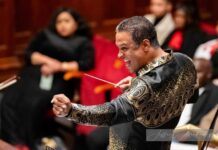
Music Director and Chief Conductor of the Australian Ballet, Jonathan Lo is not a first time visitor to Cape Town. He has made a name for himself as a ballet conductor. He was born in Hong Kong, studied at Oxford and the Royal Northern College of Music, having been appointed to his first music directorship with the Oxford University Philharmonia at age 18 after winning the Oxford University Conducting Competition. He has successfully given premieres of a wide range of new music, and it was interesting to hear his take on a work from the Classical era: the Overture to Mozart’s opera Don Giovanni.
From the first notes, we were in theatrical territory: taught, crisp, controlled and absolutely dramatic. The opening chords – denoting the opening of the gates of hell – were big and powerful, but not allowed to vibrate and overstay their moment. This seemed to define Jonathan Lo’s approach to music-making: get to the emotion of the musical statement, have your say, and get on with it, agile and without misunderstanding the intent. After the thunderclaps, Lo’s shaping of the dark scales that climb up and down the stave like snakes and tentacles, made Mozart’s writing sound startlingly modern, without changing a note. As riveting and arresting an opening as ever there was one, to this dark tale of a very dark leading man.
But, Don Giovanni is not only a tragic opera: it has comic undertones, and musical explorations of character-psychology on a whole new level in Western Classical Opera. The fast section sounded intense and crisp, with great detail in articulation, with delineation of individual lines. Written in a feverish night of inspiration, to a deadline of an opening night curtain a mere 24 hours away, there was a sense of urgency in the playing as well, which was thrilling. Yet, it left us slightly unsatisfied: it is just too short to satisfy as an entire meal is. It leaves the audience ready for the curtain to go up. In short: the perfect Overture.
From the inside
Since the reviewer of this concert was also the orchestral pianist in the following Barber Violin Concerto, the following comments are “from the inside” of the orchestra, so to speak.
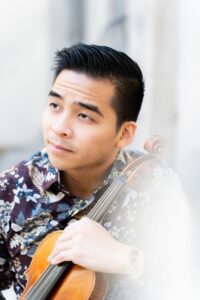
Acclaimed as “a musician of daring virtuosity with gripping access noble elegance” (Die Welt), has earned global recognition as a soloist, chamber musician, and concertmaster. Winner of multiple awards and prizes, Miclen has performed in over 60 countries and has recorded CD’s on Sony RCA Red Seal, Naxos and more. He has had the privilege to work with international artists such as Ivry Gitlis, Janos Starker, Irvine Arditti, and Peter Serkin. His playing was certainly a match for his reputation.
An American wartime Violin Concerto, composed by the most lyrical of wartime composers, Barber’s work poses special challenges to any performer: balancing the nostalgic, romantic element, with a searing and burning emotional content, over two movements as elegiac as the third is maniacal. Miclen’s solution was the violin itself: every section focussed on the vocal qualities of the instrument, from the simple opening song in G Major to the deeply moving second movement. Miclen truly exploited the “crying” register” of the D String, and instinctively makes the vibrato tighter in that register, to give the notes an intensely human quality. When the slow movement builds to that enormous eruption, the effect was emotionally spot-on and you could feel the goosebumps as the orchestra responded in kind. He also brought something new to the “scotch-snap” material that the violin plays only once, right at the end of the first movement: there was a playfulness, a naughty glint in the eye, and a kick in the step, that I had never heard before and suspect I shall from now on always miss, when hearing others.
The frenetic last movement saw the violinist articulate with refinement throughout, never pushing to brashness or scratching – a real risk in this technical steeplechase of a work. Balance was, by all accounts, never an issue through-out the performance. Easy virtuosity and deeply felt musicianship was felt again in the encore, a version of Danny Boy that will forever be remembered by anyone who heard it. The perfect encore to an astonishingly moving Barber.
Refinement and attention to detail
The deeply disturbing undertones of the rather barbaric tale that underlies Rimsky-Korsakoff’s Sheherazade was barely hinted at by this performance, but the refinement and attention to detail made this a memorable experience. Concertmaster Philip Martens was an exotic, relaxed, and seductive Sheherazade, in what is a violin concerto, in all but name. Lo gave him, and the other soloists, freedom to express their solos and the result was a performance which perfectly balanced the intimacy of the Sultan’s bedroom, with the enormity of canvass on which the stories were being painted for us. Ships and storms and sea-monsters would be a temptation to bring out the brass and go for the knockout blows, but Lo kept the volume climax of the entire work for the fourth movement, coinciding with the narrative climax.
This kind of pacing and planning of detail, puts Jonathan Lo in a musical class of his own: you could go from an intimate piece of chamber music, a duet between a cello and a horn perhaps, to an entire orchestra in full sail, while still keeping the roundness of sound only possible when the pedal isn’t being pushed flat out to the metal. It is not too far-fetched to say that some of us imagined this Sheherazade being choreographed. It seemed perfect to dance to, and I mean that as the sincerest compliment.
WS