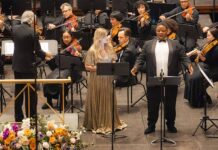
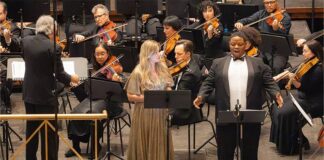
CONCERT REVIEW: THE ROAD TO THE SYMPHONY. Presented by the Cape Town Concert Series in collaboration with the 2026 Cape Town Baroque Festival. The Cape Town Baroque Orchestra with Erik Bosgraaf (conductor and recorder soloist) and Marion Treupel Franck (transverse flute), 26 September 2026. ALBERT COMBRINK reviwws.
For over a decade, already, the Cape Town Baroque Orchestra (CTBO) has been building a community of musicians, teachers, performers and faithful fans of music, specifically, of the Baroque period. This historical period, beginning in Rome around 1600, moved quickly through Western Europe and is understood to have ended roughly around 1750, with the death of one of its greatest musical exponents, J. S. Bach. The term originates from the Portuguese term barroco, which means an ‘oddly shaped or flawed pearl’. Grand, lavish and excessively ornamented, the art and architecture of the era is reflected in dynamic, energetic and emotionally expressive music.
The CTBO is part of the international movement that explores the particular peculiarities of this style of music: it has its own set of “rules”, and an entire field of scholarship exists around unearthing original manuscripts, teaching manuals, letters and documents that teach us – four centuries later – how to play this music with some form of historical accuracy. The CTBO also takes this further, playing on exact copies or on original instruments from the era, with all the conventions of the historical era. From actual instruments – Harpsichord instead of piano, a wooden transverse flute instead of the modern metal ones, ‘natural’ horns or trumpets without the modern invention of valves, or using gut strings instead of the louder, stronger, modern metal ones – to playing styles, any CTBO concert is a jump in a musical time-machine. A jump to a different time in history, with different social understanding, a different approach to literature, social structure, even politics. Given the sheer vastness of the amount of material, one of the great joys of this branch of the music tree is the joy of meeting old familiar favourites alongside new discoveries.


One of the key features of CTBO concerts has been the infectious fun communicated by the musicians, anchored in their musical director Erik Dippenaar. The musicians clearly love this music, and the attention to detail not only leads to academically sound and accurate historical performances in a musical ‘colour’ one can only experience in this context, but at their best, result in concerts that become like modern rituals, a gathering of the clan, coming together, having a joyous communal experience.
This concert was no exception. Erik Dippenaar stepped back from leading the orchestra to performing on the harpsichord as part of the basso continuo section, that little rhythmic engine that includes the cello and double bass, that effectively forms the rhythm section and harmonic glue of the music. Visiting recorder virtuoso Erik Bosgraaf is also a conductor, a function that was required, given that the programme was exploring music from the very last part of the Baroque era and the start of the next movement, the Rococo, which gave us the new musical form of the symphony.
The CTBO expanded their repertoire, and sonic horizons, into early Classical-style symphonies from the 1760’s and 1770’s, by C.P.E. Bach (1714-1788), Joseph Haydn (1732-1809) and a 17-year old W.A. Mozart (1756-1791), all presented on period-appropriate instruments. These early Classical works were then put in the context of the late baroque by presenting the concerto for recorder and flute from 1740 by G.P. Telemann (1681-1767).
Opening with a Mozart Symphony was an inspired choice, introducing us to the lean sound of an ensemble of only about 18 players, rather than the full symphonic sound we might be used to from modern performances. We also met the ‘natural horns’ and the gentle sound of wooden flutes (no dramatic tympani or the piercing textures of reeds such as oboe or bassoon). The opening sonata movement danced briskly, with flying, energetic finger work from the violins. The slow movements from this entire concert stood out for me, and the first – Andantino grazioso – was perhaps the standout moment of the entire concert. Conductor Bosgraaf took it much slower than I have ever heard it, to absolutely delightful and thrilling musical effect.
It sounded like a serenade that could have been at home in a Baroque opera: a timeless interlude, a moment of reflection, and respite from, all the bustling activity around it. I am afraid I might never be able to hear this work performed in a nonchalant ‘don’t make too much of a fuss’ classical performance, again. A brisk and surprisingly operatic-sounding finale wrapped up this little music story just waiting for someone to write a plot. I saw that the concert was being recorded, so here’s hoping we get to hear this gem again, somewhere.
 We music lovers love patrons and bless them, even centuries later: Carl Philipp Emanuel Bach composed his Symphony No. 5 in B minor (Wq. 182/5, H. 661), probably his darkest and most dramatic symphony for string instruments only, as part of a famous commission of six string symphonies for Baron Gottfried van Swieten, a Dutch patron, diplomat and music lover with the inclination to spend money on new music. The work presents both the Empfindsamer Stil (sensitive style) and Sturm und Drang (storm and stress) material, rather than the polite elegance of the Rococo.
The dramatic playing was engaging, belying the fact that one was listening to a chamber ensemble rather than a full, orchestral-sized group. Beautiful sighing motives made the slow movement a welcome respite from the volatile syncopations, jagged leaps, and sharp dissonances of the outer movements. Because of its sudden emotional shifts, jagged rhythms, and uncompromised passion, some music historians even view this piece as an early precursor to Romanticism. This performance, however, presented it as a striking bridge between the expressive counterpoint of the Baroque era and the dramatic structural shifts of the early Classical period.
Two Baroque oboes joined the natural horns for the fourth of Joseph Haydn’s 104 Symphonies. Yes, one hundred and four: he is not considered ‘The father of the classical symphony’ for nothing. It was not all smooth sailing down the path to fame: young Haydn had a complex path, beginning at the age of six as a choirboy at St Stephen’s Church in Vienna, followed by long years of financial instability and absence of steady work. His fortuitous meeting with the Austrian nobleman Carl Josef von Fürnberg, an amateur musician, led to invitations to his home to play chamber music, which in turn led to the writing of Haydn’s first string quartets. Incidentally, he was so good at it that he wrote 68 of them – yes, sixty-eight, and thus also became known as ‘The father of the string quartet’.
The ensemble responded to this early work with all the seriousness and respect one would grant a great symphonic work, but imbued it with chamber-music flexibility of phrasing and intimacy of sound. A performance to send everyone home to look up ‘early Haydn Symphonies played on original instruments’.
Erik Bosgraaf then moved to his wooden recorder, joined by traverso (transverse flute) player Marion Treupel-Franck for Telemann’s 1740 Double Concerto in E Minor TWV 52:e1. Many writers say the work is designed to explore the contrast between the sound of the flute and the recorder, but in this performance they were so evenly matched that the similarities, interaction and dialogues became a hypnotising conversation on which we were allowed to eavesdrop. The two Largo sections, in particular, were heart-stoppingly beautiful, described by one audience-member as the chortling of two turtle-doves. Utterly unforgettable. The enormous recorded output of both Bosgraaf and Treupel-Franck might go unnoticed by some of the general public, but the fact is that we had two magnificent, internationally-acclaimed artists sharing the stage with our own Baroque orchestra. The results were absolutely captivating.
This fascinating concert was a fitting collaboration between the CTBO and the Cape Town Concert Series, that specialises in chamber- and solo recital concerts, presenting a new sound world that explores that space between small chamber ensemble and full orchestra, with rarely-heard, delightful works that would find no other stage, while at the same time showing off the range of styles that our local musicians can absorb.
Some of the musicians on stage went from Wagner with the CPO on Thursday to Telemann with the CTBO on Saturday, while the ensemble also draws on the larger community of musicians trained in historically accurate music performance, all blended with the Cape Town Baroque ethos of joyful musicmaking. Truly a cause for celebration and pride.
Erik Bosgraaf: Listen.
Marion Terupel-Franck: Listen.
Cape Town Concert Series next concert: A Trio of Quartets – CPO Principal Cellist Peter Martens, CPO Guest Concert Master Suzanne Martens on violin, Japanese violist Maya Egashira and pianist Jose Dias. 17 October at 11:00. At the Baxter Concert Hall 2 Main Rd, Rondebosch, Western Cape, South Africa. Tickets R250 – R280. Hendrik Hofmeyr’s Piano Quartet “Goioso”, Wolfgang Mozart’s Piano Quartet Nr.1 and Robert Schumann’s Piano Quartet in E♭ major.
Book here.
What: The Road to the Symphony – Cape Town Concert Series review
WS