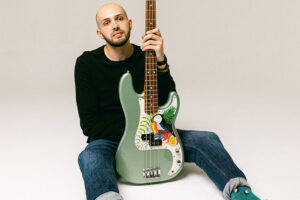
Bassist Stephen de Souza has loads of gigs in Cape Town this March 2023. KEANETSE MOKHOTHU finds out more.
Being the high in demand bassist you are, what is your definition of South African jazz?
That is a tricky one to answer, but with me through its American upbringing, jazz by nature is an improvised based art form. It has also been used as a symbol to comment on injustices throughout history. I believe music in general reflects the society, the culture and the era it is from. I see it as a snapshot or screenshot in time. It is audio proof of the past, the present and what the future could possibly hold.
South African jazz in particular is such a special phenomenon because it too was forged during the worst time period in this country. SA jazz evolved ekasi (the township) during Apartheid and was directly influenced by the struggles that musicians and the nation had to endure. Knowing this and playing the music of our forefathers now helps us get closer to understanding their viewpoint.
It shows us, as performers and listeners, how far we have come and how far we still have to go. Our music is our culture and one will never exist without the other. Our music exists in the way we walk, talk, the way we come together to eat, celebrate or even mourn. It exists within our eleven official languages and the way they all coexist, never mind the other unofficial indigenous languages that are still in our society. South Africa is known as a cultural ‘melting pot’ and our jazz is the stew that binds it all together. So, in summary, its kind of like a tasty potjie.

The Unity Band, The Fractals, your compositional style and process – take us through their journeys?
The Unity Band was the first proper jazz band I have ever been in. It is an eight-piece band made up of incredible musicians in their own regard. We all met in university and have grown together musically as well as spiritually and intellectually. We released our debut album entitled Fabric in 2019 and it really does give you a picture of what we were back then.
When we recorded that album, we took a composition or two from different members in the band. I unfortunately did not have a piece of work to contribute at the time, but throughout playing the others works I ended up ‘writing’ the bass parts for the music that the band ended up playing. This was my first venture into writing, composing and arranging music.
I later joined Fractals, which has also been an incredible experience. It is a four-piece band and we mainly play indie rock music. The guys have such energy and gees that is always a good time performing with them. Here I got to hone my performance skills in different settings to that of the jazz fraternity.
I also started to become more involved in the writing process and the music we composed reflected all of our inputs. We released an album entitled Part 1 which has been received very well and we will see what the future holds for Part 2. Circle back to The Unity Band and in the height of the pandemic lockdown, we managed to escape as a band for a week and go on a writing retreat in Kelinbrak. Here we all contributed to making a second album before the leader of our band Lumanyano ‘Unity’ Mzi left to go further his studies in the States.
Since the times of bass extraordinaire Johnny Mbizo Dyani, what is it about the contra bass that makes it such a rarity amongst South African jazz musicians?
I think a lot of factors can make double bass inaccessible to new players or students. Firstly, it is an extremely physical instrument. It is strenuous on the body and requires years of dedicated practice to get a sound out, let alone a good sound. When you start out, your hands are bound to get blisters and you almost always feel like the instrument hates you. It beats you into submission, and I still feel it time to time.
If I have not played the double bass in a week or longer it reminds me I need to stay fit. Over the years your hands get stronger and it becomes a little easier. Although I barely have feeling in my fingertips anymore, that is how hectic the callouses that develop are. I used to hate my phone when it unlocked with finger print because it always struggled to get a good reading.
The instrument is also difficult to find, most schools or young kids do not have access to this kind of instrument. Schools usually invest in recorders, pianos or violins. Smaller instruments that are easily accessible for smaller children. Which leads me to, it is an awkward instrument to live with. It is large and extremely fragile. It does not weigh too much seeing that it is hollow but you always have to take into consideration how safe it is whilst transporting. Public transport with a double bass – forget about it!
I can only ever own a hatchback or SUV type car because it is challenging to fit the instrument into a normal sedan style car. All of these factors just make it a specialist type instrument that requires certain lifestyle choices that not everyone can make. I think that is why you will only find ± 20 of us in the entire country.
What are the benefits of having an authentic sound?
The benefits of having an authentic sound are abundant. It takes quite a few years to get your voice out on an instrument, but when that happens you find a medium for expression and I think that is when you can truly be authentic. Performing and composing both have to be authentic. No one wants to hear another Bruno Mars or Taylor Swift copy. People usually gravitate to someone’s music because they connect with their sounds and words. A bond can only be made in a relationship if there is openness, vulnerability and authenticity. That is what a lot of musicians overlook and I think it is what separates the successful and not so successful artists.
I have played and continue to play bass with many artists in a sideman capacity and I have learnt a ton from all the different experiences. I even started to sing backing vocals whilst playing bass for a few artists, one of them being Mandisi Dyantyis. He has challenged me throughout working with him and I think he appreciates that I have an authentic sound and that I am always authentic in my attitude towards the music industry as a whole.
Thanks to him, I have toured the country many times, playing to packed out festivals, stadiums and other renowned venues. In this, I realized I have a sound of my own when people started recognizing my basslines and bass tones from recordings. Without even seeing me live, people could make an association with me and a bassline that I’ve recorded. I think that’s special and testament to being unapologetically yourself.
Side man – what does it mean to be one in every way possible?
As a sideman your role is completely different to that of an artist. You are there to amplify the artist’s sound and make them look and sound good. Understanding this dynamic allows you freedom in the playing and making of their music. It also requires a lot more admin than people think. From organizing charts, to learning different parts, to helping organize rehearsals, to being able to communicate on stage and possibly in different languages.
As a sideman being punctual, reliable, diligent will help create a well-rounded and organized musician. One other cool part of being a sideman is that you are exposed to the creative process of many different artists. I get to see the evolution of songs from how they are created to how they are received. I get to see different artists hopes, aspirations and inspirations. Each experience helps build my knowledge of songwriting and again, the industry as a whole.
Experiences, live performances, album recordings – what have they taught you?
I think performing music has taught me a lot of responsibility. A lot my character stems from not wanting to disappoint people. I try and stick to my word, if I say yes to something, I will be there. If something else comes up and I am unable to execute my objective, I will apologize profusely and help organize a solution. Just a simple thing like being on time or having an organized diary are ingrained in my psyche. I always put my best foot forward because you never know who is watching you.
Understanding that saying yes to a live performance is not just playing another gig, you commit to a whole bunch of prerequisites that you must deliver in order to make the gig a success as a whole. That is not just exclusive to shows and performances but to other things that crowds do not necessarily see, like rehearsals, listening sessions, recordings and soundchecks. Recording has also taught me to be clinical in my playing. It has taught me to analyze songs and try and compliment the overall composition, adding what I have to say and giving space for others to have their say.
A Stephen de Souza album, please could you indulge us with one?
Ha, ha, ha! I have been getting this question more and more. I think working with so many different musicians and artists has made me appreciate different genres and styles of music so I am not entirely sure of what avenue of music I will venture into – but who knows, maybe there will be something sooner than you think.
Stephen de Souza gigs
Kirstenbosch Summer Concerts (with Mandisi Dyantyis)
Sunday, 5 March 2023 from 5h15pm
R190
Rhodes, Dr, Newlands, Kirstenbosch National Botanical Gardens, Cape Town
Tickets Webtickets
Grub & Vine: Blue Room (with Lonwabo Diba Mafani)
Tuesday, 7 March 2023 from 8pm
R100
103 Bree Street, Cape Town
Tickets www.grubandvine.co.za
House of Machines (with Johnathan Stephens Simons aka JSS)
Friday, 17 March 2023 from 9pm
Free
84 Shortmarket Street, Cape Town
Tickets Free
Grub & Vine, Blue Room (with Lonwabo Diba Mafani)
Tuesday, 21 March 2023 from 8pm
R100
103 Bree Street, Cape Town
Tickets www.grubandvine.co.za
Intravineous Wine & Lounge Bar (with Bongani Sotshononda)
Friday, 24 March 2023 from 8pm
R150
110 Loop Street, Cape Town
Tickets Quicket
Grub & Vine, Blue Room (with Lonwabo Diba Mafani)
Tuesday, 28 March 2023 from 8pm
R100
103 Bree Street, Cape Town
Tickets www.grubandvine.co.za
V&A Waterfront (The Look Out, Grassy Spark, Tattoo Convention 2023)
Friday, 31 March 2023 from 5pm
R235
19 Dock Road, Cape Town
Tickets Webtickets
Who: Bassist Stephen de Souza interview
WS