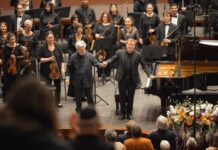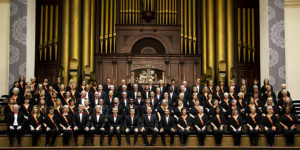
WAR REQUIEM by Benjamin Britten. At Every Nation Centre, Goodwood. Soloists Andiswa Makana, Siyabonga Maqungo, Daniel Ochoa, with the Philharmonia Choir of Cape Town (augmented by members of the Symphony Choir of Johannesburg), The Singakademie and Children’s Choir of Dresden and The St Cyprian’s Singers, with the Saxony Youth Orchestra and Cape Town Festival Orchestra conducted by Milko Kersten. On 19 October, 2018.
DEON IRISH reviews
The programme for this concert featured photographs of two ruined churches: the Kreuzkirche in Dresden, the imposing 18th century seat of the Lutheran Church’s Regional Bishop, and the St Michael’s Cathedral in Coventry, one of the largest mediaeval churches in England (with the third highest spire), that was elevated to cathedral status in 1918.
Both churches were largely destroyed in bombing raids on their cities in the course of the Second World War: the Coventry cathedral by the Luftwaffe on 14 November, 1940 and the Dresden church by combined British and American bombers on 13 February 1945.
The Kreuzkirche was rebuilt in relatively plain fashion in 1955 and, in the pure simplicity of its very spacious interior, provides a serenely contemplative response to the terrible consequences of that war. By contrast, Sir Basil Spence was commissioned to design an entirely new Coventry Cathedral to stand alongside the ruins of its predecessor; and following its consecration on 25 May 1962, this work had its premiere performance in the new cathedral just five days later, as part of those celebrations.
Intensely personal
The work was also a commission. But, in Britten’s response to this commission, he reveals it as something also close to his heart and intensely personal. One might almost surmise whether – had he not been commissioned to write just such a piece – he might not in any event have felt compelled to write something in this vein.
From as far back as his schoolboy years, Britten had been a committed pacifist. Possibly inspired by his composition teacher, Frank Bridge, his pacifism was certainly fostered by his close friendship with the poet W.H. Auden. At the time of the commencement of the Second World War in 1939, Britten and his partner, the singer Peter Pears, were already in North America and did not immediately return home, thus evoking some overt hostility in musical circles. Eventually, in March 1942 they returned on a Swedish merchant ship, Britten completing the evocative Ceremony of Carols on that trans-Atlantic voyage.
After spending the remainder of the war primarily entertaining troops and the like, the post-war years saw a burst of creative activity, with Peter Grimes (for the re-opening of Sadlers Wells Theatre), the formation of the English Opera Group and the continuation of a series of operas on which his reputation international reputation primarily rests. It was at this height of creative talent, evidenced in the captivating Midsummer Night’s Dream, that the commission for this work arrived.
Rather in the way that Brahms’ Requiem had its first performance in the Lutheran Bremen Cathedral, so this work was first heard in an Anglican cathedral. But, unlike Brahms, Britten did not hesitate to employ the words of the traditional Latin requiem mass.
And whilst Brahms stuck to biblical texts, Britten – in a stroke of genius – interspersed the Latin liturgical texts with the Great War English poetry of Wilfred Owen, nowhere more strikingly than in the extraordinary parallelism of the words of the liturgical Offertory (with an almost obligatory fugue on the words “as you once promised to Abraham”), and Owen’s evocative “So Abram arose”, with its inversion of the biblical tale to indict the obstinate old man who “slew his son, and half the seed of Europe, one by one.”
Monumental conception
To bring off this monumental conception, the composer assigns different roles to different musical elements; the main chorus, soprano soloist and orchestra sing the greater body of the requiem text. As two opposing soldiers (at the first performance representatively sung by Peter Pears and Dietrich Fischer-Diskau), the tenor and baritone soloists are accompanied by a chamber orchestra. Finally the angelic boys’ choir, set at a distance and accompanied by chamber organ.
This performance set the male soloists and chamber orchestra (conducted by Richard Cock) also away from the main stage and on the opposite side to the children’s chorus; it made for gripping theatre and the resultant surround sound effect was pleasingly effective in a cavernous venue which, despite its acres of carpets, yielded a surprisingly warm acoustic.
Of course, with this sort of configuration one’s precise position in the auditorium does make a considerable difference. I was very central and near the stage; in consequence, the soprano solo was mere meters from me, whilst the male soloists sang at some considerable distance.
Whether this was intended or not, the result was to give the men and their chamber orchestra a somewhat distant effect, as if these poems from an earlier war were echoing through the years into this commemoration of a more immediately recent conflict.
I enjoyed Andiswa Makana’s declamatory account of the soprano role. The Liber scriptus gave opportunity to demonstrate a powerful Verdian presence, with impeccable diction and a sure sense of ensemble; the Rex tremendae was fabulous in the rich power of her lower register; and the final Dies illa magisterial in its soaring assertiveness.
The most mellifluous tenor
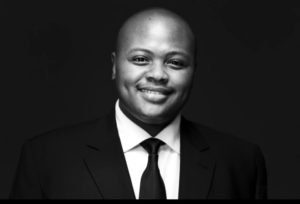
Despite this, the brightest star of the evening for me was tenor Siyabonga Maqungo. This man has the most mellifluous tenor, finely tuned and perfectly graded to turn mere notes into phrases of sleek refinement. One of the most effective episodes in this performance was the yearning Lacrimosa of Makana interacting with the chorus, and then yielding to a heart-rending “Move him into the sun” lament from Mqungo. “Was it for this the clay grew tall?” It is at moments like these that live performances assert a mastery over the best of recordings.
The third soloist, Daniel Ochoa, has perhaps the least grateful of the roles. His opening “Bugles sang” was certainly promising enough, but in his case the lower tessitura over the relative distance did exact a toll on the sound received and he would have done well to lift projection in the duets, so as to better match the better carrying capacity of the higher tenor role. Which having said, his final solo, with its chilling “I am the enemy you killed, my friend” seemed absolutely right.
The chorus was tremendous. It’s an unforgiving ask of amateur singers and they rose to the occasion with aplomb. Richard Haigh (of the Philharmonia), Ekkehard Klemm (Singakademie Dresden) and Richard Cock (Symphony Choir of Johannesburg) deserve fulsome praise for the meticulous care in preparation.
Equally impressive was the clean, ethereal purity of the Children’s Chorus, consisting of girls from St Cyprian’s School (Leon Starker) and children of the Dresden Children’s Choir (Claudia Sebastian-Bertsch).
The main orchestral accompaniment was provided by the Landesjugendorchester Sachsen, the second touring German youth orchestra to be heard in Cape Town in recent weeks. Unlike that of Rheinland-Pfalz, which performed pretty standard repertoire, this youthful ensemble was required to deliver an uncompromisingly difficult score: difficult of execution, of maintaining intonation, of jagged rhythms and potentially friable ensemble.
The overall result was astonishingly good and they achieved a musical coherence that many a seasoned orchestra of regular desk partners would battle to attain. Some instrumentalists stood out: I thought trumpets and horns were outstanding and the cellists a consistently vibrant presence. But it was the percussionists – despite an occasional diffident entry – who most impressed with their delivery of the considerable demands made of them.
Finally the conductor. Milko Kersten might well never again conduct this work with quite this degree of assured success. Given the disparity of backgrounds and training involved amongst the welter of performers, it was always going to be a hard task to make it all happen. Kersten revealed himself to be not merely a fine interpreter but an assured communicator of musical intent. In the result, attack, ensemble, rhythmic drive and tempo stability were hallmarks of an unforgettable performance of one of the masterpieces of the 20th century.
And for this, all involved in the organization of this enormous international undertaking have our profound gratitude.
What: Benjamin Britten’s War Requiem review
War Requiem soloists: Andiswa Makana, Siyabonga Maqungo, Daniel Ochoa
With: The Philharmonia Choir of Cape Town (augmented by members of the Symphony Choir of Johannesburg), The Singakademie, Children’s Choir of Dresden, The St Cyprian’s Singers, Saxony Youth Orchestra, Cape Town Festival Orchestra
War Requiem reviewer: A Deon Irish review
WS