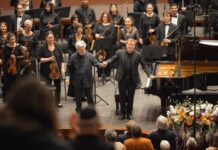
SYMPHONY CONCERT. Thursday 14 June 2018, At Artscape Opera House. CPO conducted by Victor Yampolsky, soloist Spencer Myer; Tchaikovsky: Romeo and Juliet Fantasy Overture; Grieg: Piano Concerto in A minor, Op 16; Prokofiev: Symphony No 7 in C sharp minor, Op 131.
DEON IRISH reviews
This was the third concert of the CPO’s Autumn Season and the first conducted by a frequent visitor to Cape Town over many years, Victor Yampolsky, the Russian-born director of orchestras at the Northwestern University in Illinois. He is a noted pedagogue and orchestra trainer and his careful preparation and insistence on balanced and structured playing was evident from the very outset in the delicate opening chords of the overture.
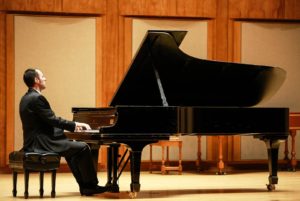
He was partnered in the Grieg concerto by Spencer Myer, another product of the American mid-West who first achieved local recognition when he won the 2004 UNISA International Piano Competition, the first of several acclaimed competition laurels garnered by him.
Grieg’s celebrated A minor concerto (the opening statement was for many years associated with a cigarette advertisement in South Africa, a supreme irony given the composer’s lifelong respiratory problems!) was written during a summer holiday in Denmark in 1868, a year after his marriage to Nina and shortly after the birth of their daughter, Alexandra. Grieg had studied in Leipzig and had there fallen firmly under the spell of Schumann’s burgeoning Romanticism. Little wonder that this concerto bears such an affinity to Schumann’s own earlier composition, in the same key. Nor that it was first published by C.F. Peters of Leipzig, in 1872.
Grieg made frequent visits to Leipzig in later years, one such giving rise to perhaps the most musically extraordinary New Year’s Day dinner ever, at the beginning of 1888. The venue was the home of Adolph Brodsky, where Brahms had spent the morning rehearsing his new C minor piano trio with Brodsky and a cellist colleague. Tchaikovsky (who was in Leipzig to conduct the premiere of his first Orchestral Suite a couple of days later) was invited to dinner and so met Brahms for the first time. Any potential awkwardness was alleviated by the charming Griegs, who happened to pop in and stayed for dinner!
By this time Grieg had turned more assiduously to the folk music of his native Norway for musical inspiration; but even this early work shows a little of that influence – particularly the final movement’s jaunty theme, which always seems like a little March for Trolls – but very nice little trolls, more like garden gnomes, really.
Neatly delivered
I found the soloist’s opening flourish a little foursquare: given the composer’s varying tempo indications, surely something a little more overtly fantasia-like is required? The first subject was neatly delivered (winds again impressing with crisp ensemble) and then the soloist gave a splendidly spiky account of the animato second subject, all glittering frost and shining icicles. Orchestral accompaniment was smoothly assured and the cello and bassoon solos of the piu lento episode richly delivered.
The big build-up to the recapitulation seemed rather tentative: triple forte double octaves are surely as big a hint as any show-off pianist needs to let rip? On the other hand, the triple forte outburst in the cadenza (with some wonderfully ominous, deep chromatic octave extended turns) was as showman-like as one could have wished, so perhaps Myer was just pacing things.
The soul of this work is its beguiling Adagio, a nocturnal vigil of deep contentment. The muted string opening sets the contemplative mood with a melodic phrase that, by subtle alteration of harmonic modulation and the addition of a seminal horn solo, achieves an effect of heightened emotion, a stirring realization of just how lovely the moment is.
Myer took full advantage of the mood set by the orchestra with a ravishing display of Chopinesque pianistic technique in the piano’s dreamy succeeding monologue. The minimal accompaniment – just the lightest of chords and gentlest of intervening modulations – leaves the pianist in almost recital mode.
There is a sudden central outburst: an emotional surge that transforms mere contentment into a chest-burning joy. Myer gave this full value, the double-handed chordal writing pulsing out in burnished triplets, but ultimately ending with the same threefold repetition of that ravishing phrase already made memorable by the horn solo.
Then the burst into the final movement, which is structurally rather disparate, including elements of Sonata and Rondo writing, episodes in major and minor modes, varying tempi from presto to tranquillo and variations of the theme in duple and triple measure. All lovely in themselves; but quite tricky to forge into a satisfying five course repast.
It didn’t quite get there, on this occasion. There were some lapses in execution: the left hand octaves in the alternatim section leading to the Quasi Presto episode simply didn’t have the requisite sonority to match those of the right hand (it is possible that this was another unwanted acoustic effect of the venue); some of the changes of tempo lacked cohesion between soloist and conductor (the enormous allargando slowing down into the final Andante was surely a great deal more than the composer’s modest “poco rit” seemingly intended) and led to a very imprecise entry in consequence.
On the other hand, the dreamy tranquillo section afforded Myer opportunity to display, yet again, some of the ravishing tonal beauty we had heard in the Adagio, a heartfelt aria over gently sighing string accompaniment. Simply lovely.
A soulful reading
The concert had opened with the Russian Tchaikovsky’s Fantasy Overture on Rome and Juliet – which was given a suitably colourful and dramatic reading by Yampolsky and the orchestra. We reverted to Russia for the concluding work, Prokofiev’s seventh and final symphony. This is a work made for Yampolsky to conduct and he did so with unfailing authority throughout its four intriguing movements.
The opening string imitative writing was neatly shaped and the rather episodic movement unfolded with a pleasing variety of colours and textures, all carefully portrayed. The succeeding Allegretto is a sort of cynical balletic commentary, a series of trivial musical ideas decorated and adorned in complex orchestral glamour and charmingly performed.
The lovely Andante was given a soulful reading, making much of its inherently wistful quality, despite individual orchestral solos being not free of blemish. The final Vivace – a sort of theatrical Gallop – was as invigorating as was undoubtedly intended, a final cock of the snook at grey Sovietism by a composer in the last year of his life.
CPO Autumn Season 2018: CPO conducted by Victor Yampolsky
Soloist: Pianist Spencer Myer
Info: www.cpo.org.za
More on CPO Autumn Season 2018: https://weekendspecial.co.za/cpo-autumn-season-2018-tickets/
WS