SYMPHONY CONCERT REVUE: SURPRISING SHOSTAKOVICH. Cape Town Philharmonic Orchestra’s Spring Symphony Season. On 4 September, 2025. At the Cape Town City Hall. CPO Conducted by Daniel Raiskin, with Tassilo Probst (violin). Review: ALBERT COMBRINK
Programme: Beethoven – Prometheus Overture, Wieniawski Violin Concerto No. 1 and Shostakovich Symphony No. 6
Visiting conductor Daniel Raiskin concluded his two-concert visit to the Mother City with a second triumph, following last week’s hugely successful “American Flair” – an all-American programme. A Symphony rarely heard, Shostakovich’s 6th in B Minor Op.54 is a brave and bold choice: a conductor new to the city, eager to make a good impression with the public, might have been tempted to select a pot-boiler.
A caveat of course would be attempting not to duplicate something we have recently heard, and with the busy CPO schedule, that knocks out quite a few works from the selection-list. It was our luck to experience the 6th of Shostakovich’s 15 symphonies. It is pretty unique in shape, shorter in scope than most of this composer’s more popular symphonies and it requires a conductor with a tight grip of the structure, who can also hold the reigns loose enough for the horses to take in the landscape. Raiskin was more than up to the task.
The Symphony was written in 1939, and its first movement is easily read as a musical snapshot of history. Hitler and Stalin had just cut Poland in half – each walking off happy with their share – and in return, had declared a mutual “non-aggression” pact. While the UK declared war on Germany, Russia stayed put. Tense but poised.
That term would accurately encapsulate the mood of the first movement of this unusual symphony: “Tense but Poised”. Described in many a write-up as a dreary, dark “slow movement” that somehow fails as a symphonic opening movement because it lacks certain repeats and extended development sections, our experience under Raiskin’s baton was quite different.
A powerful outpouring of emotion
The work started with a spurt of energy, like Parsifal at his zenith: Violas and Cellos in the baritone register, sang the first song of deep emotion, with a full warm sound that energised the take-off. This soon rose to a powerful outpouring of emotion, when that first salvo of horns arrive, bursting with life and aspiration, breaking through the dark clouds with a warming glow that can only be described as thrilling. We soon arrive in the world of Gustav Mahler: something about the viola trills, punctuated by tympany and double-bass footsteps, and Raiskin’s unhurried approach, made this a tone-poem of great beauty that referenced – without imitation – the long-breathed Mahler Adagios. The Bach-like sequential writing was crystal clear, and the balance was so good that the turns at the end of the first set of sequential trills could be heard. Such delectable details seem to be Raiskin’s pride to uncover. Bach with Mahlerian orchestration sounds like a nightmarish concept, and under some batons, that is what it could be. But tonight there was something comforting about the unhurried approach. Raiskin’s father celebrated his 90th birthday this very evening, and Raiskin senior – a renowned musicologist – had attended the world premier of this Symphony in 1939. Perhaps all these subcurrents and a life-long familiarity with every corner of this map, gave us the benefit of an un-neurotic view of the landscape…
This symphony is a “Concerto for Woodwinds and Orchestra” in all but name: from the first exposed piccolo solo to the duets and trios between various combinations of flute, clarinet, bassoon and Oboe, that follows, the work was an opportunity for our orchestra to shine. Each section-leader had more than one solo, and I would be able to mention each by name to give them credit. After the performance, Raiskin made sure to give each section-leader a solo-bow, and the winds themselves got special acknowledgement. And well-deserved it was. The extended cor anglais work by Carin Bam was deeply expressive – a song from afar and yet recognizable as located within ourselves. A lullaby? A funeral lament? No: a song for a feeling for which there aren’t words. One does not think of a piccolo as an “Espressivo” instrument, and yet Louisa Theart made it so, in all registers.
Controlled tempo
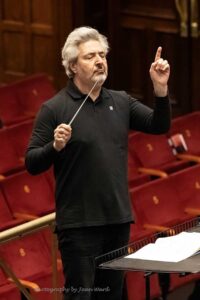 Raiskin seemed to control the tempo very tightly, but also allowed the players to be quite expressive in their many solos, making the work deeply meditative and easy to follow – drawing the attention from one decorative flourish to the next, like a slow meander through a precious place where every step held alluring beauty which insisted in being observed.
About halfway through the movement the orchestra reached a state of pianissimo that was quite hypnotic and touched the mystical: Raiskin was holding the audience in the palm of his hand, on which he would conjure mythical creatures to dance for us: Gabriele von Dürckheim and Lisa Thom’s duet-ribbons created a sense of sense of incantation, a gentle dance of mystery which opened the curtains to a timeless, floating fantasy-world that reminded a bit of Bartók, a bit of Wagner. But rather than Shostakovich referencing backward in history, I also feel that it is here that later composers like Adams, Kancheli, Pärt, Vasks, Rautavaara or even Hans Zimmer came to borrow more than one idea. From the general academic readings on this work, one can be forgiven for expecting a dull, dreary and depressing failed first movement: the much written about and oft-quoted “torso without a head” – because the symphony supposedly lacks a proper first movement. Quite the contrary.
One finds a fantasy-world where Stravinsky’s Firebird, the Prince and the evil “Kachei the Immortal” can reach a “non-aggression” pact, and for 20 minutes, the creatures that live there, can just “be”. A deeply moving experience, given the current news-cycle.
Annelize de Villiers set off the second movement with virtuosic garlands of clarinet runs. Soon the faux-heroic military-heroes arrive, their Soviet film-style posturing distracted by a crazy theme-park where the rides come alive and have a dark mind of their own. Ending with a mad scurry, there was nothing joyful about this parade, but we could not take our eyes off the tank with the squeaky wheels….
Third, final movement
The third and final movement brings more parody, as if Shostakovich wants to tell us just how far the regime had strayed from the values he held dear: it felt as if Mozart’s 40th Symphony had ingested “uppers” and had been let loose to run amok in a museum full of precious things, breaking and smashing as it goes, turning it into a mad circus of destruction and leaving us with an odd mixture of feelings from elation to sheer incredulity. Raiskin kept balance and ensemble under tight control, and orchestral detail remained delightfully clear. This was an unusual symphony, given an absolutely clear performance by a conductor absolutely in control of the material, and an orchestral instrument able and willing to work with him. Certainly a symphony to hear again.
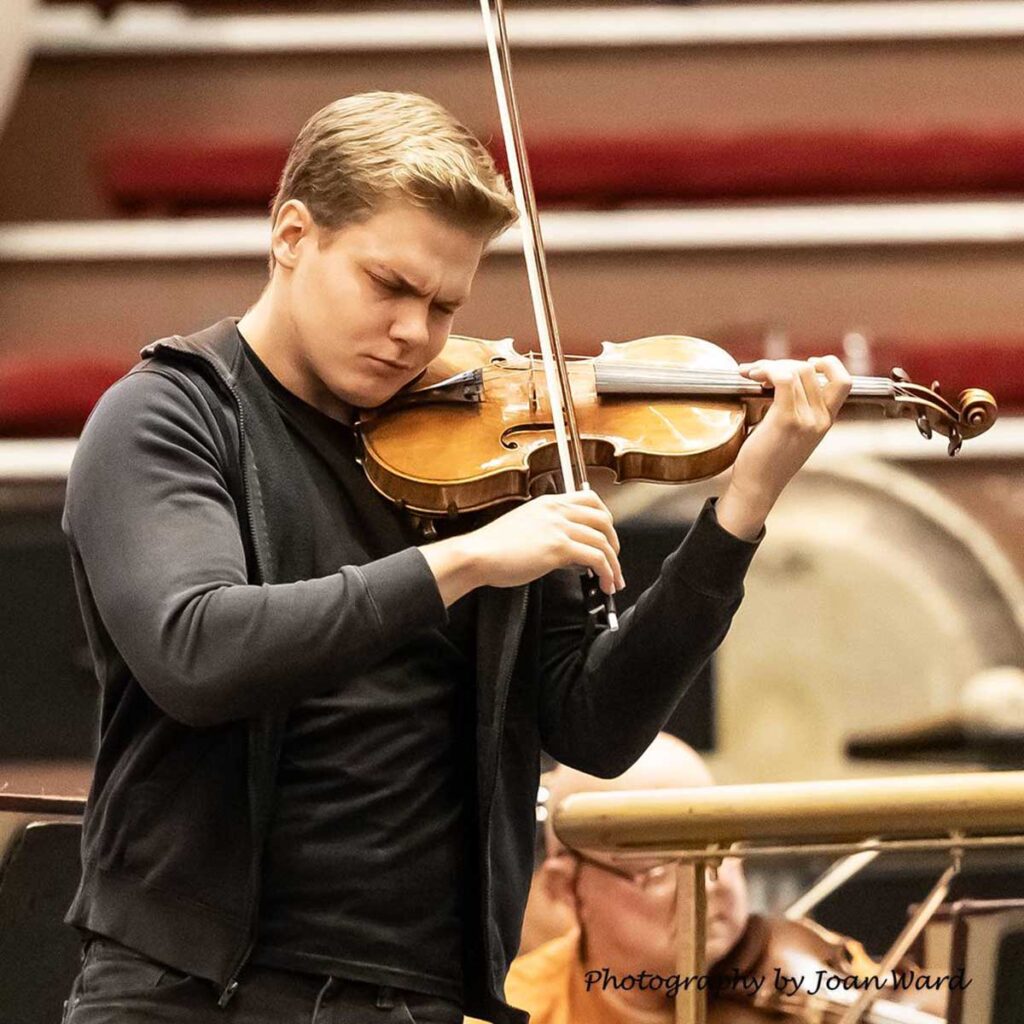
The concerto for the evening was Henryk Wieniawski’s Violin Concerto #1 in F# Min Op.14. Written by a brilliant violinist, hailed as the greatest Polish virtuoso of all time, it naturally bristles with difficulty. These technical demands are the reason often given for its slightly diminished popularity, obviously being overshadowed by the composer’s 2nd Violin Concerto, and indeed many other works from the era. A conventional virtuoso work, with some sweet and charming melodic ideas and a tender and occasionally moving slow movement “Preghiera” (Prayer), the concerto is, astonishingly, the product of a 17 year old composer.
A remarkable achievement for one so young – but then, he started young, graduating from the Paris Conservatoire at 14! Difficult, it is, launching forth with double-stops in tenths, and frequently flying in the highest register of the instrument. But ultimately it is a light work, if not to say “slight”. Paganini was clearly the model, and while it dishes the virtuosity in spades, Paganini just has a smile on the face that few other virtuoso violin-composers can match. The other model often quoted is the Chopin Piano Concertos, and on the surface the comparisons make some sense: light orchestration, easy melodies inspired by bel-canto operatic singing, interspersed by heart-rippling strings of pearls flying up and down the instrument. Lovely as the interpretation was, I am not sure the work really convinces me. Some of my heart-strings needed more tugging.
Tassilo Probst, the violinist, made as good a case for the work as one is likely to hear, live. With such virtuosic writing, some balls are destined to fall off the juggler’s unicycle. But not many, mind, and one can see why his debut CD “Into Madness” was named “Best Chamber Music CD of the Year” at the 2022 International Classic Music Awards. He has won numerous competitions such as the Tibor Varga and the Georges Enescu. He completed his Bachelor of Music Degree at the Munich Hochschule für Musik at 19, and is currently doing his Masters degree in Augsburg. As a scholarship holder of the Deutsche Stiftung Musikleben, Tassilo plays a violin made in 1690 by Milanese violin-builder Giovanni Grancino. The two of them made delightful flute flageolets and even dug into the chest register of the G string. The violinist was coaxed to play a light-hearted Bluesy and funky etude with Jazzy scoops and slides, and extended passages in 4th intervals, which pleased the audience. Those few not won over by the concerto, were soon taken by the encore.
“The Creatures of Prometheus”
The programme opened with Ludwig van Beethoven’s Overture to “The Creatures of Prometheus”. Of a 17 movement ballet on the theme of Prometheus – who steals fire from the gods to breathe life into two clay creatures he had made and watching it all go horribly wrong before going wonderfully right – only this overture is still performed. Written hastily in 1801, on commission to Emperor Franz and the empress Maria Theresa, the work is nestled between the second and third Symphonies, and avoids the temptation – or deliberately ignores the opportunity – to develop the work into a full symphonic movement.
One would think that Prometheus and his quest for life and igniting the fire in the heart, would be an ideal muse for Beethoven – much like a Lohengrin/Siegfried/Parsifal figure was for Wagner. But no. His inspirations were even loftier, and after a brief romance with the idea of Napoleon, placed his heart and last testament on Friedrich Schiller. He did however, spend his entire career “being” Prometheus – a quest for life and the fire within, despite the tortures of poverty, deafness, loneliness. One wonders what this ballet might have sounded like at the end of his career.
A powerful chordal introduction lifts the curtain on a mythical world of the struggle of “becoming of (hu)man” and “igniting the fire in the heart of this (hu)man”. One where the struggle is depicted by a frenetic scurrying of strings – Raiskin set a fast pace, and the orchestra smiled an obliged, giving us an exciting and toe-tapping opening. The overture is ultimately too short to make too many profound statements about its subject-matter – it is all over in 5 minutes – and yet the genius of Beethoven reveals not the demonic struggle of the human condition – or the horrific punishments meted out to Prometheus – but the heroic victory of the (hu)man over its own darkest impulses. When those final three tympany-strikes echo across the City Hall, one feels that perhaps all is not lost. Yet. We still have art and music to remind us of our better selves.
Here’s hoping to see both Daniel Raiskin and Tassilo Pobst in Cape Town again, sooner rather than later.
Next CPO CONCERTO: A SPANISH AFFAIR:
On 11 September – 19:30 Concert, 11:00 am Dress Rehearsal
Conductor: Martin Panteleev
Soloist: Alvaro Toscana (guitar)
De Falla The Three Cornered Hat, Suite No. 2
Rodrigo Concierto de Aranjuez
Tchaikovsky Symphony No. 4 in F minor, Op. 36
Book here.
Reviewer: Albert Combrink
WS