SYMPHONY CONCERT. Thursday 28 August, 2025. At Cape Town City Hall: CPO conducted by Daniel Raiskin, soloist François du Toit; Bernstein : Overture to “Candide”; Gershwin: Piano Concerto in F; Williams: “The Cowboys” Overture; Bernstein: Symphonic Dances from “West Side Story”. Review: DEON IRISH.
This was a hugely enjoyable concert programme: expertly conducted, assuredly delivered, enthusiastically received.
It is rare for the CPO to stage an all-American programme. But experiencing such does cause one to consider and recognize the enormous contribution to the concert repertoire emanating from the huge pool of musical talent that has characterized the United States of America. That much of its musical output is the product of inter-cultural interactions is a matter for sober reflection.
Of the composers here considered, both Gershwin and Bernstein were the sons of immigrant Russian Jewish parents: the former growing up in impoverished circumstances in New York’s lower East Side; the latter born to well-off parents of Ukrainian origin and nurtured in Lawrence, Massachusetts. By way of contrast, Williams was born of solidly middle-class, Anglo-Saxon stock, albeit in the very culturally diverse environment of the New York borough of Queens.
A remarkable overture
The two halves of the concert each kicked off with a remarkable overture, distinctive of their respective composer’s musical personality. Bernstein’s musical, Candide, to a book by Lillian Hellman based on Voltaire’s eponymous satire, opened on Broadway on 1 December 1956, but closed after only 73 performances. Although its undoubted quality has been recognized and even lauded in subsequent decades, it remains a relatively seldom performed musical – perhaps because of a tendency to become too pretentious for the genre – but its viciously sparkling overture has become a firm favourite in concert programmes.
A fine reading
On this occasion it received a very fine reading, Daniel Raiskin (making a very welcome debut with the orchestra) being evidently sufficiently satisfied with the mettle of the players to take the opening at breakneck tempo, a merciless introduction to over-the-bar, off-beat melodic stresses, chattering wind chording, punchy brass beats and flurries of snatched string conversation.
There are two significant central episodes which David Ewen likens to opéra-buffa melodies, although the earlier of the two (assigned chiefly to winds) is perhaps more accompanimental than melodic in its import. The winds tossed it off with vivacious precision and the second, string melody – which really does belong in the mouth of some pert soubrette house maid – was pertly charming. An invigorating start to the evening.
The overture commencing the second half was, although for different reasons, equally arresting in its initial impact. A Williams trademark was peremptorily stamped onto the very opening – the chain of declamatory tongued horn semiquavers, brassy and arresting in urgent immediacy, and transporting one in an instant to the Saturday afternoon movies of my youth and the dry gulches of New Mexico and the Western Badlands.
But there are plenty of derivative hints, too, and the Appalachians of Copland’s barn-dancing farmers are never all that far removed from the action. The work, although not having the technical hurdles of Bernstein’s overture, still presents real challenges in execution and the horn section, in particular, can be satisfied with their recurrent prominent contributions. Raiskin held it all together with a commendable sense of filmic drama.
The two principal works
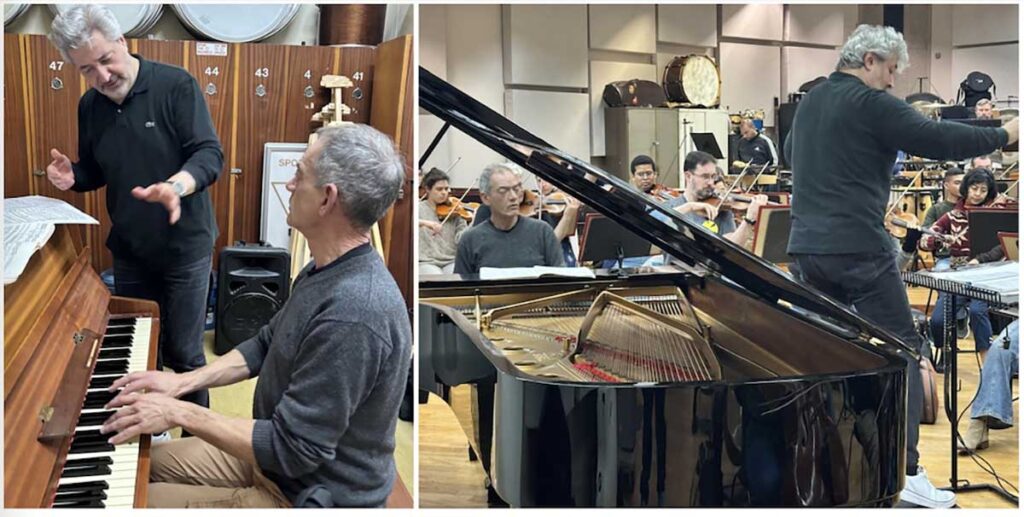
Now to the two principal works on the programme. We last had the Gershwin F major concerto in June 2017, in a concert which also featured the Bernstein Symphonic Dances. But I don’t recall du Toit having ever performed it in his many years associated with this orchestra.
Following the huge success of his 1924 “Rhapsody in Blue”, Gershwin was commissioned by the conductor Walter Damrosch in the following year by to write a piano concerto for his New York Symphony Orchestra. Whilst Gershwin had managed decent piano tuition and had significant experience in music for stage and club, he knew so little of formal symphonic music that he purchased a book to read up on the concerto form, before he commenced work on the project.
The work has inevitably been criticized for perceived formal and structural defects; but in its jazz-infused cheeky rhythms and atmospheric bluesy strains, it seems as much at home in the concert hall as an American relative in Downton Abbey.
An ergonomic efficiency
Du Toit is a very accomplished pianist and, over several decades now, has repeatedly rewarded Cape Town audiences with performances of some of the best-loved but also most taxing works in his instrument’s concerto repertoire. He always seems to achieve these results with an absolute minimum of personal display and with an ergonomic efficiency that astounds in the degree and quality of sound he produces with so little apparent physical effort.
His musical activities involve a good deal of chamber and accompanimental music, which provide rich pickings for a work of this nature, in which the more frequently encountered bravura concerto role assumes something approaching a hybrid or crossover form. For, despite its considerable and engaging solo episodes, the pianist nevertheless remains something of a jamming jazz buddy with the Charleston-declaiming bassoonist and the blues trumpeter with the fedora.
This work was Gershwin’s first major essay in orchestration (Ferde Grofé had actually orchestrated the Rhapsody) and it includes several lovely touches – including lovely melodic writing for the violas (beautifully executed, no doubt under an encouraging eye from Raiskin, who himself started as a violist).
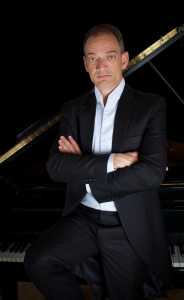 Du Toit’s delivery of the piano score was exemplary, as always; although a touch more sheer sleaze would not have gone amiss. The sometimes tricky integration of the disparate elements of the opening movement into a formal structure was well managed and Raiskin proved himself an adept accompanist.
The succeeding adagio was truly lovely; in no little part due to a quite marvellously languorous, even dreamy trumpet solo from Dave Thompson (although using a conventional mute rather than the felt hat indicated in the score). He negotiated the repeated awkward two octave plummets to a bottom A flat with commendable tonal control. Equally delicious was the perky way du Toit chirruped the theme into the central D flat episode – for all the world like a quotation from Mozart’s Spatzenmesse.
Then the allegro agitato finale, which I thought du Toit delivered with real distinction, demonstrating in its innately percussive, frequently astringent piano writing an unexpected cosinage to the Shostakovich of the second concerto. It is this movement, above all, that establishes Gershwin’s class as a pianist-composer.
Raiskin’s conducting impressed throughout; not merely for an assured control of the accompaniment, but for a wonderfully flexible cohesion with soloist and nigh faultless balances – the more impressive without previous experience of the hall. It was an exhilarating reading and du Toit, Raiskin and orchestral players – particularly solo bassoon, trumpet, oboe and flute – all deserved the delighted ovation.
Raiskin spent five years as Chief Conductor of the Slovak Philharmonic Orchestra and remains its permanent Guest Conductor. So, it was a personally happy coincidence that we heard him conduct the final work of this programme, Bernstein’s Symphonic Dances from “West Side Story”, as I had heard a marvellous account of the suite from that very orchestra in Bratislava in January this year, conducted by Peter Valentovic (who some will remember from his time as chorus master of Cape Town Opera).
In passing, for those who might not be aware: the charming Slovakian capital of Bratislava is only as far from Vienna as Malmesbury is from Cape Town and has a vibrant musical culture, including an absolutely first-rate orchestra and really good opera and ballet companies – all at a fraction of the now truly stratospheric Viennese ticket prices.
Something of a festival for the brass
The Symphonic Dances requires a huge orchestra, including cor anglais, contra bassoon, alto saxophone, five percussionists and piano; and it was a delight to hear the orchestra playing with a necessarily enlarged complement of strings in consequence. (The crush of percussionists gave rise to a marvellous moment during the scherzo when a cymbal stand was knocked forward and was – seemingly autonomically – caught by the player sitting immediately below it, the unintended (one hopes) recipient of an attempted decapitation!).
If the Williams overture had given them opportunity to shine, then these dances represented something of a festival for the brass. Unlike the writing in Candide, this musical – despite its undoubted sophistication and quite sumptuous orchestration – does not aim at any great intellectual import but remains in essence a heartfelt variation on Romeo and Juliet.
If Gershwin was a wonderful pianist-composer, of a type like a Chopin or a Liszt, then Bernstein – one of the great conductors of the last century – belongs in the same cohort as a Tchaikovsky or a Mahler. His conducting experience certainly seems to have informed the quite superb orchestration of this work. In the result, this score is a continuous exploration of texture and colour, of rhythm and lyricism and of emotional effect, and it received a wholly rewarding reading, Raiskin seemingly revelling in the Latin-American flavours.
There were far too many felicities to pick out the contributions of individual players: but – because the melody really is almost too beautiful to bear – principal horn Shannon Thebus’ “Somewhere” horn solo must be mentioned.
Reviewer: Deon Irish
WS