The African Choir 1891 Re-imagined is a multi-media installation at the IZIKO South African National Gallery in Cape Town. Presented by Autograph ABP in partnership with composers Philip Miller and Thuthuka Sibisi, the exhibition has been curated by Renée Mussai.
The site-specific digital projection featuring image, text and sound premiered in Cape Town. It will later travel to Johannesburg to the Apartheid Museum and the FADA Gallery.
Background
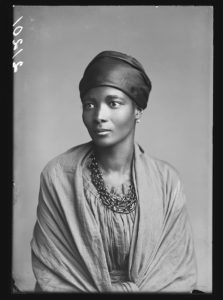
The installation is based on the African Choir’s first tour to Victorian England in 1891. It comprises five songs re-created by the composers from an original nineteenth century concert programme along with twenty photographic portraits of the original members of the Choir re-discovered in London at the Hulton Archive after 125 years.
The original fourteen-member African Choir, drawn from mission stations and church choirs in the Eastern Cape, toured England and the USA. Choir members such as Charlotte Maxeke (née Manye), her sister Katie Makanya and Paul Xiniwe later became leading social activists and reformers in South Africa. They performed to great acclaim to large audiences in England, and before Queen Victoria. Their repertoire was divided into two halves: one comprised Christian hymns sung in English together with popular operatic arias and choruses; the other consisted of traditional African hymns, and some of the first originally composed hymns by South African composers: John Bokwe and the Rev. Tiyo Soga.
Together they form an artistic representation that humanises and gives voice to a part of history long unknown by contemporary audiences and which has only been documented through written diaries, academic papers and archival photographs
The African Choir 1891 Re-imagined connects the composers, Miller and Sibisi with the curatorial research led by Renée Mussai as part of Autograph ABP’s on-going Black Chronicles/The Missing Chapter archive research programme.
The sound, photographs and installation
The Choir’s performances on tour were never recorded, although one of the concert programmes has survived. This has given freedom for the composers to re-imagine the repertoire. Working with fourteen young singers in a series of improvised and collaborative workshops in Cape Town in 2015, they recreated the original repertoire.

The visual component comprises twenty large-scale framed photographic portraits of the original members of The African Choir, enlarged as modern silver gelatin prints from 19th century glass plates. The glass plates, by the London Stereoscopic Company, were recently re-discovered by Autograph ABP at the Hulton Archive (a division of Getty Images) after 125 years and first exhibited to critical acclaim in 2014.
Curated by Renée Mussai of Autograph ABP, this multi-media installation consists of the 20 large-scale portraits surrounded by a 30-minute immersive multi-channelled sound recording of a contemporary choir in the gallery space. The photographs are displayed in one discrete gallery room with its walls painted black, creating a powerful and intimate installation, echoing the 2016 London premiere, and associated Black Chronicles programmes presented between 2014 – 2016 in different iterations and venues.
What: The African Choir 1891 Re-imagined
Where and when: IZIKO South African National Gallery until 13 November
Soundtrack available for download: https://store.cdbaby.com/cd/philipmiller9
Pictures featured:
Eleanor Xiniwe, The African Choir, 1891 by London Stereoscopic Company. Courtesy of ©Hulton Archive/Getty Images
The African Choir 1891 Re-Imagined CD cover
WS