SYMPHONY CONCERT. Thursday, 23 August 2018. At the City Hall. CPO conducted by Bernhard Gueller, soloist Alissa Margulis; Mozart: Symphony No 36 in C, K. 425 (“Linz”); Bruch: Violin Concerto No 1 in G minor, Op 26; Beethoven: Symphony No 4 in B flat, Op 60.
DEON IRISH reviews
The last performance of the Beethoven 4th Symphony that I heard at this venue was in a concert given by the then CTPO conducted by David Tidboald on 24 October, 2002, at which it served as the overture to a programme that featured a breathtakingly beautiful performance of the same composer’s violin concerto, played by David Grimal.
Mozarts’s symphonies have fared little better: we had a “Haffner” at the Shelley gala concert a couple of years ago; prior to that, the only record I have of a Mozart symphony performed by this orchestra in this century was a single performance of the 29th Symphony in A major more than a decade ago. Of course, I don’t get to every single concert, so might have missed a Mozart symphony or even two; but it is an incontrovertible fact that we hear very few symphonies of the Classical repertoire, including the earlier Beethoven works.
A welcome variation
So these Mozart and Beethoven symphonies (and the Haydn “Drum Roll” we are due to hear this week) represent a very welcome variation from the somewhat heavy regular symphonic diet.
The “Linz” symphony was written in the eponymous Austrian city in less than five days during the 1783 Autumn, when Mozart and his wife were put up by Count Thun on their way back to Vienna from a visit to Salzburg. There was to be a concert and the Count wanted something by Mozart, so he quickly dashed off this composition to oblige his host. (He also found time to write a slow introduction to a Michael Haydn symphony, given at the same concert, which was in confused consequence published in the collected works of Mozart as Symphony No 37 in G, K. 444.)
No trace of this spur of the moment composition can be found in the actual writing: the expansive first movement – with its slow introduction and extensive allegro – stamps the work as one of the earliest of the composer’s late masterpieces, infused with the musical freedom and experience already gained since his move to Vienna.
However, unfamiliarity does take its toll; which might explain the degree of apparent caution in the account of the transparent opening adagio, with the very first wind chord (at the end of the opening dotted rhythm phrase) not crisply together and the oboe response in the conversation with bassoon rather fragmented. However, the allegro took off at a good pace and Gueller did much to delineate the antiphonal architecture of the writing.
The succeeding slow movement – a rarity for Mozart in its use of trumpets and timpani – demonstrates the greatest departure from the influence of Haydn in its heartfelt cantilena, an assured outpouring of Mozart’s deceptively simple melodic gift, and in the subtle creation of a slightly threatening atmosphere in an otherwise sunny movement. I felt that Gueller might have taken this movement at an even more reflective tempo.
A suitably aristocratic dance
The rather straightforward Minuet and Trio (the latter with lovely solo oboe contributions) was a suitably aristocratic dance (Gueller not trying to turn it into a scherzo) and the finale had a controlled, brisk energy with pleasingly crisp string playing and a beautifully integrated timpani presence.
The enthusiastic audience reaction – which would surely have given Gueller and the players a further applause call-back – was cut short by some additional players wandering on to the stage for the succeeding concerto. Both ill-disciplined and impolite.
Leaping ahead to the Beethoven symphony, a work that dates from 1806, provided opportunity to gauge just how far symphonic writing had advanced in the intervening quarter century. And these changes do, in part at least, mirror the change in the social and political landscape which marked the same period. The Vienna of 1806 was no longer even a genuinely imperial city.
The thousand year old Holy Roman Empire (which had given the Habsburgs their imperial title) having imploded in the wake of the Napoleonic depredations that redrew the map of much of Europe in the years following the Battle of Valmy, Franz II (or I, depending which title you refer to) followed the example set by Napoleon in France and simply proclaimed himself Emperor of Austria, formally abdicating the throne of Charlemagne on 6 August 1806.
A little of this social upheaval infected the residence of Prince Lichnowsky outside Troppau (now Opava, near the Polish/Czech border), where Beethoven was spent the late summer of 1806 and where he met Count von Oppersdorf, who commissioned this symphony for a fee of 500 florins. His stay at Troppau came to an abrupt end when, having refused to perform at a soiree given by his host for some French officers, Lichnowsky jokingly threatened Beethoven with house arrest. The composer stormed out into the rainy night and sought shelter in the village, before leaving the next day for Vienna. He sent a scornful note to the Prince, which perhaps does reflect something of the sentiment of the times: “There have been and will be thousands of princes. There is only one Beethoven.”
And yet it is difficult to detect anything of these destructive and unsettled times in the joyous creation that is this symphony. Like Mozart’s “Linz”, it has a slow introduction. But, as Downes points out, this is more thoughtful than brooding and gives way to one of the most carefree and buoyant allegros of all of the composer’s works.
Gueller led the orchestra in a vibrant reading
Gueller was in his element in this music and led the orchestra in a vibrant reading, characterized by cohesive string playing (with a pleasingly noticeable viola presence, perhaps in part due to the new section leader, Petrus Coetzee). The succeeding Adagio was notable for some haunting clarinet solos and the declamatory concluding horn outburst – a feature that repeats itself in the final phrase of the succeeding scherzo.
Gueller took this latter movement at a brisk enough pace, quite living up to its “allegro vivace” marking. Here, any pretense at a courtly minuet had given way irremediably to a rumbustious, rhythmically complex orchestral showpiece, the frenzied string and chattering wind writing light years away from the self-assured world of Count Thun and his courtly concerts.
If the allegro was taken vivace, the finale – despite its non troppo marking – set off at breakneck tempo. I feared for bassoonist Ball, playing an instrument not noted for its celerity in passage work, who was already fated to deliver that dizzying theme on one of its rondo re-appearances. The moment came and passed in a whirl of chortling notes, which even almost sounded individually tongued. Tempo was not all, however: Gueller’s care with the intriguingly designed bridge passages was exemplary, as was his attention to the detailing of the complex cross-rhythms and off-beat stresses.
In between these two symphonic expositions, we had “the” Bruch Violin Concerto – that in G minor, written in the years 1857-1866 and revised two years later. (There are another two in D minor alone, not counting the essentially concerto-like “Scottish Fantasy”.)
The work has strong stylistic links to its lovely predecessor by Mendelssohn – but is also characterized by a lovely motif in the adagio which calls unbidden to mind Strauss’s “Alpine” Symphony.
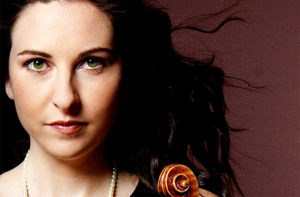
Soloist Alissa Margulis
The soloist in this performance was Alissa Margulis, who has a string of competition and recording credits behind her. The opening truncated sonata movement (a sort of prelude to the slow movement, into which it leads) was wholly engaging, particularly the quasi-cadenza that forms the link into the adagio. It was this central movement that really captivated, with some glorious arioso playing that featured a refined use of vibrato.
Orchestral accompaniment was gently tailored to match the soloist, with a true pianissimo achieved by the string band.
However, the solo account was marred by a sudden and curiously harsh tone in the final episode of this dreaming movement which one would have dismissed as a momentary lapse, if something similar had not occurred again in the passage with solo flute before the coda in the boisterous finale. And there were in addition a couple of textual inaccuracies in the giddying zigeunerisch writing.
What: CPO Symphony Concert Review
Soloist: Alissa Margulis
Reviewer: Deon Irish
Cape Town Philharmonic Orchestra: https://www.cpo.org.za/
WS