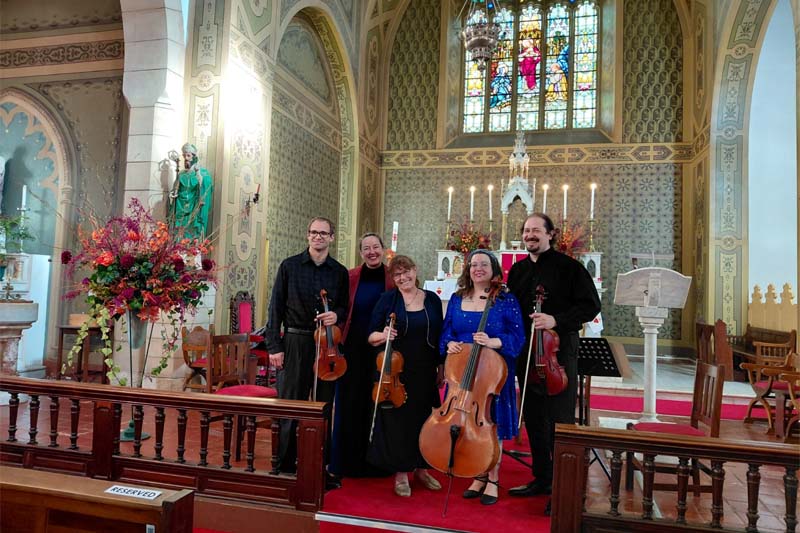
CONCERT REVIEW. Cape Town Concert Series Presents the St Petersburg String Quartet. On 23 May 2026. At Sacred Heart Catholic Church, Greenpoint, Cape Town St Petersburg Quartet comprising: Alla Aranovskaya, 1st violin, Ned Kellenberger, 2nd violin,
Boris Vayner, viola, Sascha Groschang, cello. Programme: Glazunov 3 Novelettes Op.15, Shostakovich String Quartet No,8 and Ravel String Quartet in F Major. Albert Combrink reviews
Classical music lovers across South Africa have had the opportunity to enjoy a world-class string quartet, as the Grammy-nominated St Petersburg String Quartet made its first-ever tour of the country, with performances in Johannesburg, Cape Town, Franschhoek, Hermanus, and Knysna. The tour was a collaboration between Louise Howlett of the Cape Town Concert Series and Francois Combrink from the Mzanzi Chamber Collective. The tour also included chamber music Masterclasses with students from across Johannesburg and the South African College of Music.
Sacred Heart Catholic Church
The Concert Series is usually associated with the Baxter Concert Hall, but diary and other practical considerations occasionally take the music to a variety of venues throughout the city and further afield. This concert was held at the Sacred Heart Catholic Church in Greenpoint. A successful venue on many levels, it is quite accessible (with the Cape Quarter close by), has excellent acoustics for the right music, and has ample seating with good visibility. It is also a beautiful space to enjoy, with a courtyard with the Goodman Art-Gallery and Pauline’s coffee shop to enjoy at interval, and many beautiful artworks and stained-glass windows to enjoy inside. I hope we get to enjoy many more concerts in this gem of a venue.
The St Petersburg String Quartet has performed hundreds of concerts across North America, Europe and Asia, appearing at some of the world’s most prestigious festivals and concert series. Its accolades include “Best Record” honours from Gramophone and Stereo Review, an opening night performance at New York’s Lincoln Centre Mostly Mozart Festival, and residencies at leading music institutions, including the Oberlin Conservatory of Music and Wichita State University.
Absolutely fantastic players
To accurately describe the concert would require a dip into a thesaurus. The short version is, they are absolutely fantastic players, individually and collectively. Each instrument held their own, with comfortable and fearless virtuosity, in what is, essentially, some of the most demanding works in the repertoire. And as a unit, they seemed to think with one brain, and play one heart.
An exquisitely crafted sound that never buckled under the wildest technical demands – and to be clear, in this programme they are very wild – leaving the listener to enjoy the artistic display without the slightest anxiety as to the technical execution. They are a world-class ensemble deserving of their reputation.
The programming was ideal. The quartet is travelling with two programmes, and the only issue was that we could not – practically – hear both programmes in one sitting. Common to both programmes, was the Novelettes for String Quartet, Op.15 by Alexander Glazunov (1865-1936), from which the quartet selected a suite of three – and trimming a page or two off the finale – to make a successful concert-version: a delightful introduction to a suite of which I had never heard, let alone heard live. Each movement from Glazunov’s suite tells a story from worlds distant in both time and space: Spain, the Orient, and Hungary; and uses music in a reverent, olden style. A dazzling display of string quartet techniques, each piece is in a three-part ternary form, and the set contains a wealth of drama and emotion.
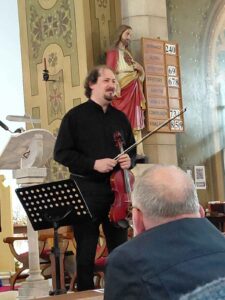 The sweetness of the first violinist caught attention in the melodic material from the outset. The way the players seemed to back off into quirky accompaniments or step forward for melodic material and conversational interactions was superbly handled. I had one question in that the ornaments in the music inspired by the Orient and Hungary – as Glazunov calls “the ancient modes” – were not always clearly audible. Acoustics or artistic choice? Nonetheless, their interpretations seemed to focus on the larger musical contour and not all the minutiae.
The String Quartet No. 8 in C minor, Op.110, by Dmitry Shostakovich (1906-1975) is probably his most important and famous of the 15 he wrote in the genre. The strength and power of the work takes one by surprise when hearing that it was written in just three days. But the context soon becomes apparent. The composer was visiting Dresden to work on a Soviet film score. The city had been destroyed by the Allied firebombing in 1945. The bombing killed more people than the atomic bombing of Hiroshima. The city still showed the scars, even after a decade-and-a-half. In just three days, there erupted from Shostakovich one of the most powerful and important string quartets, not only of this composer, but of the entire 20th century, inscribed “In memory of victims of fascism and war.” The work, described as the composer’s “emotional confession”, is dominated by his musical signature, using his initials and reading them as German letter names: DSCH (D–E♭–C–B). His many quotations and self-quotations also include a popular revolutionary song “Exhausted by the Hardships of Prison”.
The quartet did not play as harsh or acidic an interpretation as I have heard, and I wondered if I was missing some level of anger or defiance from the players. But these are expectations I bring to the music, from years of listening, reading about the composer, his suicidal depression and his personal and political rebellion against Stalin. The listener’s expectations are valid – of course. But the artists are bringing their vision. What they brought, was less of a soundtrack to a war-movie and more of what Shostakovich himself wrote about the piece – that if someone were to write his musical tombstone, what would it say? The music-making of the quartet is deeply musical, and one is struck again and again by the way they both blend and distinguish the four individual instruments, functioning both as individual players, and as one, large, four-throated voice. And at the end of the quartet, they held the moment in the air, delaying applause. That kind of finesse – brought to everything they play – is noted and appreciated.
Interval was spent in the spacious, sunny courtyard with a delicious cappuccino and popping into an art gallery. There were many musicians in the audience, and especially string players. And there was complete consensus: we were in the company of exceptional musicians. After interval, we heard the String Quartet in F major by Maurice Ravel (1875-1937), his only work in the genre – sadly – and along with Debussy’s, the defining work of French Impressionist quartet writing. The work caused a scandal, not for the usual reasons: it was considered a masterpiece by public and artists, but the conservative musical intelligentsia dismissed it out of hand as unstructured, dissonant and a failed attempt. When it did not win the coveted “Prix de Rome”, the scandal resulted in a governmental enquiry which forced the resignation of Théodore Dubois, the director of the Paris Conservatoire. Thank goodness for Debussy, who said: “In the name of the gods of music, and in mine, do not change a single note of what you have written.”
A superb reading of the work
The St Petersburgers gave us a superb reading of the work. Highly virtuosic, with extreme technical demands on the individual players as well as complex ensemble hurdles such as pages and pages of plucked pizzicato work that simply has to be 100% accurate or descend into chaos. I was struck by the rich sonority of these plucked notes and the rather intimidating passages of violin and viola playing in unison two or three octaves apart. Intonation simply did not fail. The tempos were flowing rather than fast, and the rhythmic sections had bite rather than a scramble. A work containing so much joy and lightness, conveyed with such joy and lightness, was just a joy to hear, from first note to last.
The encore was Indi Mindi by Georgian composer Sulkhan Tsintsadze (1925-1991), one of his famous 6 Miniatures for String Quartet. Lively, rhythmic and deliciously virtuosic, we got a snapshot of Georgian folk music. Like a Georgian Béla Bartók or Zoltan Kodály, Tsintsadze writes folk-infused material that is easy on the ear and tickling on the toes. The composer, a cellist, also wrote 12 string quartets and a string of miniatures for quartet – even an arrangement of this very suite for mandolin and string orchestra. Surely, this is a recording project waiting to happen for this ensemble!
This concert has been an absolute highlight of the season so far, and I hope a return visit happens soon.
The Next Cape Town Concert Series Concert is something completely different:
Charl du Plessis Trio: Mozart, Mambo, Merlot – 6 June at 15:00. See here.
Booking: Webtickets
What: Cape Town Concert Series Presents the St Petersburg String Quartet
Reviewer: Albert Combrink
Info: info@ctconcerts.co.za
WS