SYMPHONY CONCERT REVIEW: RISING STARS 1. On Thursday, 16 January 2025. At the Cape Town City Hall. CPO Conducted Jonathan Lo (Conductor), George Harliono (piano)
Wagner: Meistersinger Overture Tchaikovsky: Piano Concerto No. 2 in G, Op. 44.
Beethoven: Symphony No. 2 in D, Op. 36. ALBERT COMBRINK reviews.
There is something very special about the atmosphere at the City Hall at the start of a new symphony season, when the hall is packed and the programme promises to be a humdinger. A Tchaikovsky Competition Medalist as the soloist, a programme of popular but not overplayed works, and a fine orchestra conducted by a fine conductor, did not disappoint.
Friends of Orchestral Music
The event was hosted by the Friends of Orchestral Music (FOM), a non-profit organisation consisting of volunteers, and has as its main aim the support of developing a love of classical orchestral music, and the development of youth in music. Through various fundraising activities the Friends are able to assist in a range of portfolios – Youth Orchestral Development, Individual Music Study, Classical Music broadcasts on Fine Music Radio, Instrument Repairs & Donations, and the professional body of the Cape Town Philharmonic Orchestra (CPO). FOM run the dress-rehearsals of the CPO concerts and raise money from donations. Donate here.
Fluidity and natural musicmaking
Chief Conductor of the Australian Ballet, Jonothan Lo, is a return visitor to Cape Town, and a welcome return it is. His South African debut in 2022 with the CPO and the Cape Town City Ballet drew unanimous praise for his light touch, the fluidity and natural musicmaking, and an ability to step back and let the music speak for itself. These qualities made themselves known from the first bars of the large Overture to Wagner’s “Die Meistersinger”. There can be something “organ-like” in the writing, with blocks of brass orchestration broken up by different registration, much like the organ that introduces the following Act 1. The music is intended to invoke the grand history of German music, setting the scene for a highly nationalistic story which unfolds around a singing-competition with a bride as first prize. (It is perhaps best to enjoy the music and not over-analyse the plot…).
Strong echoes of Bach appear in the counterpoint, and the muscular Lutheran Choral is present from bar one. The relatively uncomplicated key of C Major adds to a lighter, festive atmosphere, perfectly captured by Lo and the orchestra. Lo chose to start the Overture a little under full-throttle, giving scope for a satisfying build-up to a climax that didn’t overblow the brass in the generous acoustics of the City Hall. The orchestra – presenting some brand new members for the first time – played well, and the first violins in particular, nailed that pesky unison unaccompanied run that scatters and turns at the very top of the fingerboard, to the dismay of many a professional orchestra.
Superstar George Harliono
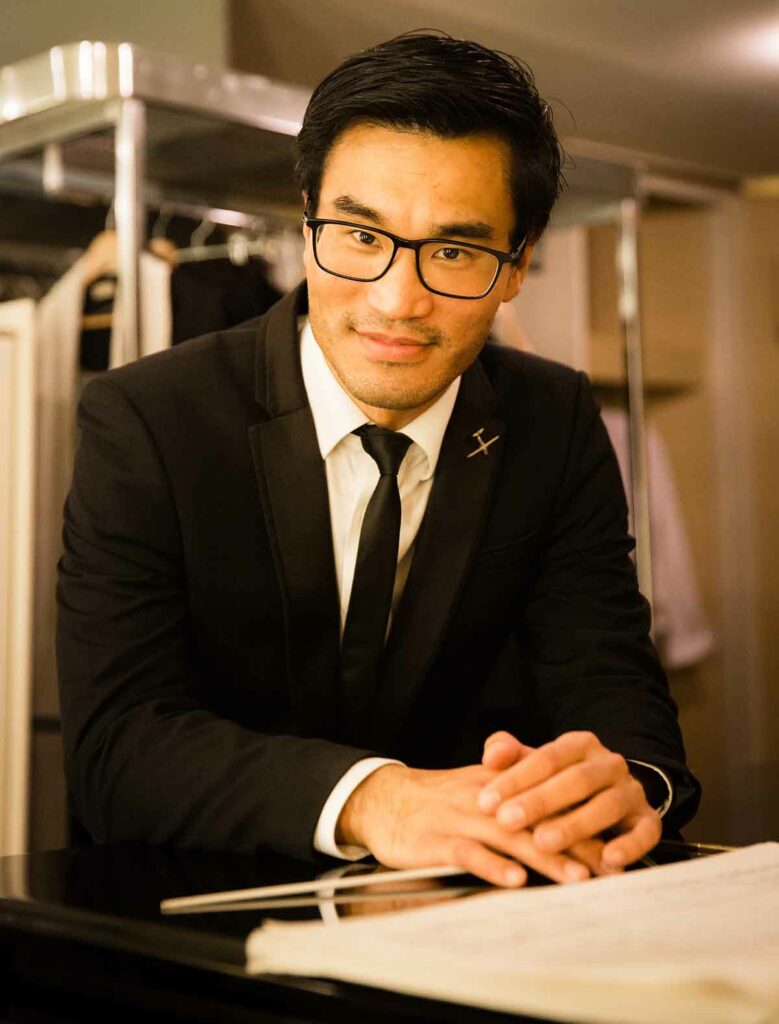
Although only 23 years old, George Harliono is already an international superstar on the classical music stage. In the decade since his concert debut at age 12, George has performed with orchestras that include The Moscow State Symphony Orchestra, The Mariinsky Orchestra, Tatarstan National Symphony Orchestra, New Millennium Orchestra of Chicago, Frankfurter Opern- und Museumsorchester, Tyumen Philharmonic Orchestra, and Sendai Philarmonic Orchestra. His collaborators reads like a who’s-who already: Valery Gergiev, Alexander Sladkovsky, Evgeny Shestakov, Ainars Rubikis, Anton Lubchenko, Ken Takaseki, Sebastian Weigle… Winning Silver Medal in the last Tchaikovsky Competition proved faith in his early promise was not misplaced: he shot into the international spotlight after an invite to play Rachmaninoiv in Moscow with the Mariinsky Orchestra, becoming a media celebrity in the process.
George Harliono has received awards from several competitions including the Grand Piano Competition in Moscow, the Royal Overseas League Music Competition, the Gina Bachauer Piano Competition and the Dino Lipatti Piano Competition in Bucharest. Presently he studies with Pascal Nemirovski, international chair of keyboard studies at Birmingham City Conservatory.
Speed, power, fleet-footedness
It says a lot about Harliono that he presents the less-played of Tchaikovsky’s 2 big Concertos, rather than a more obvious war-horse. He plays with the speed, power and fleet-footedness we have come to expect from today’s piano-competition athletes. This concerto is long – at 45 minutes, some consider it too long – and the challenge for the musicians is two-fold: sustaining the sheer athletic energy through out, and sustaining interest in the listener. The athleticism was a given, from first (was there a finger out of place in the second chord), to last, we were left gasping at the virtuosity. The speeds of the fast material was alarming – one wonders if the “scotch-snap” of the Finale’s Tartar dance might not have had a bit more kick at a slightly slower tempo, and one wondered if the orchestra and soloist would stay afloat through the rapids when material gets passed from soloist to orchestra in dizzying torrents of notes. One or two tiny wobblies aside – in a 45 minute piece not every orchestral entry is going to be flawless – the audience were kept at the edge of their seats.
Tenderness and gentle musicality was abundant, none more so that in the violin and cello solos by Peter Martens and Philip Martens (the former, leader of the cello section and the latter, the concert-master), where the focus shifts from the large canvass of the orchestral textures, to a tender trio – a quiet conversation and an invitation to a dance – before the flurry of the last movement erupts. Harliono has already found his own unique voice in the mainstream repertoire: He says in interview: “I don’t play in the Russian way. Actually, I was working with an orchestra in Siberia, we were performing Tchaikovsky No.1 and the conductor said to me that no Russian pianist would ever play Tchaikovsky in the way that I was, he thought that was cool. I will never play the same way that Russians play, I play my own way, without restrictions. I don’t think this is a bad thing, I perform the music my way and of course not everyone will agree with my interpretation. I try to remain faithful to the composer and to myself.”
Two encores
We were treated to two encores: the first was “Dizzy Fingers” by American pianist “Zez” Confrey 1895-1971), known for composing “novelty pieces” such as “Kitten on the keys” and “Dizzy Fingers” – both reflecting the influence of Ragtime and his work as an arranger of music for silent movies. Played with a sense of fun and a groove that would be as welcome on TikTok as at Wigmore Hall, was indeed “Dizzying”. For the second encore, Harliono was joined by conductor Lo as piano-duet partner, and cellist Peter Martens, for a mic-drop “Swan” from “Carnival of the Animals” by Camille Saint-Saëns. A little lollipop perhaps, but so exquisitely performed we needed only sit back and enjoy.
The sheer range of sound and volume that Harliono produced, makes one excited to hear his recital for the “Cape Town Concert Series” 70th Anniversary Concert at City Hall, at 11am on Saturday 18 Jan.
After interval, Jonathan Lo introduced some of his ideas about Beethoven’s 2nd Symphony before the performance started. It feels mean to complain – but the sound system just was not up to the task and most of the balcony could only catch the gist of the brief talk: that Beethoven had been sent away from Vienna in an attempt to tackle his failing mental health and encroaching deafness, and the failure of this attempted cure resulted in the “Heiligenstatt Testament” – a letter by Beethoven to his brothers – which has been interpreted as a conversation with God, and/or a suicide note. Lo felt inspired by the fact that Beethoven – despite the darkness of this period in his life – did not, in fact, harm himself, but attempted to deal with it in the only way he knew how – to keep working and expressing his music.
Transparent textures
Lo presented the symphony as an optimistic and light-hearted attempt to move on past the diagnosis of his deafness. As a performance-model, it absolutely works, as the darkness, heroism and Four French Horns of the “Eroica” Symphony still lay well into the future. One of Lo’s gifts is transparent textures and the willingness to use the large-volume climaxes sparingly. This makes for delightful touches, like the Double Bass section counterpoint at the coda of the first movement, suddenly being powerfully present, driving the movement to an exciting end. Beautiful woodwind playing made the slow movement a delight, and the pastoral mood of the central trio was nostalgic rather than sentimental. The Final movement ran along without any disturbances, stopping just a bit short of a state of “Gemütlichkeit”. I was wondering about the wisdom of programming the Symphony at the end, rather than the massive concerto – as a return to lighter classical fare might feel like a let-down. I was wrong. After all the drama and emotion of the Tchaikovsky, to enjoy the different kind of drama and emotion of the Beethoven, was effective programming and the concert was the perfect length, given the memorable encores.
Conductor Jonathan Lo will conduct the CPO next week, 23 January, in Elgar Serenade in E minor, Op. 20, Mozart Violin Concerto No. 3 in G, K. 216, Shostakovich Symphony No. 9 in E-flat, Op. 70 with soloist Lidia Baich (violin).
Read more about CPO concerts here.
What: CPO conducted by Jonathan Lo, soloist George Harliono piano
Reviewer: Albert Combrink
WS