 CPO SYMPHONY CONCERT REVIEW. 11 April 2024. At The Cape Town City Hall: CPO conducted by Bernhard Gueller, soloist Jan Jiracek von Arnim; Schumann: Overture to Manfred, Op 115; Mozart: Piano Concerto No 23 in A major, K.488; Schumann: Symphony No 1 in B flat major, Op 38 (“Spring”). DEON IRISH reviews.
Bernhard Gueller loves Schumann and Brahms. We don’t have to take his word for it: that connection has been established over many years in a great number of performances of major works by both composers – although Brahms certainly dominates the list on a straight headcount.
The commentator Donald Tovey recounts the first visit to London in 1902 of the wonderful Meiningen Orchestra, with its famous conductor, Steinbach – arguably (with Joachim) the finest Brahms interpreter of his time. The English organizing committee requested that they perform a Schumann symphony. Steinbach’s replay was “Schumann we cannot and will not play.” After further entreaty, Steinbach eventually consented to perform that composer’s Manfred Overture. The anecdote gives some inkling of the status of this overture amongst Schumann’s orchestral works.
Lord Byron poem
The work was inspired by the eponymous poem by Lord Byron, a work written at the height of the English fashion for the ghostly, which manifested in the ghost story evenings of the Shelleys and in Mary’s own still popular, “Dr Frankenstein”. It was written in Switzerland, whither Byron had fled after the outbreak of a scandal in London, in which he was implicated in a suspected incestuous relationship with his stepsister.
That circumstance is quite likely reflected in the guilt-ridden character of Manfred, a dabbler in necromancy haunted by some personal guilt. He wanders the lonely reaches of the Alps, encountering sundry ghostly incarnations and, in a famous scene, contemplates suicide by jumping into a gorge on the higher slopes of the Jungfrau.
Oboe solo
Liszt conducted the first full staged performance of the poem, with all of Schumann’s incidental music included, in 1852. In correspondence preceding that performance, Schumann wrote to his colleague: “I commend especially the Overture to your heart. I feel it is one of the strongest of my artistic children, and I hope that you may agree with me.”
It certainly received a reading that fully enunciated the many effects it employs to depict the character of the hero and the despairing situational melancholy to which he was wont. The opening oboe solo was beautifully shaped and immediately set the rather dark character of much that was to follow. Gueller managed to integrate the rather arbitrary and transitory allocation of prominence to the violin section or brass chorus in the course of the work into something approaching a more structured architectural intent and, in particular, caught the suggested Alpine character of at least some of the suggested context with high-soaring phrases that showed the way to a much later Richard Strauss.
Böttger poem
It is convenient to pass to forty minutes after interval, when we heard the same composer’s “Spring Symphony”, dating from his “happy year” of 1840. He had been obliged to sue his prospective father-in-law and to petition the court in order to be permitted to marry his great love, Clara Wieck. That consent was eventually granted after a 10-year struggle on 1 August and the couple were married shortly afterwards, on 12 September.
The first few post-nuptial months were largely devoted to an outpouring of lieder; but in just four days in January of 1841, he sketched out his self-titled “Spring Symphony”, the initial impetus for which came from a poem of Böttger.
Last outburst of heady joy
Gueller gave the un poco maestoso opening a suitably portentous rather than solemn character: this was new life stirring from a hibernation, the first slow and stiff outlines of a budding joy that is yet to come. Schumann is frequently criticized for poor orchestrational technique (although less so in respect of this symphony); but no-one doubts his musical ideas and innovations. (It has been said that his greatest contribution to music was the ideas he gave others.)
Here, however, that nascent theme bursts into a gloriously invigorating molto vivace, taken at a suitably heady tempo on this occasion and delivered with admirable lightness of touch. The winds were lovely in the opening measures of the development and the delicious tinkle of the triangle gave a suitably light-hearted touch to the soundscape. The cleverly attenuated recapitulation was built up with beautifully gauged increased tension through the sequence of rising modulations that lead, ultimately, to the quite novel material of the coda, a strangely relaxed episode – perhaps depicting sheer contentment – after which Gueller unleashed a last outburst of heady joy to end the movement.
Schumann’s original manuscript had titles for each movement, although they were discarded on publication. The Larghetto was designated “Abend”, and its evening character is indeed more than apparent. But this is no Chopinesque nocturne; rather, the gentle ending of a Spring day, the warmth lingering as the light fades, the colours of the blossoms gradually becoming, with the music, ever more pastel until, at the last, hardly more than a suggestion.
It was a finely conceived and beautifully delivered account and, in Gueller’s hands, this slow movement of Schumann sounded as good as any written by his younger and more distinguished disciple, Brahms.
A sound compass
I thought Gueller’s chosen tempo for the molto vivace scherzo was ideal – just restrained enough in the hall’s acoustic to preserve clarity and preserve the somewhat deliberate nature of the subject, even at its indicated pace. The trio formed a beautiful contrast of mood and time signature, the final measures with the timpani rolling away under the sequence of chattered chords in the winds quite delicious.
Lastly, the great finale, indicated as being both animato and grazioso – well, after the initial flourish had been got out of the way. The strings, with the winds, are principally tasked with delivering and engendering this spirited delicacy and both bands of the orchestra did extremely well in that task. There is a lot of almost moto perpetuo writing – contrasted with fragmented and snatched comments between one group and the other. The winds also have some splendid little choruses of their – tricky of execution and always at risk of ensemble coming unstuck.
No such problem in this reading: Gueller knows this score intimately and led the orchestra through the treacherous reaches with a sound compass and a sure foot. The beautifully delivered flute solo led us into the final episode and – in the manner of a horse approaching the stables on the ride home – the final gradual accelerando to us to the wonderfully invigorating conclusion. This was a fine reading and fully deserved the ovation it received.
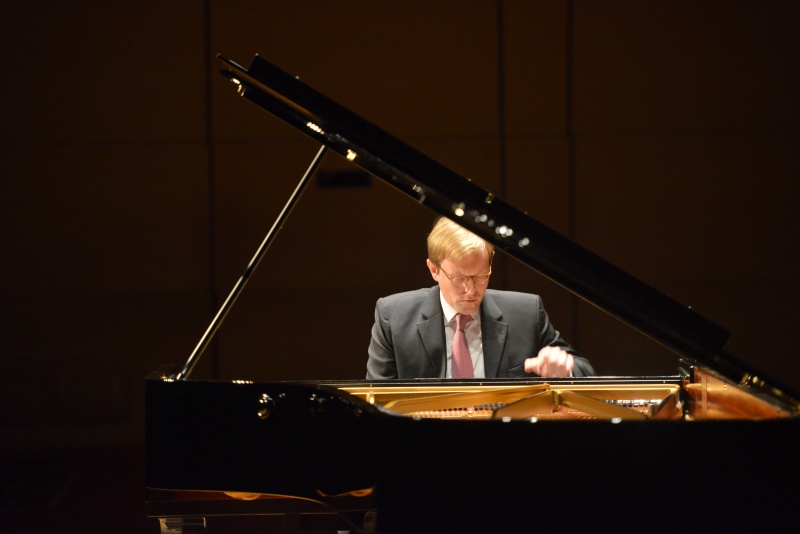
Sandwiched in between these Schumann works was one of Mozart’s most delightful concertos, that in A major, K.488. I found this account less than rewarding, not because of any failure of execution (which there was not), but rather because of an increasingly restless belief during the performance that we were not getting to the elusive soul of the music. Jiracek von Arnim is a distinguished pianist and a Viennese resident to boot. So that ought to be that.
And yet – where was the sheer loveliness of tone, that elusive hint of melancholy even in the warmth of the A major tonality; the sense of intimacy, as if you and the composer were sharing some private exchange even in the midst of the public statements; and, even more particularly, the extraordinary emotional depths generated by the minimalist writing of the extraordinary Adagio?
It all came across as rather of matter of fact, I fear. And left one feeling just that.
What: CPO review Jan Jiracek von Arnim
Reviewer: Deon Irish
WS