CAPE TOWN OPERA. Wagner’s Der fliegende Holländer, with Jaco Venter, Johanni van Oostrum, Gregory Frank, Samuel Sakker, Lukhanyo Moyake, Nonhlanhla Yende. CPO and CT Opera Chorus conducted by Tim Murray. Directed by Matthew Wild, design Michael Mitchell, lighting Kobus Rossouw, video design Kirsti Cumming. At Artscape Opera House.
DEON IRISH reviews
FOR an opera company that operates in a city on the very peninsula which is home to the legend on which this opera is based, there have been remarkably few local stagings of the work in recent decades.
There was a production mounted by the local chapter of the Richard Wagner Society in 2011; but, for a staging by this opera company, one has to go back to the 1993 revival of the Schneider-Siemssen production for reference. A particularly curious anomaly for a company that has a chorus of this stature!
Memorable moments
This is very much a production of two disparate elements: vocally, it proves an arresting evening with some memorable moments; in theatrical terms, it suggests a somewhat confused attempt to force the ugly sister’s foot into the glass slipper.
The ugly sister, in this case, is Cape Town’s colonial history, which Wild has sought to identify as the curse that keeps the Dutchman forever sailing the unforgiving waters of the Cape. The neatly integrated graphics that portray evils attributable to colonialism – imprisonment, slavery, torture – provide the evidence which gave rise to the curse.
The attempt to make opera relevant to contemporary issues is, of course, laudable. But not every opera libretto is necessarily a suitable vehicle for a particular contemporary debate. The central theme of this libretto, as conceived, is redemptive love: in this case, that of the heroine, Senta. The Dutchman, condemned to sail forever, for whatever reason, can only be released from his limbo and achieve a peaceful rest by the love of a woman who is true to him until death.
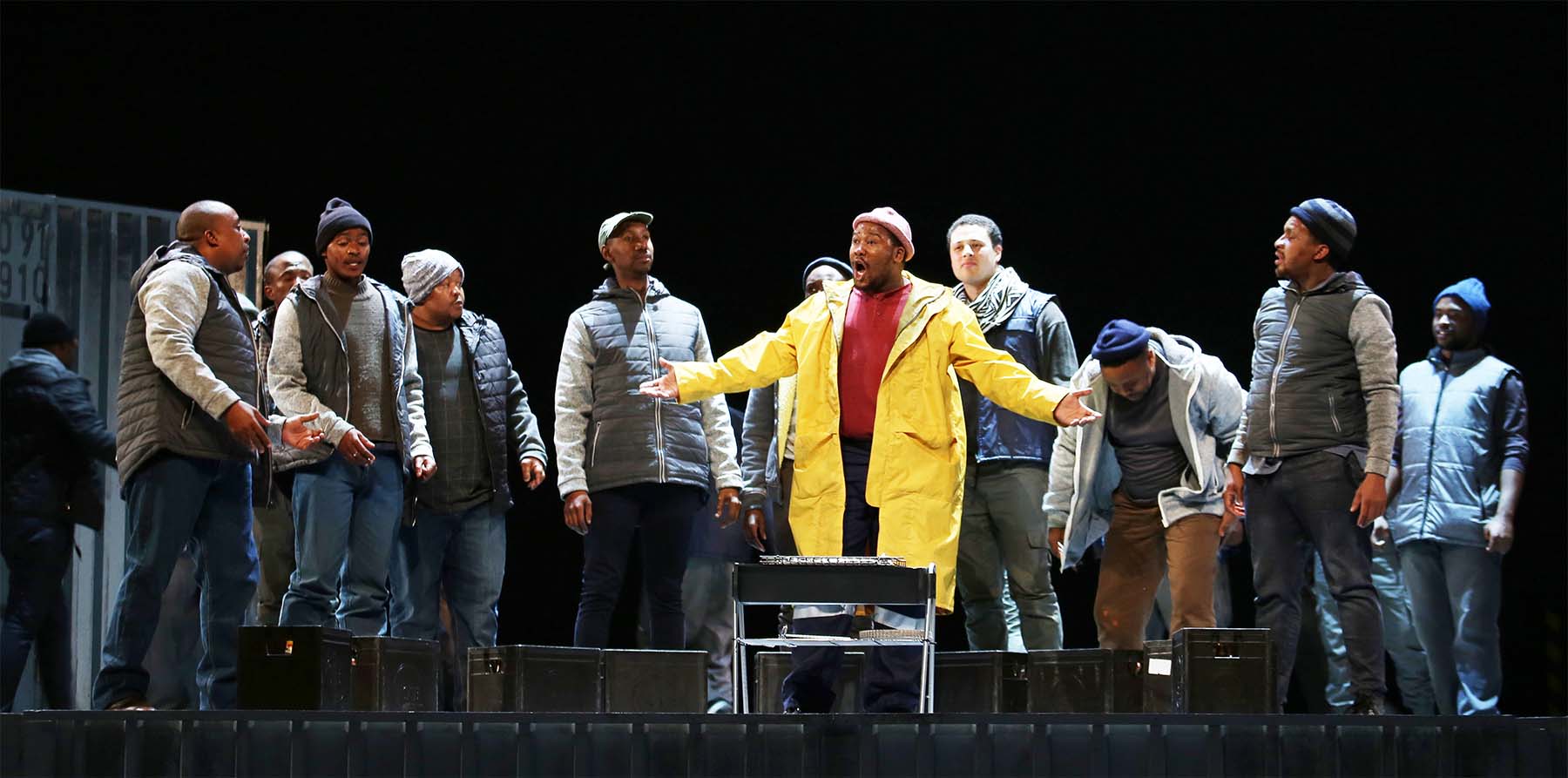
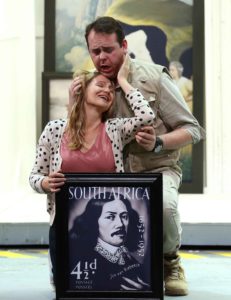
The production is vividly and effectively set in the present, with Daland and his sailors very much contemporary seamen who, seeking shelter from a storm, meet up with the phantom vessel. Senta is portrayed as a sort of Romantic, idealizing the past and obsessed with portraits of colonial worthies and cardboard cut-out sailing vessels. Upon meeting the ghostly Dutchman, the attraction is immediate: she soon starts emulating his 17th century clothing, as if realizing an abiding fantasy.
The dramatic problem with this approach is that, far from making her a present-day source of redemption for the Dutchman from his cursed colonial background, she becomes an uncritical adulator of his problematic history, and her father the beneficiary of its ill-derived gains. A somewhat failed allegory, then.
Beguiling lyricism and easy projection
The strong cast was led by South African-born baritone Jaco Venter in the title role. Starting almost diffidently in his first appearance, the character grew in stature and sympathy as the plot unfolded. Venter is capable of a beguiling lyricism and easy projection, particularly rewarding in set pieces such as the almost comic duet with Daland, Wie? Hört ich recht?, with its Rossini-derived accompaniment. But he is capable of authority, too: the lyrical yearning implicit in the opening chromatic measures of Wohl hub auch ich were neatly delivered and then smoothly increased to a passionate cry for release in the final measures.
With him in this duet was Gregory Frank as Daland. A bass of considerable power, he made a brave stab at making the rather incredible character almost credible. But the contemporary staging really does make a father giving away his daughter in marriage to a rather peculiar stranger – even with a promise of immense wealth – rather improbable.
As the object of this exchange, Johanni van Oostrum (another South African-born singer) makes a radiant Senta. Whilst her voice might not have great dramatic power, her carefully focussed projection achieves considerable presence even over fairly full orchestration. The undoubted benefit is that the more lyrical episodes have easy warmth and an even more pleasing lack of intrusive vibrato.
Of the smaller roles, Samuel Sakker was a finely conceived Erik, portraying Senta’s rather bewildered suitor with convincing stagecraft and vocal assurance. Mein Herz voll Treue and the succeeding duet with van Oostrum was another highpoint of the evening.
Star of the evening
Lukhanyo Moyake’s Steuermann and Nonhlanhla Yende’s Mary were both satisfactorily portrayed.
But the undoubted star of the evening was the Cape Town Opera Chorus, at last given their head in a score worthy of their considerable powers. If the women were engrossing in the spinning chorus, it was the final male choral battle between the two ships’ companies that cranked the entire production onto a different level.
In the pit, Tim Murray conducted the CPO with vacillating levels of success. The truly wayward horn parts can certainly not be laid at his door; but he does bear responsibility for frequently overbearing brass in a reading that too often failed to achieve satisfactory balances, either within the orchestra, or between pit and stage.
What: Wagner’s Der fliegende Holländer
Web: www.capetownopera.co.za
WS