Sheila Chisholm
MILLENNIUMS ago when mankind discovered pinching thumb and index finger together could hold objects, among the limitless uses this movement allowed was… sewing. That could be achieved by holding a sharply pointed instrument, with a hole at the opposite end, through which a thread could be threaded to “overstitch/cobble” skins together – usually clothing or shelters.
Over centuries, sophisticated needle and thread embroidery and tapestry techniques have developed to not only help women living in rural areas to earn a living by embroidering scarves, handkerchiefs, shawls and clothes, but also to create extraordinarily magnificent works of art that today hang in museums.
Although embroidery is a “textile craft that utilizes a needle and thread,” tapestry is (normally) produced on vertical looms – often depicting historical events. Yet the term tapestry tends to be loosely used to describe any stitched wall hanging. One such masterpiece is hanging in the Normandy’s Bayeux museum. The so called Bayeux tapestry, is actually a (1080) crewel embroidered piece illustrating the 1066 Norman Conquest of England.
There was a time when embroidery stitches were taught in schools. Today that picture has changed. While sewing (as opposed to tailoring) is still predominantly a woman’s domain for both urban and rural woman, it is for the rural woman that Carol Hofmeyer has dedicated the past 17 years of her life. In 2000 she founded and developed the Keiskamma Art Project in Hamburg, Eastern Province.
Holding both a medical degree and arts diploma, in 2000, Hofmeyer with her husband Justus, moved from Gauteng to East London. Purchasing a tiny cottage in Hamburg changed her life as well as people in surrounding communities.
Appalled by the poverty and rampant spread of HIV/Aids in the villages, Hofmeyer set about trying to change conditions. Firstly she started at a clinic to treat HIV/Aids patients. Then began teaching women to crochet plastic bags into hats and bags for sale in shops and craft markets.
Hofmeyer, in a recent speech at the UCT Irma Stern museum when Professor Brenda Schmahmann’s book The Keiskamma Art Project was launched, confessed her guilt at being “white, advantaged” and thought she could heal this community by treating them medically and also teaching them to work with their hands.
Those feelings all but stalled this life-giving project. “Then Brenda produced the Keiskamma Art Project book with its marvellous illustrations and facts. That’s when I realized, regardless of our differences, the community and my own life are entwined.” To quote Hofmeyer “we need each other at least equally. I am because you are, I exist because you do.” A message all should apply every day in our country torn apart by disunity.
Published by Robin Stuart-Clark of Print Matters (www.printmatters.co.za) and selling at R445, The Keiskamma Art Project takes the reader on a journey of an extraordinary woman who started an extraordinary project. A project where art works, having become nationally and internationally recognised, have aided restoration of hope, livelihoods and self-pride to a depressed community.
Professor Schymahmann’s book is available at UCT Irma Stern Museum, Cecil Road, Rosebank, where excellent examples of the Keiskamma Art Project are on show in the Coral Room from 11a.m until Saturday, February 25, 2017
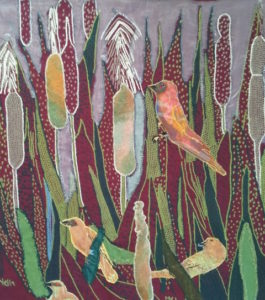
Among the most outstanding pieces is Cebu Mvubu’s Imizwilili tapestry. Worked on velvet in running stitch, chain stitch, hemming, French knots, stem and back stitch, Mvubu not only designed the picture, he formed a team to embroider birds, sugar bush proteas and other indigenous plant life. Priced at R40 000 Imizwilili is a rare collector’s item.
What: Keiskamma Art Project
Where: UCT Irma Stern Museum, Cape Town
Call: 021 685 5686.
WS