Mick Raubenheimer
Givan Lotz is a playful auteur. A visual artist and musician currently signed to the US-based Other Electricities label, his music is idiosyncratic, skilfully intricate and suggestive, and often evokes humankind and the individual’s various quests for theistic, romantic and aesthetic meaning in the vast, splendorous apathy called the universe.
I first encountered him at a concert during Righard Kapp’s Jaunted Haunts Press tour. His set was short and focused (just him and a guitar) and utterly mesmerizing. I distinctly remember glancing down at my hand after the first 10 minutes or so, to notice that my cigarette had burned all the way down. I hadn’t taken a puff. I could sense that I was witnessing something special: The entire audience seemed under the spell of the music, there was none of the usual chatter, or clearing of throats or shufflings that tend to accompany small venue performances like unwanted, detracting decorations – everyone was listening with baited breath.
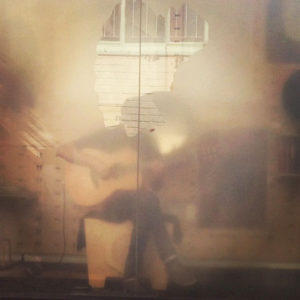
A cornucopia of electric slashes/washes
Three years later and Lotz’s spare, delicate debut, EASY NOW, was followed up with a four-disc release, 2013’s SNARL, and a seeming transformation – the lone guitar and voice were now just elements of a swirling canvas of sound, seething with a cornucopia of electric slashes and washes and ambient eruption. Last year saw the unveiling of MAW, a gorgeous, Royal Blue pressed vinyl, a concept album tracing some parallel human reality where mankind exists post science, in an impossible, ebbing world of mists and visions and ellipse. It is an eccentric and starkly beautiful meditation of an album.
We took a seat with Givan in the cybersphere, on the eve of his latest release, YAW.
Do you have a set approach to songwriting?
Songwriting starts with me and a guitar or an organ. I never decide to sit down and write songs — it just happens when I’m experimenting on the guitar as part of my daily playing routine. Vocal melodies present themselves as I’m noodling away. About half the time vocal melodies present themselves when I submit myself to some sort of drone: fridge hum, electric fan purr, traffic white noise, guitar feedback, the buzzing you hear like bees in your ears just before you fall asleep. These things activate melodies in my head. Songwriting and lyrics take a little longer. I prefer to wait till the end of the process when I have a bunch of different songs to work on, so I can write across them with some unifying idea. On MAW, the songs deliberately borrow from each other — some lyrics link with each other, some musical motifs are repeated. The ambience or treatment mostly occurs at a recording and production level. Some of that droning that led to the initial song has to come back into play. I try not to over-layer things — much of the fullness often comes from a single instrument with just the right type of reverb or room noise.
How/when did the music-making bug first bite?
Music has been a part of my life as far back as I can remember. My grandmother was a piano teacher and I’d sit with her when she played the organ in church. I started playing guitar when I was 9 and had classical and finger-style training in high school. After playing in a few bands at university, I self-released a solo album, EASY NOW, in 2008 as part of an art show. It was never meant to be a debut but it was re-issued in 2010 by Jaunted Haunts Press. It took me 4 years after recording EASY NOW to muscle-up the courage to start documenting songs again. By then I’d written in excess of 80 songs, 36 of which would eventually become the four-disc set called SNARL.
Music has taken on a variety of roles throughout history – what does music mean to you?
Music, for me, offers a potential transport, a ritual induction, an escape from the mundane. It is no accident that traditional rites of passage are accompanied by some sort of song and dance. The music’s potency assists the aim of transition in these rituals, the crossing of a threshold. When I make and perform music I want to enter into a sublime state, it’s therapeautic, it’s catharsis. Hopefully some listeners will follow me there but it’s not essential to me reaching my private, internal goal.

Why is YAW a companion piece to last year’s MAW?
I have a general problem of having too much material going into an album. My last album output before MAW, called SNARL, had to be released over a four-disc set, and then eventually culled to 20 songs to become SNARLING [Other Electricities, 2013]. With MAW I wanted to fit the material into 44 minutes’ playback so I could do a single traditional vinyl LP. I tried my best to cut the fat and the result was a succinct 10 song cycle. But I can’t really get away from my default setting which is generating new material every time I pick up the guitar. So while meticulously editing and whittling down MAW, all these short instrumental vignettes were being written alongside the ‘main’ songs. It was enjoyable not to overthink them and allow for something more meandering. Of course they were written and recorded with the same mental setting as MAW and as such there are recurring themes. MAW and YAW share the same world. YAW attempts to do what MAW did but without words, without voice, written for and primarily performed on a uniquely prepared, tempered classical guitar. If MAW is a fragmented description of a speculative visionary future where the myth of progress has failed, then YAW acts as a collection of artifacts from this strange imagined culture, an incomplete forgotten catalogue.
You are also a visual artist – are the two disciplines distinct for you – do they overlap?
The relationship between the two has changed over time. Initially, the two practices operated separately, in parallel, with very little convergence. Exceptions were projects like Gaze, Gush, Gasp, Glare and occasional visuals for my live shows (https://vimeo.com/67306991). Not so long ago, my visual projects had an almost didactic approach — it had very clear agendas and objectives — whereas the music has always been more open and automatic, unencumbered by audience expectation and, in this sense, at once pure but idiosyncratic, bordering on solipsistic in its opacity. Lately, the two are coming closer together, not only thematically, but also as a result of my art practice becoming more fluid and less heady and my songwriting more focused and less random.
How did you become involved with Other Electricities?
Other Electricities is an experimental music label based in Miami. It represents artists in diverse genres, from sludge metal to ambient electronica, to deep techno and field recordings. João Orecchia, who’s band Motel Mari are on Other Electricities, has been a friend of mine for some time now. We have a mutual respect for each other’s work. He enjoyed the new music I was sharing with him at the time of the SNARL series and decided to send it to Other Electricities. They liked it and after some discussion we decided to release the redux version of SNARL as SNARLING in December 2013.
What arts and artists outside of music have been formative on you?
Philosophically, I’m drawn to the ideas of the absurdist school — the tragically comic beauty inherent in our constant search for meaning up against the human inability to ultimately find any. Specific names that have influenced my approach: Duchamp, Camus, Borges, Beckett, David Foster Wallace, Ben Marcus, Franz Wright.
Who: Givan Lotz
Current release: YAW
Official Bandcamp: https://givanlotz.bandcamp.com/
WS