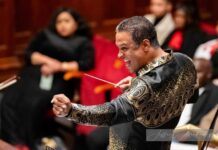
SYMPHONY CONCERT. Thursday, 8 February, 2018. At Artscape Opera House. CPO conducted by Jochen Rieder, soloist Mûza Rubackyté; Schubert: Symphony No 3 in D, D.200; Schubert, orch. Liszt: Fantasy in C for Piano and Orchestra, “The Wanderer”, Op. 15 (D.760); Schubert/Berio: Rendering.

DEON IRISH reviews
The second concert of the CPO’s 12th International Summer Music Festival, given in the Artscape Opera House due to the current renovation and installation of air-conditioning in the City Hall, provided an evening of unusual delights.
The lovely programme was based on and around Franz Schubert and was appropriately entitled “Schubertiade”, after the soirees of his music which he performed for friends during his all too short life.
On this occasion an early (1815) symphony by the compose was coupled with an orchestrated arrangement by Franz Liszt of one of his best-loved piano works, the great “Wanderer Fantasy” of 1822, which in this 1851 conception achieves the status of a quasi-Romantic concerto. Finally came the work entitled “Rendering” – which is, indeed, a rendering of fragments of an intended D major symphony, never completed.
The symphony opens with a solemn adagio, characterized by timpani rolls and pulsing minor mode chords. The oboe solos here and in the succeeding allegro gave me a first opportunity of hearing the newly-appointed principal oboe, Lisa White, in action. Her tonal quality was sweetly appropriate for the writing, but she did display a tendency to shape every note, which ultimately becomes harmful to the lyrical line.
Carefully chosen tempi, neat precision
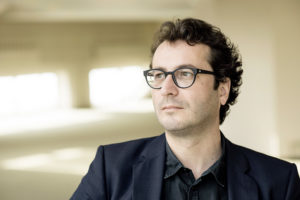
Jochen Rieder, whom we heard last year conducting “La Cenerentola” for UCT Opera, was making his CPO debut in this Festival. I much appreciated his carefully chosen tempi and the neat precision with which the opening movement’s classical structure was delivered. Orchestral playing was subtle and responsive.
The second movement – a winsome allegretto based on a subject that might well have served as a little marching song for the nursery – was delightfully restrained, with neatly weighted string bowing on the dotted notes of the subject. The clarinet solo for the central episode was beautifully delivered.
The third movement minuet demonstrates a clear intent to follow the earlier models of Haydn and Beethoven in heading in the direction of a Scherzo; but the young composer appears to have shied at the final hurdle and the movement remains a minuet – even if an undoubtedly brisk one. The oboes were sweetly discreet in the trio.
The finale – one of Schubert’s happiest creations and one which presages a good deal of Mendelssohn’s later symphonic writing – was extremely well controlled by Rieder and brought the performance to a most satisfactory conclusion.
The orchestration of works conceived for solo or concerted instruments is a fairly common phenomenon and one which, nowadays, gives rise to little controversy. However, there always remains the question of whether the particular work chosen for such treatment has been well served, or not. Few nowadays would cavil at, for example, Ravel’s orchestration of Mussorgsky’s “Pictures at an Exhibition”; however, it might be more difficult to find a present enthusiasm for Eugene Ormandy’s orchestration of Bach’s celebrated D minor Toccata.
Liszt lived in the epicentre of the Age of Arrangements. One can scarcely think of another composer who made as prolific use of arrangements, both of his own works and those of other composers. Part of this stemmed from his abiding interest in the works of other, earlier composers and his determination to bring to life the forgotten masterpieces of earlier times. Many of the arrangements are of larger works, reduced to piano versions – although, in the case of many of these, the virtuosic Liszt transcriptions seem ill-served by the term “reduction”. The other group are orchestrations of piano or smaller ensemble works, reworked – with little regard to the original structure or sonorities, into large orchestral works.
Liszt arranged a large number of Schubert’s songs for solo piano and also orchestrated a number of the composer’s works: namely, the marches for piano duet and the great “Wanderer Fantasy”. One can but speculate as to his true intention in so doing: was he providing the concert-going public with the regrettably absent concerto that Schubert ought undoubtedly to have written; or was this his chosen vehicle for popularizing a composer who was increasingly remembered only for his lieder.
It matters not. The sole question is whether the work still enjoys a place – as an arrangement – on the concert stage. I confess to being ambivalent in this regard. Part of the problem has to do with the fact that the “Wanderer Fantasy”, in its original format, is no longer a “nigh-forgotten” work, but a major item in the recitalist’s repertoire – even if the composer himself thought it “unplayable”. So we have become used to the sonorities of the work in that form; the clean, percussive piano lines; the internal, imitative structure (so clearly suggestive of solo and accompanimental or tutti episodes).
Liszt’s orchestration is a far cry from these parameters. When done with the utmost care, using period instruments and with an orchestra specializing in the repertoire (Martin Haselböck’s recordings with the Wiener Akademie spring to mind) the thing almost works. But even then, many – and I confess to being one – would not be entirely convinced.
On this occasion, the chances of the account gaining universal approval was marred by the frequent lapses from accuracy of the distinguished Lithuanian soloist, Mûza Rubackyté. Much of the opening movement suffered from a certain instability of tempo, as if conductor and soloist had not quite found each other, or reached a common understanding. Given that it is probably the least satisfactory movement of the arrangement, this was unhelpful.
The adagio – a sort of extended cadenza – was altogether more successful, perhaps because it preserves so much of the original and has the least addition of Lisztian devices. Which having said, one must concede that the succeeding Presto does work rather well as a concerto movement, perhaps because so much of the original score is allocated, alternatim, to piano and to orchestra.
The octaves commencing the finale were not secure – and another memory lapse just before the final serialized subject might explain its rather brutal delivery.
The final work of the evening might be compared to one of those museum exhibits in which the fragments of an artefact or fossil have been encapsulated in some resinous substance, to suggest the shape or form of the original in its entirety.
In 1989 Luciano Berio (1925-2003), an Italian composer who for some time pursued the post-WWII 12 tone cul-de-sac, conceived the idea of employing the remaining fragments of an intended symphony by Schubert to create a three-movement symphonic work. Happily, the Schubert fragments are left to be what they are; and the “resin” employed by Berio is a translucent sheen of suggested shape and form, never seeking to compete with or complete that which remains; but through the faintest suggestions hinting at what might have been.
The orchestra rose to the difficult task with alacrity and provided considerable insight into their potential as an orchestra capable of performing more nearly contemporary works. The opening of the central Andante was particularly alluring, with the gossamer light writing calling to mind the sort of out-of-focus writing so masterly employed by Strauss in his Rosenkavalier. Doubtless the use of the celeste had something to do with it.
Who: CPO conducted by Jochen Rieder, soloist Muza Rubackyte
What: Symphony Concert, 8 February, 2018
WS