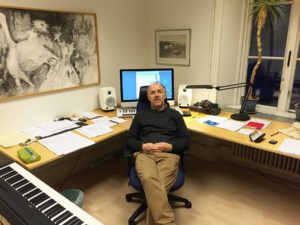
 MICK RAUBENHEIMER’S Round Corners mini-interviews situate artists outside their media, while exploring their experience of the artistic. He spoke to highly original composer and adventurous thinker MICHAEL BLAKE.
When did you first identify as a creative artist?
As a kid, when I started having piano lessons, probably around age 8 or 9. That was prompted by hearing music and being intrigued by sound (radio, church, school, the street!). Composition was always my preferred profession – I relished the stories of the lives of the ‘great’ composers, who seemed to live very dangerously. So I guess I could have become an outlaw or a guerrilla fighter, but composition got me.
Outside of your medium, what branch of art most stimulates you?
Toss up between film and literature I guess. As a kid I spent my Saturday afternoons and school vacations in the bioscopes (remember those?) of Cape Town – what else was there to do in 1960s South Africa? TV doesn’t quite do it for me, it can’t replace the darkened theatre and the jumpy images. Reading books, on the other hand, meant I could never get bored – my greatest fear in life – and never waste time when travelling, sitting in waiting rooms or standing in queues.
 Which artist/s in said discipline have significantly inspired you, and why?
Film: B&W silents (I guess all silents were B&W) in particular Murnau; Resnais and Robbe-Grillet (especially L’année dernière à Marienbad); Bunuel’s Chien Andalou.
Lit: Sebald and Coetzee – the sparse economical writing, not an unnecessary word; also the blurring of fact and fiction in Sebald; the structure of Coetzee’s Diary of a Bad Year influenced my Symphony; Cormac McCarthy – love the breathless sentences, such musical constructions – especially All the Pretty Horses. The only three writers (apart from Proust and Joyce) whose every word I have aimed to read.
Footnote: I am currently making my first artist book – of an early piece of mine, and in 2019 I hope to make my first movie – of a recent piece of mine. So these mediums have got me too.
What, to you, is art’s most important function?
Provocation. Can’t think of any other good reason. If we can’t change listeners’ thinking in some way, we might as well give up and do something else.
Sadly the tendency these days is for composition to reinforce comfort zones.
Local creatives (in any medium) that currently excite you?
Two composers who stand out from the general schlock: Andile Khumalo and Pierre-Henri Wicomb. Of course I’m biased because they are both colleagues, good friends and Wicomb is currently my PhD student. But they are composers who stand apart, don’t repeat themselves, are constantly searching… And in the world of black choral music, a favourite genre of mine, I think Lihle Biata is quite brilliant.
In other mediums, Willem Boshoff and Aryan Kaganof really hit on something powerful and beautiful every so often – which is as much as one can expect from any artist. (Despite the hooha, Kentridge for example does nothing for me.)
What specific work – be it in literature, music, or visual art – do you return to again and again, and why?
Stravinsky’s Symphonies of Wind Instruments. It is a very influential work in later 20th century composition (like Le Sacre was in earlier), and constantly provides answers to problems of structure/material that I’m trying to solve. And when young composers have problems, I usually give them the score.
Any current project you’re unveiling/wrapping up?
Completing my Afrikosmos cycle – several volumes of piano pieces for everyone from beginners to virtuosi, which draws together many of the threads of my music over the past 40 years; and putting the finishing touches to a choral piece for 16 solo voices which I composed mostly during an artist’s residency at STIAS in 2014-15, titled Migrations or The Journey to the South. And then my new CD is due out soon – The Philosophy of Composition – an integral recording of all my cello music (solo and with piano). It includes a new Cello Sonata “Hours with the Masters”, which together with Migrations and a piece I’m currently writing for saxophone quartet, explores the notion of imaginary museums – in these cases whole repertoires of music.
Who: Michael Blake
Links: www.michaelblake.co.za, https://soundcloud.com/ichaellake, https://vimeo.com/album/3290650
WS