

THE EULOGISTS. Written by Louis Viljoen. Directed by Greg Karvellas. With Emily Child, Pierre Malherbe and Kiroshan Naidoo. Set design by Rocco Pool. Costume design by Widaad Albertus. Lighting design by Kieran McGregor.
TRACEY SAUNDERS reviews
If funerals bring out the best and the worst of people, death watches amplify those qualities and lay bare the true nature of the living who wait for the final breath The Eulogists is about an imminent death and those that hover like vultures on the fringes, waiting to nibble at the carrion.
Louis Viljoen, the resident playwright at The Fugard is a writer’s writer, one who creates phrases and conjures characters that settle in your mind and days later still demand attention. He dips his pen in bitter ink, sharpens his pencil with disillusion and poses the question, are some deaths worth more than others and are there deaths that leave the world emptier? “What do you say to the dead, that they don’t already know?” he asks, and leaves you to ponder the question.
Two award-winners in the house

The ambitious and earnest young researcher, Zee (Kiroshan Naidoo, pictured left) accompanies Audrey (Emily Child) to a small town where they await the death of an unnamed statesman. Naidoo, the winner of the Fleur Du Cap Most Promising Student Award (2015) has grown in leaps and bounds and delivers increasingly solid performances. Initially he wears the character with some reluctance and takes some time to settle in. He finds his stride towards the end of the play and is the most believable of the three characters. Whether or not that is because he is the most likeable or perhaps just the least reprehensible, is to be debated.
He stifles his disdain for Audrey, until it boils over in to a personal attack, not just at her but at all that she represents. As a totem of white privilege, she bears the brunt of his general frustration with national politics. She is “the centre of her own universe” and so accustomed to being heard that she is unable to listen. Her success as a result of her proximity to the ailing politician is ascribed to her being “lucky, the worst thing you can be.”

The banter between the two provides an opportunity for broader political discourse and much of the polemic will be familiar to anyone who engages with the current dissatisfaction in the country. Child (pictured right) is a regular feature of Viljoen’s plays and also a previous winner of the Fleur Du Cap Most Promising Student Award (2008). Her award winning performance in The Pervert Laura was compelling and she was riveting as she sparred with Andrew Laubscher in The Emissary. She has a remarkable stage presence and the slovenly, self-absorbed and narcissistic Audrey is a character that has the potential to be one of her finest, condensing Laura’s sleaze and Delia’s despair in to a cocktail of entitled belligerence.
And then there were three
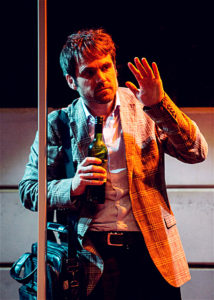
The arrival of Harris (Pierre Malherbe, pictured below) the quintessential hard-drinking correspondent for an American radio station has the potential to ignite the tension between Audrey and Zee. It is mostly his final impassioned soliloquy that fuels the fire though. Malherbe’s collaborations with Viljoen include the hilarious Champ and the political thriller, The Kingmakers. There are several echoes of Arlow, the cynical and conniving politician from The Kingmakers which haunt this performance and once Malherbe fires on all cylinders, this will be a cracker of a role.
In addition to the political tension, there is the personal pain of individual tragedy lurking beneath the surface. Zee and Audrey both recount intimate and painfully revelatory truths about their families. Small deformities, calamitous disease, the stuff of intimate anguish and for Viljoen, a few uncomfortable laughs. As sad, painful and raw as much of the dialogue is he displays the same insouciance and irreverence as Sarah Silverman and holds very little sacred. Cancer, scatology, profanity – all are fair game. Viljoen makes you want to play Waits very loudly while sipping smoky scotch. His words demand attention, avid attention and until the closing scene the words aren’t given enough weight.
Space to breathe
There is a sense of rote learning, a laboured delivery which doesn’t do the text justice or allow this stellar cast to reach its full potential. It is the truth that is delivered in the denouement that has the necessary passion which feels absent through the rest of the play. The characters are so multi-faceted that it seems a pity that they aren’t give more space to breathe, something that might change as the run progresses.
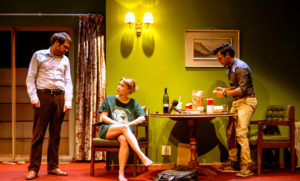
The hyper-realistic staging has the sensibility of a Coen brother set, replete with tacky décor, and the functional, slightly seedy hotel room could be anywhere. The separation from the world outside is further amplified by an external security light that announces each arrival and departure at the sliding door with a bright glare.
Ultimately the eulogy that is penned is a paean of despair on the demise of hope. Individually and collectively there seems no chance at redemption. Is it bleak? Yes, but it’s honest and perhaps only grace and honesty afford us an opportunity to find hope again.
Where and when: The Fugard Theatre until 24 June 2017
Book: Computicket
WS


