THE MOTHER. Written by Florian Zeller. Translation by Christopher Hampton. Directed by Janice Honeyman. Costume and set design by Birrie Le Roux. Sound design by Nicolaas van Reenen. With Anna-Mart van der Merwe, Graham Hopkins, Sven Ruygrok and Amy-Louise Wilson.
REVIEW: Tracey Saunders
There are few silences as dense as that experienced by a mother waiting for her son to call. Anne’s life is a series of silences and unanswered questions. Will her son call? Why doesn’t he visit any more? What does her husband do all day? Why is her daughter so ugly? We watch her futile struggle for answers and some semblance of meaning escalate during the course of the evening. While other members of her family drift on and off the show, it is her state of mind that remains centre stage.
There’s a decidedly European sensibility about the script. Translated from the original French that is unsurprising but the French notion of liaisons and discrete extra marital affairs is an important aspect of the text which would be received differently in a less laissez-faire society. For Anne though the possibility that her husband may be unfaithful tears at her and the mere thought of it rather than any concrete evidence is enough to leave her seething and embarking on “small acts of revenge”.
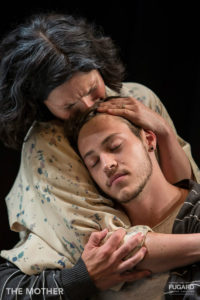
Between her mild obsession with her husband’s activities, illicit or otherwise she is equally obsessed with her children, primarily her son, Nicolas, and admits to that very seldom voiced notion that he is in fact her favourite child. She struggles to relinquish him to a life of his own and seems hell bent on keeping him as close as possible for as long as possible. There is an underlying Oedipal thread to their encounters and one is never quite sure if they are real or imagined. One particularly moving scene is given a heightened emotional resonance as it is repeated in over sized photographs which are screened on the partitions on stage and reflected in the large mirror which covers the side stage. The use of the projections imbues the stage with a haunting sense and leads to further questioning of which images are in fact real and which imagined.
“Falling off the round, turning world”
While it’s not the central theme of the play there is enough tension in Anne’s relationships with her children to explain much of her anxiety. Her daughter Sara, appears or does she, briefly. If not physically present herself she is glimpsed in the image of Nicolas’s girlfriend, Elodie. Amy-Louse Wilson first appears as Elodie and then incarnates in various versions of the archetypal beautiful younger woman, at one stage dressed in the equally archetypal red dress. Anne herself dons a red dress defiantly at some stage. The newly purchased item paired with high heeled red shoes is reminiscent of Hans Christian Andersen’s ill fated heroine of The Red Shoes. The virility and passion of the bright crimson red are a stark contrast to the hazy grey reaches of Anne’s mind and her convoluted thought patterns. Elizabeth Bishop in her poem In the Waiting Room refers to the sensation of “falling off the round, turning world into cold, blue-black space” and Anne seems perpetually on the precipice, about to plunge at any moment. She is never entirely present. She lingers in the past and longs for the moments of raising her children, taking them to school, preparing, breakfast for them. That sense of herself as a mother seems to be more real and tangible to her than who and where she is now.
Her husband, Pierre, played impeccably by Graeme Hopkins brings a practical, slightly British urbanity to his character. While his name is French his character seems far more solid and conventional. He is the cold voice of reason, continually distracted by his phone and presumably his peccadilloes. His emotional absence so intense that it fills the stage.
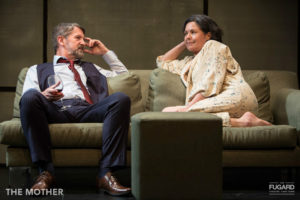
Zeller is a canny writer with a keen eye for the minutiae and mundane repetitions of ordinary human relationships. As with his play The Father staged at The Fugard in 2016, the ground-hog day style of repeating scenes with slight variations in tone and sometimes content, underscores the banality and tireless repetition of not just Anne’s existence but everyone’s.
Captivating psychological portrait of a woman
As powerful and moving a story as The Mother is I look forward to the day when older women are not perpetually depressed, harbouring thoughts of suicide or just generally falling apart. Many representations of women on the stage and screen seem to occupy the extreme ends of a continuum – young, desperate and seeking fulfilment or older, desperate and having abandoned all hope. I am interested in the women who occupy the other shades of the continuum and despite it all have some semblance of hope.
The Mother is a captivating psychological portrait of a woman in search of herself, bitter and betrayed, not only by her family but society’s expectations of her. While this is the story of one woman, a mother, a wife it is also the story of the universal quest for meaning. What is it that matters? What and how do we remember and who, if anyone in the end, is worth living for?
Where and when: The Fugard Theatre until 4 March 2017
Book: Computicket
WS