SCENES FROM AN EXECUTION. Written by Howard Barker. Directed by Claire Stopford. With Jennifer Steyn, Graham Hopkins, Nicky Rebelo, Khathushelo Ramabulana, Elizabeth Akudugu, Cleo Raatus, Lauren Blackwell, and Phoebe Ritchie. Set design by Patrick Curtis. Lighting design by Luke Ellenbogen. Costume Design by Leigh Bishop.
Review: TRACEY SAUNDERS
Theresa May, Hilary Clinton and Angela Merkel walk in to a bar …Well not really, but humour is often the response to powerful women and Barker’s portrait of a fierce female painter defying the Venetian establishment is as funny as it is prescient. Male politicians affronted by an outspoken woman, the imprisonment and ridicule of an artist for portraying an image contrary to popular political dogma? Surely not and yet we live in an age where strong women are still easy targets and art provides one of the few platforms which speaks truth to power. It’s twenty three years since Stopford first directed this play at the Market Theatre in Johannesburg where Hopkins played the Doge and while it has the density of a classic text it is fresh and engaging and its relevance is underscored by one of Barker’s asides: “The time for satire is ended. Nothing can be satirised in the authoritarian state.”

Role of art in the body politic
Written by Howard Barker who recently found himself embroiled in protest amidst accusations of yellow face casting in the staging of Depths of Dead Love at The Print Room in London in January, the role of art in the body politic is at the heart of this delicious piece. While Barker objects to persuasive theatre and told Mark Lawson of the Guardian: “I have contempt for messages in the theatre. I’m not trying to influence anyone,” there is no denying the battle between arts and politics in this narrative. Funding for the arts is at a critical juncture, both here and abroad with Trump proposing the elimination of the National Endowment for the Arts and local arts funding under increasing pressure. The struggle will be familiar to artists subject to the strictures of patronage and cognisant of the cost of creating art at the dictates of a benefactor.
The titular execution is the rendering on canvas of the Battle of Lepanto fought between Christians and Muslims in 1571. The play is not the first artistic response to the battle with a Spanish Poem written by Fernando de Herrera in 1572 and King James VI of Scotland penning a celebratory poem twenty years after the victory.
Commemorative music and a Catholic feast day, Our Lady of Victory, crediting the victory to the Virgin Mary are indicative of the import accorded to the battle. Barker’s choice of this particular event is no accident and there is a measure of irony in this age of the “War on Terror” that the site of contestation is a religious battle. The female protagonist in Scenes from an Execution is one of the finest female stage roles, having first been performed by Glenda Jackson, who returned to the stage last year in the role of King Lear. One can only hope Steyn herself follows a similar trajectory. Given this superlative role and her recent powerful performances Lear seems a fitting role for her to add to her resume.
Galactia is a woman who knows her mind
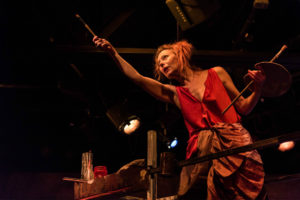
Galactia is the painter, an artist of a promiscuous nature and a woman who knows her mind. Her depiction of the battle is one of a brutal slaughter, painted in a red that reeks of blood and which brings her male lover Carpeta to tears at the sight of it. Galactia doesn’t “trust beauty” calling it “an invention, a lie” and has little time for those who “have drugged their consciences and numbed their pain.” She is a woman who feels and feels deeply. Her passion is there for all to see, unafraid of lust, blatant in her desire and her coupling with Carpeta is unfettered by prudery. Carpeta, her lover and a lesser painter, accuses her of an inability to paint pity, “rather than pity you want to allocate responsibility.” Her painting unveils the brutality and lunacy of war and she doesn’t shy from the gruesome images of the naval massacre. Decrying that, “In the absence of responsibility the world is just a pool, a great pool of dirty tears through which vile men in boots run splashing,” she is determined to assign responsibility. It is the vileness and the visceral brutality of death that she portrays with scenes of flayed flesh and bloated corpses. Steyn paints and postures and she does both brilliantly with a vibrant intensity that is riveting.
Shared stage
Stopford has paired the seasoned talents of Steyn, Hopkins and Rebelo with a younger cast of recently graduated UCT students. As one actor remarked: “I have learnt more in rehearsals than I did in four years of drama school,” and indeed sharing a stage with these veterans must be a very special experience. Hopkins as Urgentino, the Doge of Venice, is an absolute joy. Every expression and gesture is steeped in a sense of self importance and he brings an ease to the role which Stopford coaxes in to one that is less caricature and all character.
Kahtu as Carpeta glows with youthful vigour and his charming ardour is the perfect counterpoint to Galactia’s cynicism. Akudugu is regal as Rivera, the Critic with an insight on patronage where she accuses patrons of vulgarity and her critique of the Doge: “He loves artists, and the harder he loves them, the more vulgar he becomes,” is delivered with haughty disdain. Raatus has the unfortunate task of portraying a veteran from the battle, replete with a bolt through his head being the least of his gruesome injuries. He is delightfully funny in this role and aloof as the prosecutor, easily slipping between the roles of jester and official. Blackwell and Ritchie portray Galactia’s daughters amongst other roles and they comport themselves with an ability that belies their youth while Ritchie draws the most laughs when she begs for a “sliver of consideration” from her “fruity smelling” cellmate.
Stitched in the richest of shades Leigh Bishop’s costumes make the absence of a canvas negligible. In her palette of rich crimson and gold hues we have the sumptuous sense of oils, the colours so vibrant that the pigment is tangible. There is no actual painting on the stage but perhaps the closure of the play offers some writing on the wall: “It is a great nation, is it not, that shows its victories not as a parade of virility, but as terrible cost?”
Where and when: Baxter Theatre 30 March to 22 April 201. Note the earlier than usual starting time of 7:30 pm
Book: Computicket
WS