SUDDENLY THE STORM. Written by Paul Slabolepszy. Directed by Bobby Heaney. With Paul Slabolepszy, Charmaine Weir-Smith and Renate Stuurman. Set design: Greg King. Lighting design: Wesley France. Sound design: Ntuthuko Mbuyazi.
KAREN RUTTER reviews
Suddenly the Storm is Paul Slabolepszy at his most Slab. That insouciant East Rand swagger – with all its hidden poignancies and complexities – which permeates so much of his writing, is bang at the centre of this narrative. Like a breker throwing open a barroom door, there’s a sense of the script exploding into the theatre. And, taken that it’s been seven years since Slabolepszy has penned his own, personal work (he’s been doing TV scripts and the like), it’s no surprise that there’s an incendiary energy driving this production.
Slabolepszy has always been drawn to exploring the psyche of the South African male, whether through a solo structure like The Return of Elvis du Pisanie or ensemble works such as Saturday Night at the Palace. Certainly his comedies, notably the successful sporting romps like Heel Against the Head – place male concerns at the fore. And they are particularly local, white, often working class, heterosexual concerns. No issue with this – in the words of Shannell in his latest play: “Hashtag Just Saying”. It’s what Slab does. Often incredibly well.
And Suddenly the Storm is no different, in many ways. It is a three-way script, but the central character, the one whose actions and emotions are the ones that are pivotal to the narrative, is a white, East Rand, working class male. Flanking him is his younger wife, and a mysterious stranger.
Sad marriage and siff surroundings
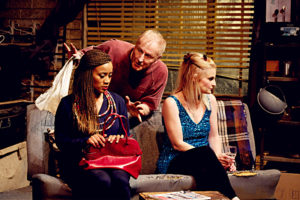
The play is set in a seedy house and workshop on a plot in the East Rand. Here Dwayne (Slabolepszy) runs his welding business, with a sideline in debt-collecting. His spouse Shanell (Charmaine Weir-Smith) is an aging party gal, still significantly younger then Dwayne however, who is sick and tired of her sad marriage and her siff surroundings. Into their lives comes Namhla (Renate Stuurman), a smart city woman who is clearly a cut above their social standing. Both Dwayne and Shanell assume she is there to secure a debt-collecting service. But after a series of visits, during the course of which Dwayne and Shanell’s marriage breaks down in an inevitable, grim series of bickering, it appears this is not the case.
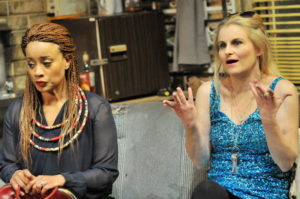
All three characters are in search of something: Shanell wants love, and a life with pretty things – she is somewhat bewildered by her current circumstances, even though they have lasted a while. Dwayne seeks forgiveness, while burying a deep and significant grief – he, too, appears bludgeoned by his present situation. Namhla wants answers, and she wants revenge – but her certainty about this changes as she learns about the past.
Three different characters
While Dwayne/Slabolepszy’s back story is key to the narrative, it is interestingly Shanell/Weir-Smith whose unsophisticated racial faux-pas and simple desires pack the most authenticity. Like a character in a Jennifer Ferguson song, there is a ghastly bedrock of tragedy under the glitter; the combination of Slabolepszy’s script, Weir-Smith’s on point delivery and Bobby Heaney’s direction make for gold. If she had overplayed it, it would have become farce. But she doesn’t.
Namhla/Stuurman is an impressive and somewhat daunting presence, and her eyes particularly speak volumes. But one feels the script doesn’t give her much space to play with. The basics are there, in broad brush strokes – exiled youth, successful but aloof husband – but hers is not a very nuanced character, to my mind. Nevertheless, she is a strong figure on stage.
Dwayne/Slabolepszy is the most compound character, and we learn the most about him – his abusive childhood, his early manhood in the apartheid police force, and the unexpected entry into his life of a person who is to change him forever. It goes towards explaining some of his actions – his sadness over the death of his employee, his antipathy towards his wife. It is a role that Slabolepszy clearly relishes, and it is difficult to imagine somebody else playing it.

Director Bobby Heaney keeps a tight watch, at the same allowing for a natural flow between the actors, which pays off. His long-standing relationship with Slab is obvious in the sensitive yet controlled handling of his script. The set by Greg King has just won a Naledi award, and justifiably so – it is positively depressing in its realistic depiction of a house and lives held in a dark limbo. Wesley France won a Naledi for his lighting design of the same set, also rightly so.
Harder truths
Slabolepszy has never flinched from facing the harder truths, notably when writing during the apartheid years, and still now when creating in a post-apartheid but by no means resolved society. He uses the tool of story-telling to excavate underlying seams of racism, or self-hatred, or insecurity. And he has repeatedly interrogated the role of men, often with devastatingly moving results.
He has just won the Naledi award for Best New South African Script for Suddenly the Storm, and it’s a fitting reward for such a hard-working, genuinely engaged writer and actor. That I felt this particular script is not credible in its resolution, and rushed towards a rather sentimental climax, is perhaps not relevant. The awards are out, the reviews so far have been rave. Perhaps you should judge for yourselves …
What: Suddenly the Storm
Where and when: Baxter Flipside until 8 July
Book: Computicket
WS